In this series / On this page· 12 of 18
- 1. Disaggregated Serving: Dynamo, llm-d, and When Splitting Prefill from Decode Pays
- 2. TTFT, ITL, Goodput: Measuring What Users Feel
- 3. Benchmark an Inference Server Without Lying to Yourself
- 4. Expert Parallelism, and What DeepEP Does for It
- 5. Serving Kimi K3.1 Pro: The State per Request, the Indexer's Cost, and Where 1M Tokens Fit
- 6. Other Users' Data in the KV Cache: What Cloudflare's GLM-5.3 Incident Teaches Operators
- 7. Flow Control in the Serving Stack: What llm-d, Dynamo and AIBrix Do When the Fleet Is Full
- 8. Context Parallelism for Long-Context Serving: PCP and DCP in vLLM and SGLang
- 9. Several Models, One GPU: Time-Slicing, MPS, MIG, and What CUDA 13.4's Memory Caps Change
- 10. Serving Mistral Large 4: What Its Cache Costs and Where It Fits
- 11. Prefix-Aware Routing Across Replicas: Kubernetes Service, Dynamo's KV Router, the llm-d EPP and Kinference
- 12. Serving Ripple-65B: What a Dense Model with 1M Context Costs, and When It Beats an MoE
- 13. Cost per Million Tokens, Computed: GPU-Hours, Utilization, and the Cache
- 14. Kinference at alpha.7: What Buoyant's Inference Control Plane Does, and What It Reuses
- 15. Splitting Off the Vision Encoder: When Encoder Disaggregation Pays in vLLM
- 16. The Cache Hit That Changed the Answer
- 17. Prefix Caches That Collapse Under Bursts, and the Session Cap That Prevents It
- 18. MLPerf Endpoints v1.0: How to Read an Agentic Inference Benchmark
Serving Ripple-65B: What a Dense Model with 1M Context Costs, and When It Beats an MoE
Ripple-65B caches 64 KiB per token but reads 56 GB of weights per step: what 1M tokens cost, and when it beats an MoE.
Ripple-65B (Ricursive Intelligence, weights on Hugging Face since 4 November 2026) is a dense 65B with a 1M-token context that its card says beats 501B to 975B MoEs on agentic coding. Size its cache with the usual GQA formula and 1M tokens cost 320 GiB; its config.json says 64 GiB, because 64 of its 80 layers forget everything older than 1,024 tokens. What this model costs is the 56 GB of weights every decode step reads, and that decides when it beats an MoE.
The 80 layers, read for the server
Four sliding-window layers with RoPE, then one full-attention layer without it, sixteen times: that pattern is the whole cache story. config.json at da94cc0 lists 80 layer_types in ssssF order, a sliding_window of 1,024, 8 KV heads of 128 dimensions and 80 query heads, 10,240 wide on a 5,120-wide model. vLLM's port gives a window, and RoPE, only to the sliding layers (ricursive.py L146-163); the 16 full layers keep every token.
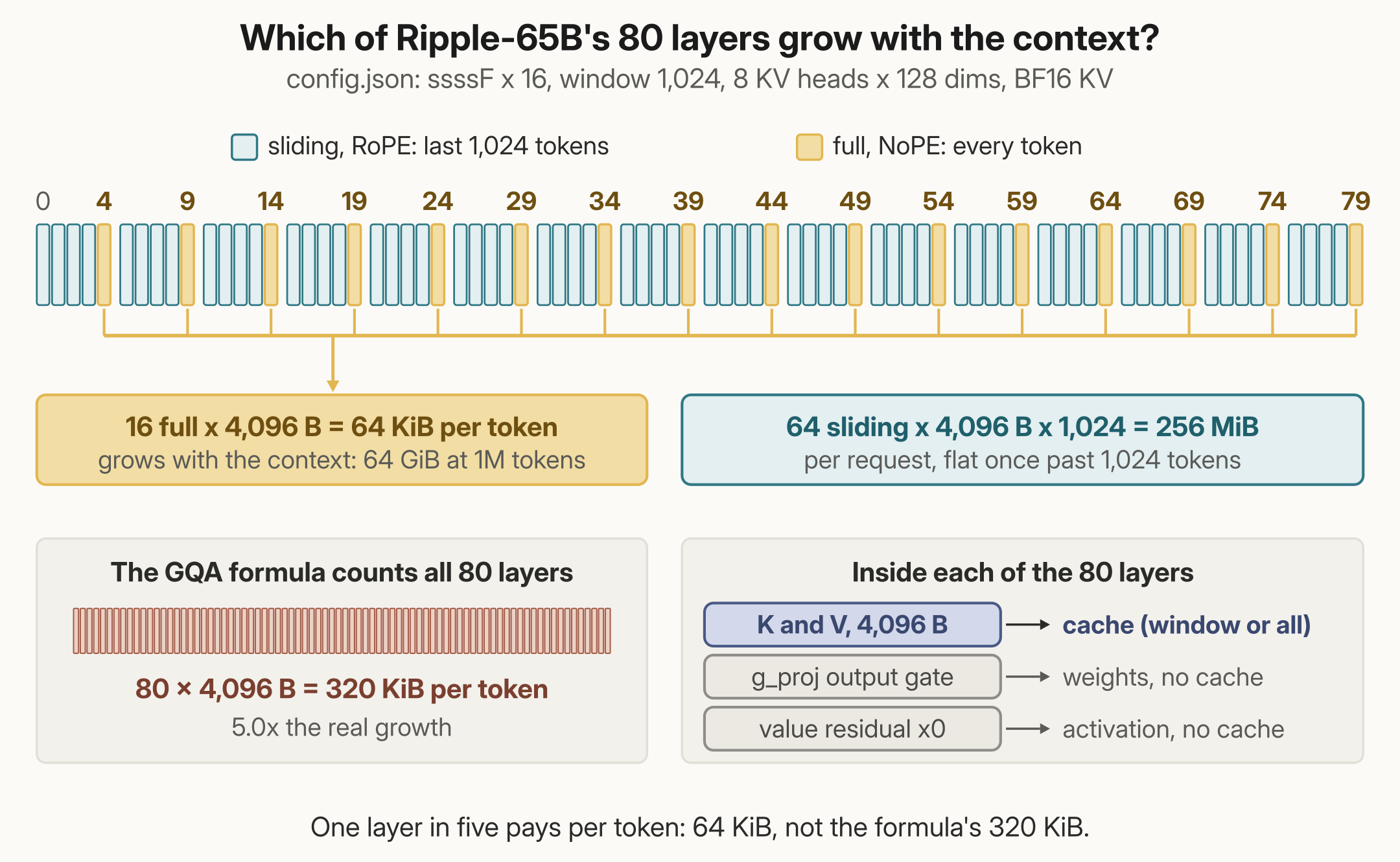
Figure 1: one layer in five pays per token. The gate and the value residual add weights and an activation, not cache.
The card's three novelties cost weights or activations, never cache:
- Gated attention: a
g_proj(5,120 to 10,240) whose sigmoid, in FP32, scales the attention output (L192-195). It is 4.19B parameters, 6.5% of the model, but 8.39 GB, 14.7% of the NVFP4 checkpoint, because attention stays in BF16. - Value residual:
v_projreadslerp(x0, h, sigmoid(λ)), a blend of the layer input withx0, the scaled embeddings (L178-182).x0is one more hidden-sized tensor carried through all 80 layers and across pipeline stages; vLLM clones it because the fused add-and-norm writes the residual in place (L311, L345). - NoPE global layers: the full layers have no rotary embedding, so nothing needs RoPE scaling up to the 2,097,152 positions the config declares.
The "overprovisioned heads" put 167.8M parameters per layer in attention, against 629.1M in the MLP. The card says "Gemma 3N-like" and the vLLM PR "PeriNorm (Gemma 3 style)"; ssssF with RoPE only in the window layers is Kolibri-1's layout, sized in When Most Layers Stop Caching; the output gate is Gated Attention's, as in Qwen3-Next. The value residual is a variant of ResFormer: it blends the input of v_proj with the embeddings instead of reusing the first layer's values.
Bytes per token, computed
A full layer stores K and V for every token, 2 × 8 × 128 × 2 B = 4,096 B in BF16. Sixteen of them grow the cache by 64 KiB per token; the 64 sliding layers hold 1,024 tokens each, a flat 256 MiB per request. The formula of The KV Cache, Sized multiplies by all 80 layers and gets 320 KiB, five times too much. ripple65b_kv.py rebuilds the numbers from config.json and the safetensors headers (standard library, HTTP range requests, no weights):
$ python3 ripple65b_kv.py
# … (excerpt; columns: real BF16 KV, real FP8 KV, GQA formula)
layers 80: pattern ssssF x 16 (repeats); full (NoPE) 16 [4, 9, 14, 19]..79; sliding (RoPE, window 1024) 64
grows with context: 16 full layers x 4,096 B = 65,536 B per token (64 KiB)
fixed per request : 64 sliding layers x 4,096 B x 1024 = 256 MiB once the context passes 1024
GQA formula (all 80 layers): 327,680 B per token (320 KiB) = 5.0x the real growth
| 131,072 | 8.25 GiB | 4.12 GiB | 40.0 GiB |
| 1,048,576 | 64.25 GiB | 32.12 GiB | 320.0 GiB |
| 2,097,152 | 128.25 GiB | 64.12 GiB | 640.0 GiB |
FP8 KV would halve the cache, but the authors' launchers refuse anything but BF16 KV and vLLM's recipe sets none: BF16 is the tested path today.
The pool is what the weights leave, and in NVFP4 they leave room for long sessions on any current datacenter GPU:
| GPU | Checkpoint, TP | Pool per GPU | 128k sessions: bytes / vLLM's accounting | 1M sessions |
|---|---|---|---|---|
| H200 | NVFP4, 1 | 63.7 GB | 7 / 4 | 0 |
| B200 | NVFP4, 1 | 98.8 GB | 11 / 7 | 1 |
| B300 | NVFP4, 1 | 196.0 GB | 22 / 14 | 2 |
| B200 | BF16, 2 | 91.2 GB | 20 / 13 | 2 |
| B300 | BF16, 1 | 123.6 GB | 13 / 9 | 1 |
| B300 | BF16, 2 | 188.4 GB | 42 / 28 | 5 |
| GB10, 0.70 util (measured, below) | NVFP4, 1 | 23.1 GB (21.47 GiB) | 2 / 1 | 0 |
Datacenter pools are memory × 0.90 minus weights and 6 GB, from the script; vLLM's accounting is at 8,192 batched tokens; the last row is the pool vLLM actually settled on, below. TP2 halves the cache per GPU, since each rank holds four of the eight KV heads. The DFlash2 draft (8.1 GB) costs one to four 128k sessions per GPU in this arithmetic, and more in vLLM, which pads the full layers (below). The card's "fits a DGX Spark" holds at 128k for one session, not at 1M: 64 GiB of cache on top of 65 GB of weights and draft is more than the box has.
How vLLM sees it
vLLM puts the 80 layers in five KV cache groups of 16, one full and four sliding, sharing one block pool (kv_cache_planning.py L434-574). A request reserves blocks for its whole length in the full group and, in each sliding group, room for window - 1 + max_in_flight_tokens tokens plus one block (kv_cache_interface.py L917-943). In-flight tokens are --max-num-batched-tokens times the batches in flight, two with async scheduling on model runner V2. At 8,192 batched tokens each sliding group reserves 17,407 tokens instead of 1,024: 4.27 GiB per request against 256 MiB of real window. The logged "GPU KV cache size" is the pool divided by this per-request total, times --max-model-len (kv_cache_utils.py L1090-1184).
We checked it on one machine on 9 November: an NVIDIA GB10 (128 GB of unified memory, 121 GiB visible, about 273 GB/s), vLLM nightly 0.33.0rc1.dev992+g1648fefab (main at 1648fef, which contains the model), the NVFP4 checkpoint at 99eea44, BF16 KV, --gpu-memory-utilization 0.70, 8 sequences, 8,192 batched tokens, prefix caching off. vLLM first logged 26.75 GiB of KV memory, from which the script predicted 347,344 tokens at --max-model-len 266240; it then logged 278,609, 1.05x. The gap has two causes. First, vLLM main sizes the cache again after CUDA graph capture and FlashInfer's autotuning (extensible_kv_cache.py L553-640), keeps the 7.01 GiB of transient activations it measured, and settles at 5,496 blocks:
# arms/A/server.log L183-185, log prefixes stripped
Memory after warmup: 55.65 GiB free, 2.53 GiB committed to the KV cache, 7.01 GiB kept for transient activations; 5496 KV cache blocks (21.47 GiB) fit within the requested 85.14 GiB. Torch may reserve up to 90.35 GiB.
GPU KV cache size: 278,609 tokens, Maximum concurrency for 266,240 tokens per request: 1.05x
Extended KV cache to 5496 blocks (21.47 GiB).
Second, the blocks are 64 tokens, not the script's 16: a request at 266,240 tokens reserves 4,160 blocks in the full group and cdiv(1,023 + 16,384, 64) + 1 = 273 in each sliding group, and 5,496 / (4,160 + 4 × 273) × 266,240 is 278,609 to the token. Fed 21.47 GiB (--kv-gib 21.47), the script predicts 278,781, within 0.1%.
The draft adds four 4,096-window layers (64 MiB per request) and one full NoPE layer (4 KiB per token). In vLLM it also regroups the cache: groups shrink to four layers and the 17 full layers are padded to 20 ("may waste at most 17.65% KV cache memory"), so each token costs 80 KiB of pool. With DFlash2 at --max-model-len 139264 the pool settled at 18.30 GiB, 1.20x: one 128k session either way. The authors' SGLang path caps the draft's NoPE layer at a 16Ki window.
Where the time goes in decode
At batch 1 a step reads every weight but the embedding table: 56.19 GB in NVFP4, 128.54 GB in BF16. Half the NVFP4 checkpoint is BF16: the 50.3B MLP parameters are 4-bit (28.3 GB with their scales), the other 14.45B, attention, embeddings and head, stay BF16 (28.9 GB). That is why launch coverage that sized it at 33 to 37 GB was wrong. The cache adds 8.86 GB per sequence at 128k, 15.8% on top.
Bandwidth over bytes is the ceiling (The Roofline for LLMs): 4.8 tok/s at batch 1 on 273 GB/s, 141 on a B200 or B300 at 8 TB/s (62 in BF16). Batching reuses each weight read, so at 2k context batch 8 reaches 36.8 tok/s summed on 273 GB/s and 1,077 at 8 TB/s; at 128k each sequence's cache is read too, and batch 8 tops out at 17.2 and 504. Compute doesn't bind on datacenter GPUs here: 1,077 tok/s at 128.5 GFLOP per token is about 140 TFLOP/s.
On the same machine, with 24 coding prompts of about 1.9k tokens cut from vLLM's own source, 128 output tokens, greedy and streamed, ripple_bench.py measured per-request decode rates ((tokens − 1) / (last token − first token)) and the draft's mean acceptance length τ (Speculative Decoding from First Principles) from /metrics, bonus token included:
| Arm | 1 request | 2 | 4 | 8 | 8, aggregate | 128k prompt, 1 request |
|---|---|---|---|---|---|---|
| NVFP4 | 3.92 | 3.77 | 3.75 | 3.17 | 20.1 | 3.44 |
| + DFlash2, 7 draft tokens | 15.24 (τ 4.45) | 12.67 | 10.33 | 8.83 | 40.1 | 10.06 (τ 4.19) |
| + DFlash2, 15 draft tokens | 16.41 (τ 5.17) |
tok/s per request, medians over 3 requests at 1, 4 at 2, 8 at 4, 16 at 8; "aggregate" is all output tokens over wall time, prefill included.
The kernel was FlashInferCutlassNvFp4LinearKernel, FP4 weights and activations, not Marlin. 56.19 GB × 3.92 tok/s is about 220 GB/s, 81% of the 273 GB/s peak, above the 160 to 190 GB/s the MoE checkpoints of Quantizing Mixture-of-Experts Models reached on the same GPU. With 220 GB/s, the simple model predicts the rest. The draft run did 15.24 / 4.45 = 3.42 steps per second, each reading the target and the draft, 64.27 GB: 220 GB/s again. At 128k, the extra 8.86 GB per step predicts 3.38 tok/s and we measured 3.44; at 256k (262,087 tokens), 2.99 against 3.07. The 64 KiB per token shows up in decode exactly as computed.
Batching works as the dense case promises: from one request to eight, per-request speed fell 19% (3.92 to 3.17) for eight times the tokens. The draft's gain shrinks with batch, 3.9x per request at one, 2.8x at eight, as verifying eight tokens per sequence makes each step heavier, but it still doubles the aggregate at batch 8 (40.1 against 20.1), above the 36.8 tok/s that no draft can pass at this bandwidth. Acceptance on code was 4.45 at 7 draft tokens and 5.17 at 15, against the 7.34 the PR reports on GSM8K at 15 on a B300: at the 220 GB/s this machine sustains, 7.34 would have given about 25 tok/s; code gave 15 to 16.
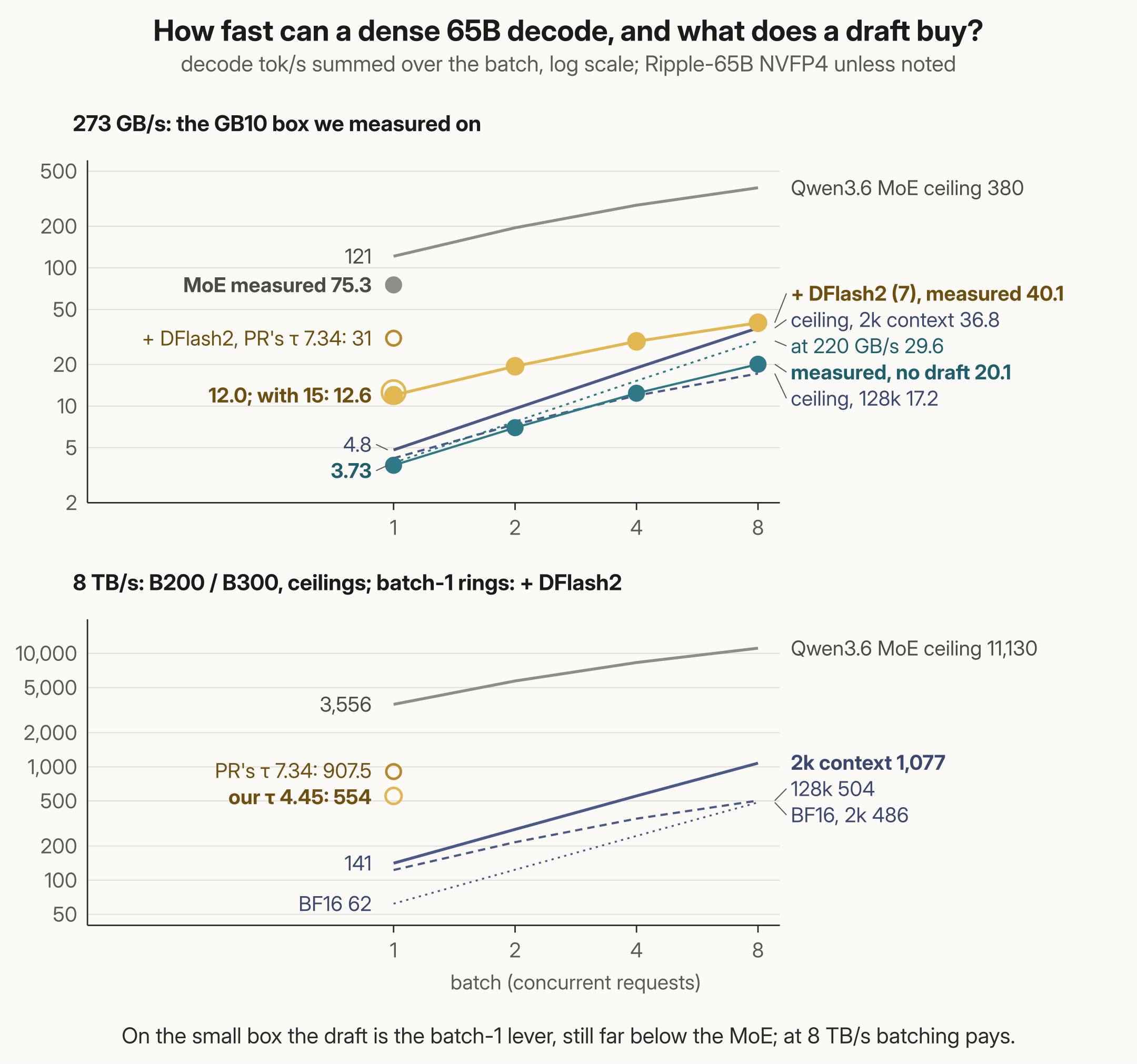
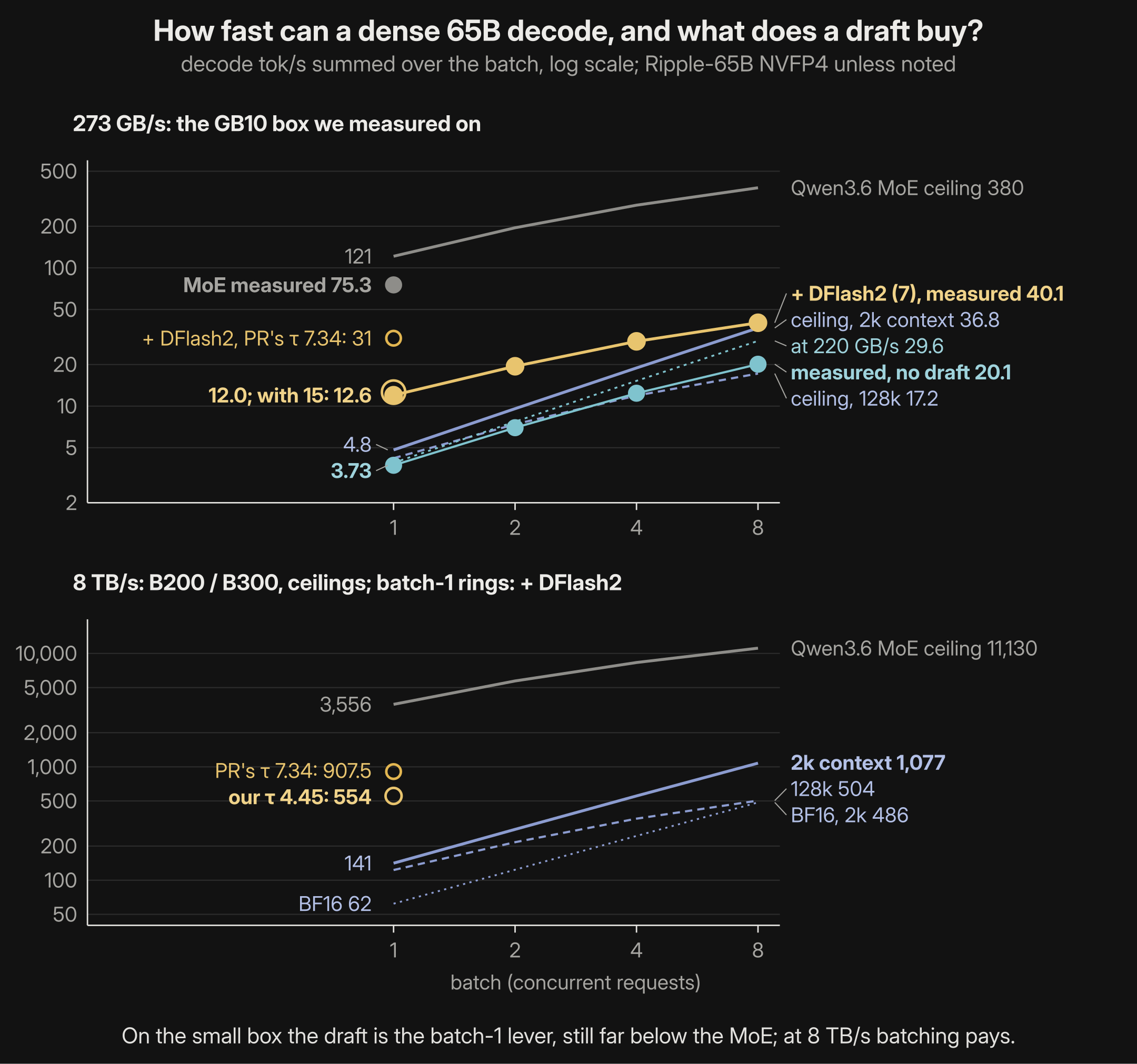
Figure 2: measured dots are output tokens over wall time, prefill included (so 12.0 at batch 1, against 15.24 per request in decode alone). On a small box the draft is the only batch-1 lever, and it leaves the dense model several times behind a 3B-active MoE (measured on different builds); on datacenter GPUs, batching pays for the dense weights.
Long prompts hurt most on this box. The 128k prompt (131,015 tokens) took 205 s to its first token, about 640 tokens/s of prefill, with or without the draft; the 256k one took 568 s. The card's 250 tok/s on 2x B200 at batch 8 in BF16, "prior to quantization or custom kernels", is about a quarter of that setup's 1,000 tok/s bandwidth ceiling, and it doesn't say whether DFlash2 was on (the authors' B200 launcher turns it on by default).
Choosing: dense 65B or an MoE
Keep two comparisons apart. The first is the twins you would deploy in the same memory:
| Ripple-65B NVFP4 | Kolibri-1 FP8 | Qwen3.6-35B-A3B NVFP4 (NVIDIA) | |
|---|---|---|---|
| Checkpoint | 57.2 GB | 78.8 GB | 23.4 GB |
| Parameters, total / active | 64.8B / 64.8B | 78B / 3.46B | 35B / ~3B |
| KV per token | 64 KiB | 20 KiB | 20 KiB + linear-attention state |
| Read per step, batch 1 | 56.2 GB | 3.84 GB (14.6x less) | 2.25 GB (24.9x less) |
| Read per token, batch 8 | 7.0 GB | 1.45 GB (4.8x less) | 0.72 GB (9.8x less) |
| Batch-1 decode, same machine | 3.92 tok/s, 15.24 with DFlash2 | not run | 75.3 tok/s (vLLM 0.32.0) |
Expert reads at batch 8 assume uniform routing, an upper bound. Kolibri-1 has Ripple's ssssF pattern.
At batch 1 Ripple reads 15 to 25 times more per token than these MoEs, and computes about 128 GFLOP against about 7 for 3.5B active parameters. Batching narrows the gap to 5 to 10x at batch 8, because Ripple's weights amortize fully while an MoE's union of experts grows. Even with its draft, Ripple decoded about 5x slower than the Qwen MoE without one (another vLLM version and prompt set: read it as an order of magnitude). What the twins don't claim is Ripple's quality; that is what you pay for in bytes.
The second is the quality peers the card names, Reflection Beam 501B-A23B, Nemotron 3 Ultra 550B-A55B, Muse Spark Open 816B-A42B and Inkling 975B-A41B. Their 23B to 55B active parameters are 0.35x to 0.85x Ripple's 64.8B, so at the same precision they read less per token at batch 1, but they hold 8 to 15x its parameters: several GPUs, expert parallelism, an all-to-all per layer. The card ran them at BF16 "maximum effort" with mixed harnesses and admits Terminal-Bench is hard to replicate; the speed side of this trade doesn't depend on that, the quality side does.
The rule: take the dense 65B when total memory or operational simplicity binds (one GPU, TP or PP only, no expert parallelism, a predictable cost per token) and its quality is what you need. Take an MoE of the same memory when batch-1 speed per dollar binds. Take the 500B-class MoEs when you have the node and the EP stack and want their quality at fewer bytes per token.
What "supported" means in the engines
vLLM merged the model on main on 5 November (#65745, 03bd3c6). As of 9 November the latest release, v0.33.0 (published 2 November), doesn't contain it, so you need a nightly: the vllm/vllm-openai:nightly image, arm64 included, or a per-commit wheel. The recipe says nightly_required: true and min_vllm_version: "0.33.0", is verified on B300 only, and makes DFlash2 opt-in; the PR leaves BF16 at TP > 1, ROCm and LoRA untested; the draft needs model runner V2. The recipe's line, assembled from its default variant and feature args:
$ vllm serve ricursiveAI/Ripple-65B-Preview-NVFP4 \
    --reasoning-parser ripple \
    --enable-auto-tool-choice \
    --tool-call-parser ripple \
    --speculative-config '{"method":"dflash","model":"ricursiveAI/Ripple-65B-Preview-DFlash2","num_speculative_tokens":7}'
Ours, from the session script (SNAP and DSNAP are the local snapshots of the NVFP4 checkpoint at 99eea44 and the draft at 35609b3):
$ vllm serve "$SNAP" --served-model-name ripple --tokenizer "$SNAP" \
    --port 8132 \
    --gpu-memory-utilization 0.70 \
    --max-model-len 266240 \
    --max-num-seqs 8 \
    --max-num-batched-tokens 8192 \
    --disable-prefix-caching \
    --generation-config vllm
# with the draft: --max-model-len 139264 and
#   --speculative-config '{"method": "dflash", "model": "'"$DSNAP"'", "num_speculative_tokens": 7}'
--max-num-batched-tokens is explicit because it sets the sliding reserve; --generation-config vllm stops the checkpoint's sampling defaults from overriding greedy requests; prefix caching is off so repeated prompts pay their prefill.
SGLang's #48636 is still open at 8cdc13a (last updated 5 November), without DFlash2, and v0.5.23 (2 November) doesn't include it. The authors' own path is SGLang 0.5.19 with their out-of-tree model file: 2x B200 in BF16 with DFlash2 (16 draft tokens, a 16,384-token draft window) at 1Mi context (serve.py), and a DGX Spark launcher with NVFP4 on flashinfer_cutlass, one request, 128k, BF16 KV, 32 draft tokens and PDL off because "SM121 PDL softmax can produce NaNs".
llama.cpp merged #31692 on 5 November (fecdc81), in builds from b12167, with GGUFs from 18.5 to 129.6 GB on AtomicChat's repo (40.6 tok/s for Q4_K_M on one GH200, by their card). We didn't test it.
Pin a nightly commit; when the model reaches a vLLM release, re-check the pool line and the draft's acceptance there before you upgrade.
Gotchas
"1M context" is several numbers. The card says 1Mi; the config and the recipe, 2,097,152 positions; the NVFP4 tokenizer's model_max_length, 131,072, which only makes Transformers print a warning. Set --max-model-len yourself, from your pool.
The NVFP4 checkpoint is 57.2 GB, not 33 to 37. Attention, embeddings and head stay BF16. The recipe's vram_minimum_gb: 69 is 57.2 × 1.2.
Read the second pool line. On vLLM main, Available KV cache memory is an estimate; the pool is Extended KV cache to N blocks, after warmup, here 20% smaller. A lower --max-num-batched-tokens shrinks the sliding reserve and the warmup transients, at a prefill-speed cost.
Greedy outputs are not bit-identical, draft or not. Greedy verification keeps a drafted token only if the target would have picked it, yet none of the three batch-1 outputs matched between the NVFP4 and DFlash2 runs: re-tokenized, they diverged after 43, 39 and 29 of 128 tokens, each at a near-tie (" some" or " imports"), then stayed on topic. Without a draft, the same prompts at one request and at eight diverged too, after 18, 76 and 60 tokens. On this build greedy decoding depends on the batch shape, and a verify step is one more shape; FP4 GEMMs autotuned per token count are a plausible cause, not a proven one. Judge a draft by acceptance and evals, not by diffing text.
Check the build before judging the draft. Before #65745, vLLM rotated the draft's NoPE layer by mistake, and acceptance was 4.98 instead of 7.34 (PR, GSM8K, B300). The DFlash2 card's own validation used an RL-step-500 target on 8x H100 with ripple-sglang, "not necessarily the released one".
No decode context parallelism in vLLM. Its sliding-window spec asserts DCP is off ("DCP not support sliding window", kv_cache_interface.py L945-949), and 64 of Ripple's 80 layers slide (read in the source, not run). For more 1M sessions, use TP, which halves the cache per GPU, or replicas.
Verdict
Smallest nodes in NVFP4: one H200 for a few 128k sessions and none at 1M, one B200 for one 1M session, one B300 for two; in BF16, one B300 for one, two B200 at TP2 for two. A same-memory MoE reads 15 to 25x fewer bytes per token, so pick Ripple only for its quality and its one-GPU simplicity. On a 128 GB desktop box, NVFP4 serves one 128k session at 3.9 tok/s, 15 with DFlash2, after 3.4 minutes of prefill: a box to evaluate it on, not to serve from. Turn DFlash2 on, on a nightly with #65745: it nearly quadrupled batch-1 speed and still doubled throughput at batch 8.
For the MoE side of this trade, Quantizing Mixture-of-Experts Models shows what 4-bit does to expert weights and which kernel each checkpoint lands on.
Sources
- Ricursive Intelligence, Ripple-65B Preview model card @
da94cc0(weights 2026-11-04, last modified 2026-11-06), NVFP4 @99eea44, DFlash2 @35609b3; launch page. - vLLM PR #65745 (merged 2026-11-05 at
03bd3c6) and its recipe; nightly0.33.0rc1.dev992+g1648fefab(main at1648fef, 2026-11-07); latest release v0.33.0 (2026-11-02, tagv0.33.0rc3), checked 2026-11-09. - SGLang PR #48636 (open at
8cdc13a, checked 2026-11-09); release v0.5.23 (2026-11-02). - llama.cpp PR #31692 (merged 2026-11-05 at
fecdc81); AtomicChat GGUF card (2026-11-05). - Papers: Gated Attention for Large Language Models, Value Residual Learning (ResFormer), DFlash.
- Comparison models: Aleph-Alpha/Kolibri-1 @
abfe85f, nvidia/Qwen3.6-35B-A3B-NVFP4 @1355db6.