In this series / On this page· 13 of 18
- 1. Disaggregated Serving: Dynamo, llm-d, and When Splitting Prefill from Decode Pays
- 2. TTFT, ITL, Goodput: Measuring What Users Feel
- 3. Benchmark an Inference Server Without Lying to Yourself
- 4. Expert Parallelism, and What DeepEP Does for It
- 5. Serving Kimi K3.1 Pro: The State per Request, the Indexer's Cost, and Where 1M Tokens Fit
- 6. Other Users' Data in the KV Cache: What Cloudflare's GLM-5.3 Incident Teaches Operators
- 7. Flow Control in the Serving Stack: What llm-d, Dynamo and AIBrix Do When the Fleet Is Full
- 8. Context Parallelism for Long-Context Serving: PCP and DCP in vLLM and SGLang
- 9. Several Models, One GPU: Time-Slicing, MPS, MIG, and What CUDA 13.4's Memory Caps Change
- 10. Serving Mistral Large 4: What Its Cache Costs and Where It Fits
- 11. Prefix-Aware Routing Across Replicas: Kubernetes Service, Dynamo's KV Router, the llm-d EPP and Kinference
- 12. Serving Ripple-65B: What a Dense Model with 1M Context Costs, and When It Beats an MoE
- 13. Cost per Million Tokens, Computed: GPU-Hours, Utilization, and the Cache
- 14. Kinference at alpha.7: What Buoyant's Inference Control Plane Does, and What It Reuses
- 15. Splitting Off the Vision Encoder: When Encoder Disaggregation Pays in vLLM
- 16. The Cache Hit That Changed the Answer
- 17. Prefix Caches That Collapse Under Bursts, and the Session Cap That Prevents It
- 18. MLPerf Endpoints v1.0: How to Read an Agentic Inference Benchmark
Cost per Million Tokens, Computed: GPU-Hours, Utilization, and the Cache
Compute what a million tokens costs on your own GPUs: GPU-hours over throughput, then utilization, cache hits and the costs a headline figure leaves out.
Revolut says it serves GLM-5.3 to about 2,000 engineers on 56 B200s for $0.30 per million tokens. On an agentic-coding benchmark, at the same 200 tokens per second per user, a fully loaded B200 produces them for $0.049 to $0.216, depending on what it pays per GPU-hour. The difference is idle hours, the latency target, and what counts as a token, and each of them can be computed for your own GPUs.
The formula, and which tokens
Cost per million tokens is what a GPU costs per hour, divided by the millions of tokens it produces in that hour, divided by how busy you keep it:
$/Mtok = ($ per GPU-hour) / (tokens/s per GPU × 3,600 / 1,000,000) / average utilization
Take SemiAnalysis's InferenceX measurement of GLM-5.3 on B200: FP4, Dynamo with SGLang, its AgentX agentic-coding workload, runs from 22 October to 6 November 2026. At 200 tokens/s per user, the best configuration on its frontier serves 9,876 tokens/s per GPU. That is 35.6 million tokens per GPU-hour, so at full load:
| $ per GPU-hour | What it is | $/Mtok |
|---|---|---|
| $1.73 | Owning at large hyperscaler volume (SemiAnalysis TCO model) | $0.049 |
| $3.70 | Retail rental tier (SemiAnalysis TCO model) | $0.104 |
| $7.69 | Lambda's on-demand B200 from 16 November 2026 | $0.216 |
Which tokens sit in the denominator matters as much as the price. InferenceX converts throughput to "$ per million total (input plus output) tokens" (InferenceX ranking), and its benchmark client, AIPerf, counts every prompt token in that total, cached or not: input length is the token count of the whole prompt, and total_token_throughput = (total_isl + total_osl) / benchmark_duration_seconds (metrics reference). AgentX replays real coding-agent sessions whose median request is 142,016 prompt tokens for 444 output tokens (methodology): prompt tokens are 99.7% of what is counted. At that mix, divide the same GPU-hour by output tokens only and the $0.049 becomes $15.6.
So a $/Mtok figure means nothing until it says which tokens: output only, total, or "blended", with cached prompt tokens counted at full weight. Revolut said "blended". InferenceX's total is blended too.
The throughput in the formula must be the one you can serve at your latency target, not the benchmark's peak. Measuring it is the subject of benchmarking an inference server; reading it at a latency target is goodput.
The latency target sets the throughput
Our own load sweep from the goodput piece shows how much. One NVIDIA GB10 (an ASUS Ascent GX10), vLLM 0.31.0 (one release behind 0.32.0, the current stable release), Qwen3-8B in BF16, random prompts of 1,024 tokens in and 256 out, Poisson arrivals, no prefix-cache hits. To price the box, take today's entry price for a 128 GB GB10 box in the US: $5,999 for ASUS's 1 TB model, on its eShop (out of stock) and on Amazon, 7 November 2026. Over 36 months that is $0.228 an hour. Add power at 240 W, the rating of its power supply (NVIDIA's user guide) and so an upper bound, at 18.2 cents per kWh, EIA's 2026 US residential average: $0.044. The box costs $0.272 an hour. No input here has moved more than that price. Memory shortages took NVIDIA's own DGX Spark from $3,999 to $4,699 in February (NVIDIA) and to $6,950 in October (The Register); the GX10, announced at $2,999, still sold for about $3,500 in spring 2026. At $3,500 the box costs $0.177 an hour, and each of the box's figures below drops by 35%: use your own invoice.
| Offered load (req/s) | Completed (req/s) | Total tok/s | $/Mtok, total | $/Mtok, output only | Best SLO it meets (TTFT / TPOT) |
|---|---|---|---|---|---|
| 0.5 | 0.43 | 550 | $0.137 | $0.687 | 1 s / 100 ms (chat) |
| 1 | 0.81 | 1,037 | $0.073 | $0.363 | 2 s / 200 ms |
| 1.5 | 1.15 | 1,472 | $0.051 | $0.255 | 5 s / 300 ms |
| 2 | 1.33 | 1,702 | $0.044 | $0.222 | none |
| 2.5 | 1.42 | 1,818 | $0.042 | $0.207 | none (throughput peak) |
| 3 | 1.40 | 1,792 | $0.042 | $0.212 | none |
| 4 | 1.36 | 1,741 | $0.043 | $0.218 | none |
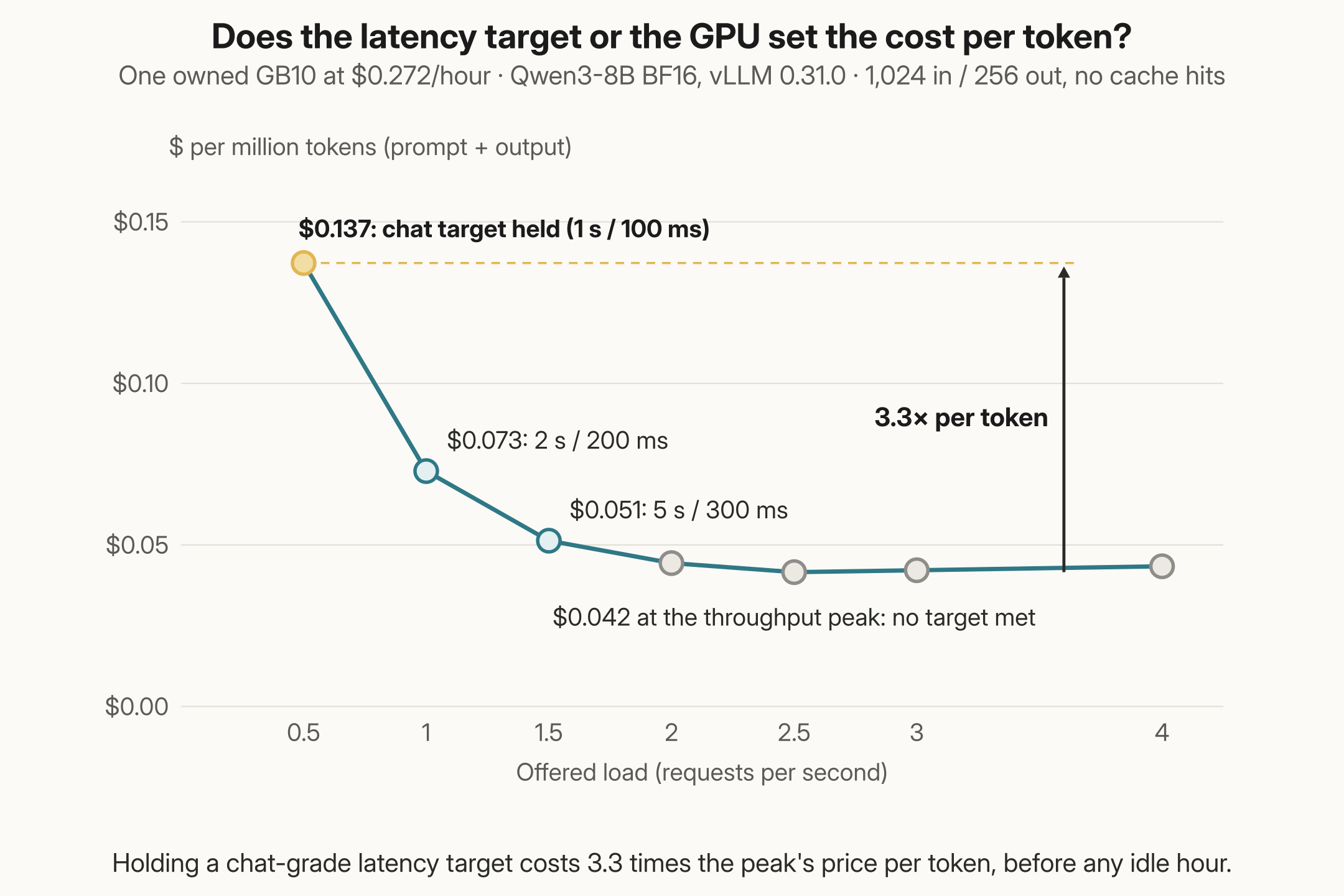
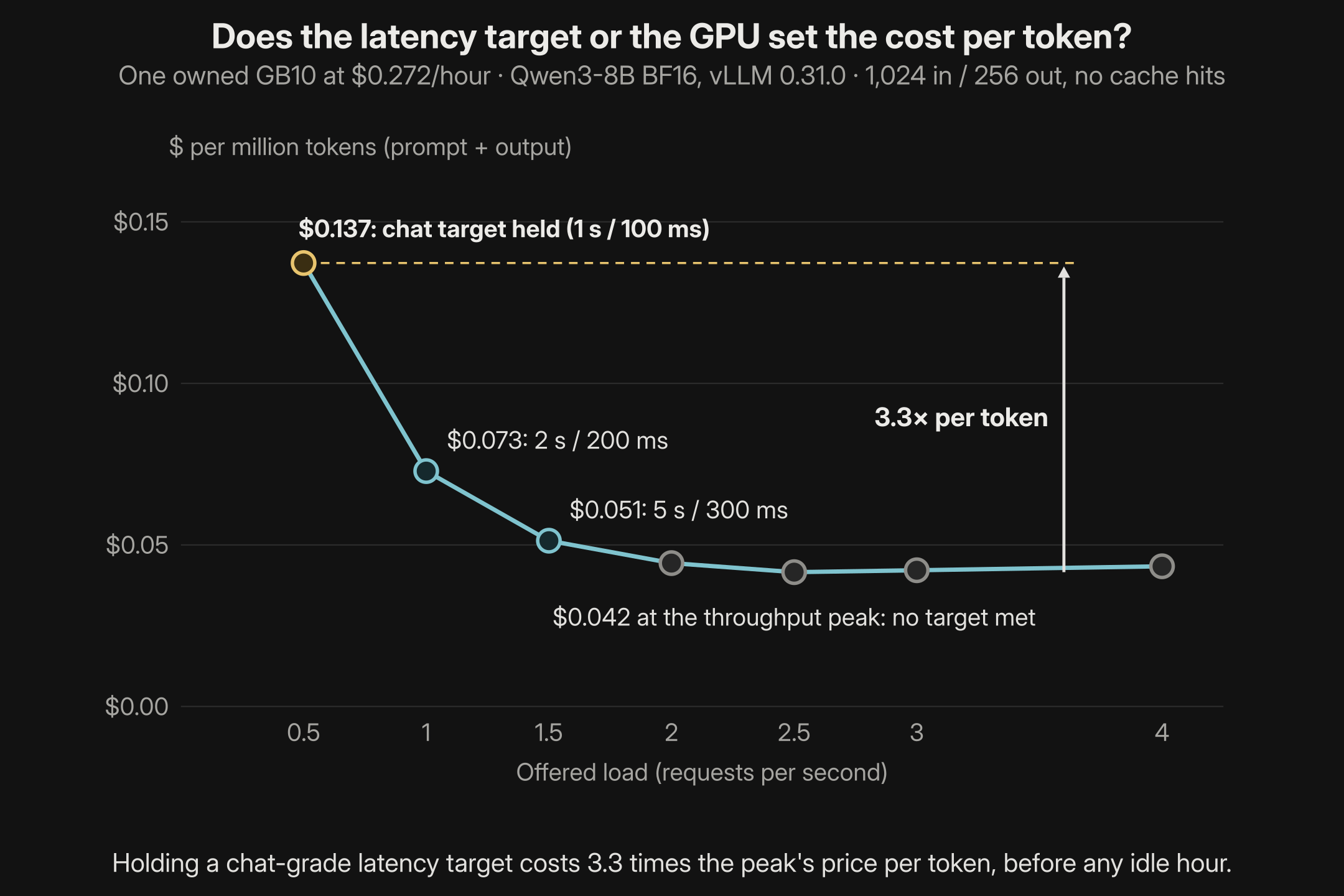
The same box costs 3.3 times more per token at a chat-grade latency target than at its throughput peak.
The peak is the number a benchmark prints first, and it is the cheapest token on the table. It is also a server on which no request met even a 5-second target. Hold the chat target and you pay $0.137 per million total tokens, before a single idle hour. The B200 ladder says the same: at Lambda's price, GLM-5.3 costs $0.131 per million at 100 tokens/s per user, $0.164 at 150 and $0.216 at 200. On this box, the latency target moves the price of a token 3.3 times; on the B200, going from 100 to 200 tokens/s per user moves it 1.65 times. A $/Mtok without its latency target means nothing.
Owning changes only the dollars per hour: the purchase price over its useful life, plus power, space and cooling. For the B200 there is no list price to plug in: NVIDIA sells through partners and reseller quotes vary, so use your own quote, price / (months × 730) + kW × $/kWh, with the 1.71 kW per GPU that InferenceX counts once the host, network and cooling share are included (B200 page). Its $1.73 tier is SemiAnalysis's estimate of that sum at hyperscaler volume, not a price you can buy at.
Utilization is the denominator
Every hour you pay for and don't fill divides the result. A team that works ten hours a day, five days a week, uses 50 of the week's 168 hours: 29.8%. The box at its chat target then costs $0.461 per million total tokens instead of $0.137.
Revolut described the shape of its own curve: "you're an engineer at Revolut, you just connect after 5 p.m. ... you can get 800 TPS" (5:42:07), four times the daytime 200. A fleet sized for the daytime peak at the latency target has much of its capacity free at night, and the cost per token counts those hours. Spare capacity counts the same way: an N+1 replica for availability adds its full cost to tokens it never serves. One spare per seven serving GPUs adds a seventh.
Try it on the B200 case: move the utilization, add a spare node or a fixed monthly cost, and see where the line crosses the API price.
The cache changes both sides
A prefix-cache hit changes the cost on both sides of the comparison, in different ways. On your GPUs, a cached prompt token skips prefill: the engine reads its KV from memory instead of recomputing it (how prefix caching works). With a 90% hit rate, the server reports far more prompt tokens per second than it computes, and a blended $/Mtok counts all of them. On an API, cached tokens are billed apart, at a fraction of the input price:
| API (list prices, 7 Nov 2026, per million) | Input | Cached input | Cache write | Output |
|---|---|---|---|---|
| Z.ai GLM-5.3 | $1.40 | $0.26 | none | $4.40 |
| Claude Sonnet 5.5 | $2.00 | $0.10 | $2.50 (5 minutes) | $10.00 |
| Claude Opus 5.5 | $4.00 | $0.20 | $5.00 (5 minutes) | $20.00 |
| OpenAI GPT-6.1 Sol (prompts up to 272K) | $2.00 | $0.10 | $2.50 (30 minutes) | $10.00 |
Anthropic and OpenAI charge cache reads at 0.05 times the input price on these models and cache writes at 1.25 times (OpenAI's caching guide); Z.ai charges reads at 0.19 times and nothing for writes. Blend each at a given mix, counting uncached prompt tokens as cache writes where the API charges them:
| $/Mtok, blended | Hit rate | Z.ai GLM-5.3 | Sonnet 5.5 | Opus 5.5 | GPT-6.1 Sol |
|---|---|---|---|---|---|
| 95% prompt, 5% output | 0% | $1.55 | $2.40 | $4.80 | $2.40 |
| 90% | $0.575 | $0.823 | $1.65 | $0.823 | |
| 99% | $0.478 | $0.618 | $1.24 | $0.618 | |
| 99.7% prompt (AgentX median request) | 0% | $1.41 | $2.03 | $4.05 | $2.03 |
| 90% | $0.387 | $0.370 | $0.740 | $0.370 | |
| 99% | $0.284 | $0.155 | $0.310 | $0.155 |
Two things follow. The mix and the hit rate move an API's price per token by more than 15 times, so a blended figure is comparable only with an API price blended at the same prompt share and hit rate. And at an agentic mix with a high hit rate, the ranking changes: Sonnet 5.5 and GPT-6.1 Sol undercut Z.ai's own price for GLM-5.3, because their cache reads are cheaper. Opus 5.5 at a 99% hit costs about what Revolut reports for self-hosting.
Prices per token also hide the tokenizer. Anthropic says its 4.7-and-later models produce about 30% more tokens for the same text than its earlier models. Comparing two models, compare the price of the same work, not of a token.
Revolut's $0.30, reconstructed
The talk is David Abitbol's (he leads AI operations at Revolut) at AI Engineer NYC in October 2026; the conference page carries a machine transcript with reviewed terminology and livestream timestamps. What it states:
- "to serve 2,000 engineers, we roughly need 56 B200. And that's to host GLM 5.3" (5:41:18). They started self-hosting with GLM-5.1 in April.
- A target under 3 seconds to first token, complaints above 5 (5:41:31), "200 tokens per second" per user (5:41:48).
- "blended cost of token is 30 cents per million. And so our invoice is one-tenth of what we were spending on Anthropic and OpenAI" (5:42:17).
- Coding needs a cache hit rate "above 90%" (5:44:43); FP4 on Blackwell, TP8 rather than TP4, speculative decoding and P/D disaggregation are listed as things to consider.
It doesn't state what Revolut pays per GPU-hour, whether it owns or rents (it mentions a "GPU provider" and a "US-based service"), how many hours the fleet runs, or how "blended" is counted. The $0.30 is Revolut's own figure, unaudited. The coverage added to it: The Register calls it "$0.30 per million input/output tokens" and attaches it to GLM-5.1, and reports NVFP4, disaggregated prefill and decode and context tuning as implemented, where the talk lists them as things to consider. A line in other outlets, that the figure excludes cloud spend, staffing and observability, is not in the talk; they attribute it to StartupHub.
Invert the formula with InferenceX's throughput at the same 200 tokens/s per user: utilization = $/Mtok at full load ÷ reported $/Mtok. At $1.73 per GPU-hour, $0.30 implies an effective utilization of 16%; at $3.70, 35%; at $7.69, 72%. Effective, because it counts idle hours plus any gap between Revolut's stack and InferenceX's best configuration. The talk gives one cross-check: over 7 requests per second on the same 56 GPUs in August. At 72%, the fleet would serve 399,000 tokens/s, about 57,000 blended tokens per request at 7 requests per second around the clock; at 16%, about 12,800. AgentX's median request, in its variant capped at 256K tokens (the talk recommends 256K over 1M contexts), has 88,768 prompt tokens. Every tier is plausible for a daytime rate with quiet nights, so the load doesn't pin the price down. It is a consistency check, not an audit.
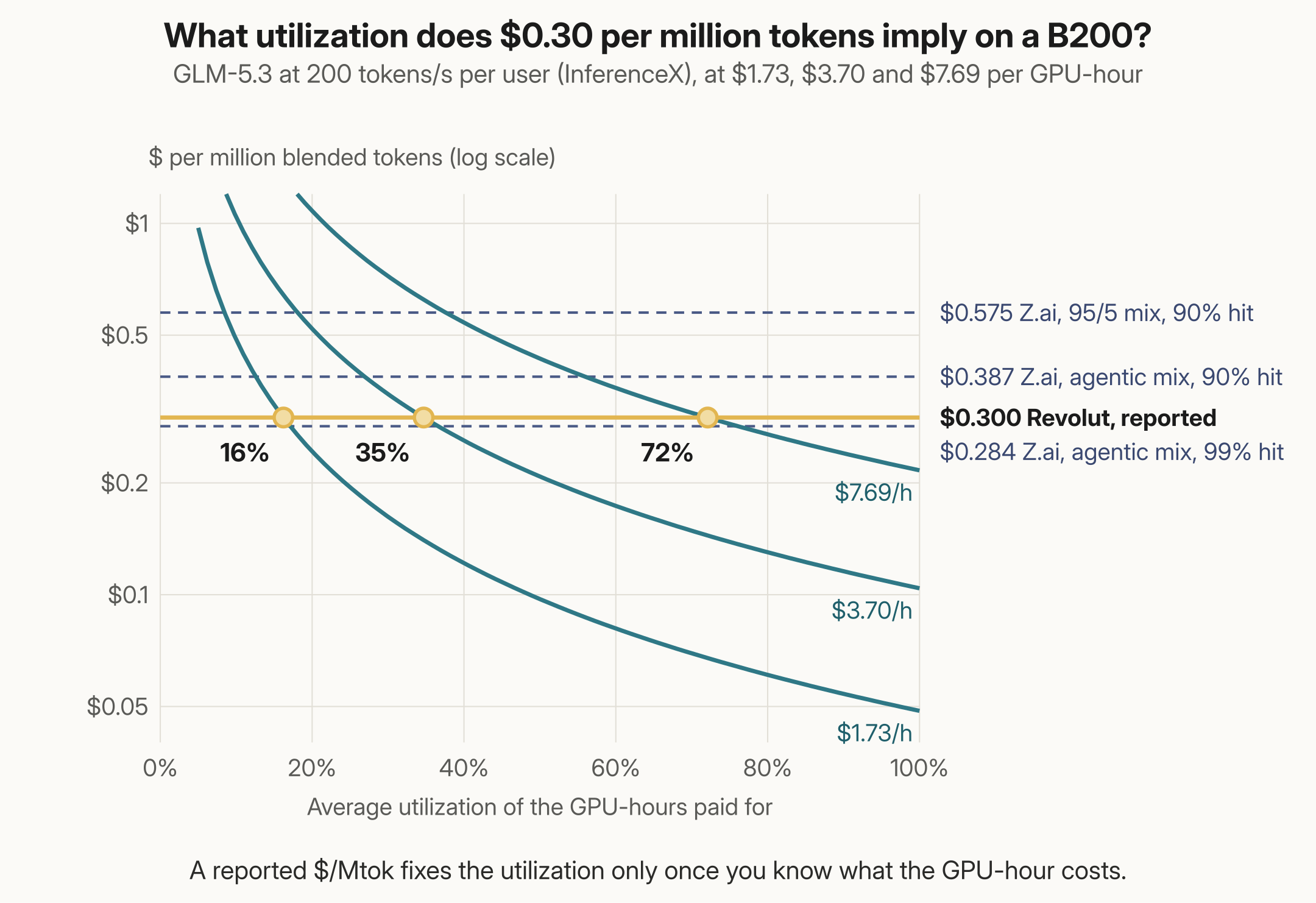
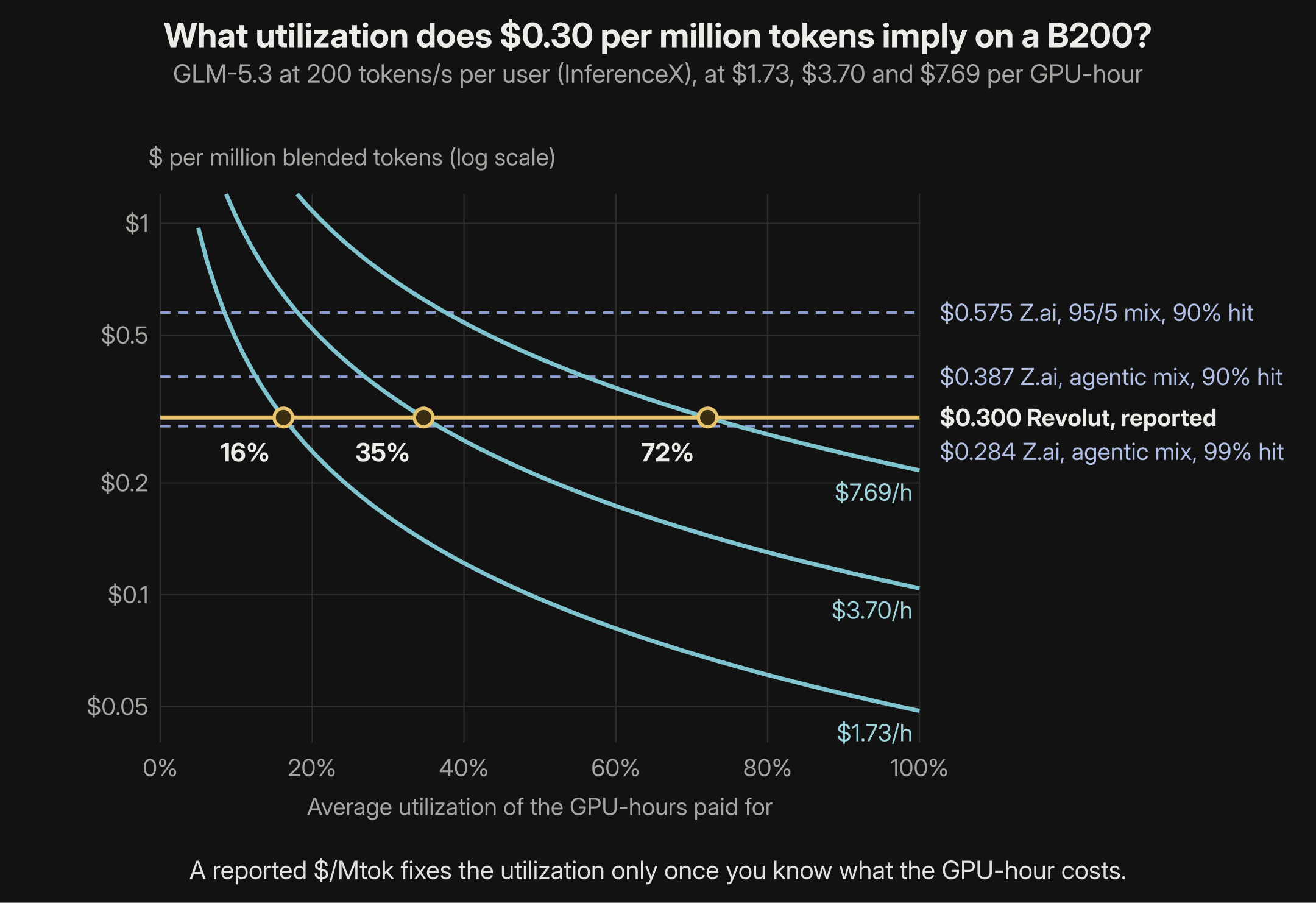
A reported $/Mtok fixes the utilization only once you know the GPU price.
Now the comparison that means something: the same mix on an API, at Revolut's hit rate. The talk says only "above 90%", so take 90% and 99% as the bounds. At the AgentX mix, GLM-5.3 on Z.ai costs $0.387 at a 90% hit and $0.284 at 99%: from 1.3 times the $0.30 to slightly less than it (1.9 to 1.6 times at 95% prompt tokens). Across both mixes, Sonnet 5.5 and GPT-6.1 Sol run from 2.7 times down to half, Opus 5.5 from 5.5 times to about even. Not ten, and at the top of that range the same model's API costs no more than Revolut's own figure. The "one-tenth" is a ratio of invoices, set by which models were billed and on which price schedules (Anthropic's earlier models charge cache reads at 0.1 times input, not 0.05), and by volumes the talk doesn't give. A ratio of bills is not a ratio of prices per token.
Enter another operator's figure, or your own, and read the utilization behind it:
What a per-token figure leaves out
Costs that don't scale with tokens divide by how many you serve. At Revolut's scale they nearly vanish: at 72% on $7.69 GPUs, the fleet serves about 1,048 billion tokens a month, and each $10,000 a month of fixed cost adds $0.0095 per million. At the 16% that the ownership tier implies, it serves 236 billion, and the same $10,000 adds $0.042, 14% of the figure. On one box serving 1.45 billion tokens a month at its chat target, $100 a month adds $0.069. The list to price:
- People. Someone is on call for the endpoint and upgrades the engine: vLLM went from 0.29.0 to 0.32.0 between 9 September and 18 October 2026, and each release is a test cycle.
- Observability. Revolut names "very strong open telemetry" as a requirement; tracing and log storage at 7 requests per second, with prompts of tens of thousands of tokens, are a line item.
- Evaluation on every model, quantization or engine change.
- Spares and headroom for failures and peaks, in the denominator as above.
- For owned hardware: power at the data center's price, cooling, space, and the resale value at the end of the useful life you assumed.
The widget takes these as one monthly number and shows the cost with and without them.
Gotchas
A benchmark's $/Mtok is a full-load, around-the-clock figure. InferenceX's $0.049 assumes the GPU is busy every hour at that operating point. Quote it as the floor, never as the cost of self-hosting.
Your throughput must come from your cache structure. Our sweep has no cache hits, so it understates blended tokens per second for agent traffic; InferenceX's has AgentX's sessions, which overstate it for traffic with shorter shared prefixes. Measure at your hit rate, then compare with the API at that same hit rate. vLLM exports both numbers: vllm:prefix_cache_hits over vllm:prefix_cache_queries, in tokens, is the hit rate, and vllm:prompt_tokens (cached tokens included) plus vllm:generation_tokens is the blended throughput (v0.32.0). SGLang returns cached_tokens in each response's usage.prompt_tokens_details when started with --enable-cache-report (v0.5.23).
Caching on with a low hit rate costs more on Claude and GPT-6.1 Sol. A write costs 1.25 times plain input. Below a hit rate of about 21% at these prices, caching raises the bill.
Prices move. Lambda's B200 on-demand price changes on 16 November 2026, and the box in our example lists at twice its launch price. Put a date next to every price in a business case.
Verdict
Compare like for like, in this order. First the same model on its maker's API, at your measured prompt share and hit rate: that is the price self-hosting must beat. Then compute the break-even utilization for your GPU price; against Z.ai's GLM-5.3 at the agentic mix and a 90% hit, it is 13% at $1.73, 27% at $3.70 and 56% at $7.69 per GPU-hour, before spares and fixed costs. Self-host when your real duty cycle, with a spare, stays above it, or when a requirement is worth paying for: data residency, a pinned model version, a flat bill. A frontier API is a separate decision about model quality, not a price comparison.
On its own figures, Revolut's case is a requirements case as much as a price case: if the $0.30 holds, it beats GLM-5.3 on Z.ai by about a fifth at a 90% hit and roughly matches it at 99%, and on top it buys a flat bill, a pinned model and its own data terms, on steady daytime load from 2,000 engineers, with tuning that held time to first token on the same 56 GPUs while demand more than doubled. What its $0.30 doesn't show is a tenfold saving per token.
Raising the hit rate is the lever that moves both sides at once: prefix caching covers how to design prompts for it, and disaggregated serving how to hold the latency target at higher load. The script behind every number here is attached: token_cost.py (python3 token_cost.py, standard library only).
Sources
- David Abitbol (Revolut), AI Engineer NYC 2026, transcript: ai.engineer/nyc/2026/talks/revolut (clip published 29 October 2026)
- SemiAnalysis InferenceX, GLM-5.3 on B200 (runs 22 October to 6 November 2026), B200 tiers, AgentX methodology, read 7 November 2026
- SemiAnalysis InferenceX, cheapest GPU for GLM-5.3 (ranking and cost method), read 7 November 2026
- NVIDIA AIPerf, metrics reference (latest docs, read 7 November 2026; latest release v0.13.0, 24 September 2026) and WEKA trace replay (28 October 2026)
- NVIDIA, DGX Spark user guide, hardware (240 W power supply)
- vLLM v0.32.0 metrics; SGLang v0.5.23
--enable-cache-report - Price pages read 7 November 2026: Z.ai, Anthropic, OpenAI, Lambda, ASUS eShop USA
- EIA, Short-Term Energy Outlook, 6 October 2026