In this series / On this page· 10 of 18
- 1. Disaggregated Serving: Dynamo, llm-d, and When Splitting Prefill from Decode Pays
- 2. TTFT, ITL, Goodput: Measuring What Users Feel
- 3. Benchmark an Inference Server Without Lying to Yourself
- 4. Expert Parallelism, and What DeepEP Does for It
- 5. Serving Kimi K3.1 Pro: The State per Request, the Indexer's Cost, and Where 1M Tokens Fit
- 6. Other Users' Data in the KV Cache: What Cloudflare's GLM-5.3 Incident Teaches Operators
- 7. Flow Control in the Serving Stack: What llm-d, Dynamo and AIBrix Do When the Fleet Is Full
- 8. Context Parallelism for Long-Context Serving: PCP and DCP in vLLM and SGLang
- 9. Several Models, One GPU: Time-Slicing, MPS, MIG, and What CUDA 13.4's Memory Caps Change
- 10. Serving Mistral Large 4: What Its Cache Costs and Where It Fits
- 11. Prefix-Aware Routing Across Replicas: Kubernetes Service, Dynamo's KV Router, the llm-d EPP and Kinference
- 12. Serving Ripple-65B: What a Dense Model with 1M Context Costs, and When It Beats an MoE
- 13. Cost per Million Tokens, Computed: GPU-Hours, Utilization, and the Cache
- 14. Kinference at alpha.7: What Buoyant's Inference Control Plane Does, and What It Reuses
- 15. Splitting Off the Vision Encoder: When Encoder Disaggregation Pays in vLLM
- 16. The Cache Hit That Changed the Answer
- 17. Prefix Caches That Collapse Under Bursts, and the Session Cap That Prevents It
- 18. MLPerf Endpoints v1.0: How to Read an Agentic Inference Benchmark
Serving Mistral Large 4: What Its Cache Costs and Where It Fits
Mistral Large 4 caches 46 KiB per token: what that leaves on four or eight Blackwell GPUs, when decode context parallelism pays, the smallest deployment.
Size Mistral Large 4's cache with the formula most sizing guides use, 2 × layers × KV heads × head dim × bytes, and its params.json (72 layers, 64 KV heads, head dim 128) gives 2.36 MB per token in BF16. vLLM allocates 47,136 bytes, fifty times less. The gap is the serving story of this model: which layers write a cache, which only read one, and what a long context then costs on four or eight GPUs.
The 72 layers, read for the server
Everything a server needs is in params.json (FP8 repo at af26e78; the NVFP4 repo's file differs only in its quantization block). Six groups of keys decide the cache:
nope: "rope,rope,rope,nope": every fourth layer, 3 to 71, has no rotary embedding. 18 NoPE layers.kv_sharing.source_layers_str: layers 39, 43, 47, ..., 71 point at layer 35. These nine NoPE layers read layer 35's latent cache and write none: 63 layers own one.dsa.sharing: 44 layers run their own DeepSeek Sparse Attention indexer; the other 28 (pairs 17-18, 21-22, ..., 69-70) reuse the top-k of the nearest earlier indexer layer and store no index keys.kv_lora_rank: 512,qk_rope_head_dim: 64: one 576-wide latent per token per owner layer, read by all 64 heads.dsa.topk: 2048,dsa.fp8_kv_cache: true,dsa.fp8_indexer: true: each query attends to 2,048 selected tokens, and both caches default to FP8.mtp: a DSpark drafter shipped in the checkpoint, three sliding-window MLA layers (window 2,048, depth 3) fed by hidden states tapped at layers 1, 18, 36, 54 and 71.
vLLM's port turns these keys into one spec per layer (layer_spec.py), and its config parser asserts that a consumer reads an earlier owner with the same NoPE flag (mistral.py). NoPE layers keep the full 576-wide row, with the RoPE part zeroed (attention.py), so they cost the same bytes as RoPE layers.
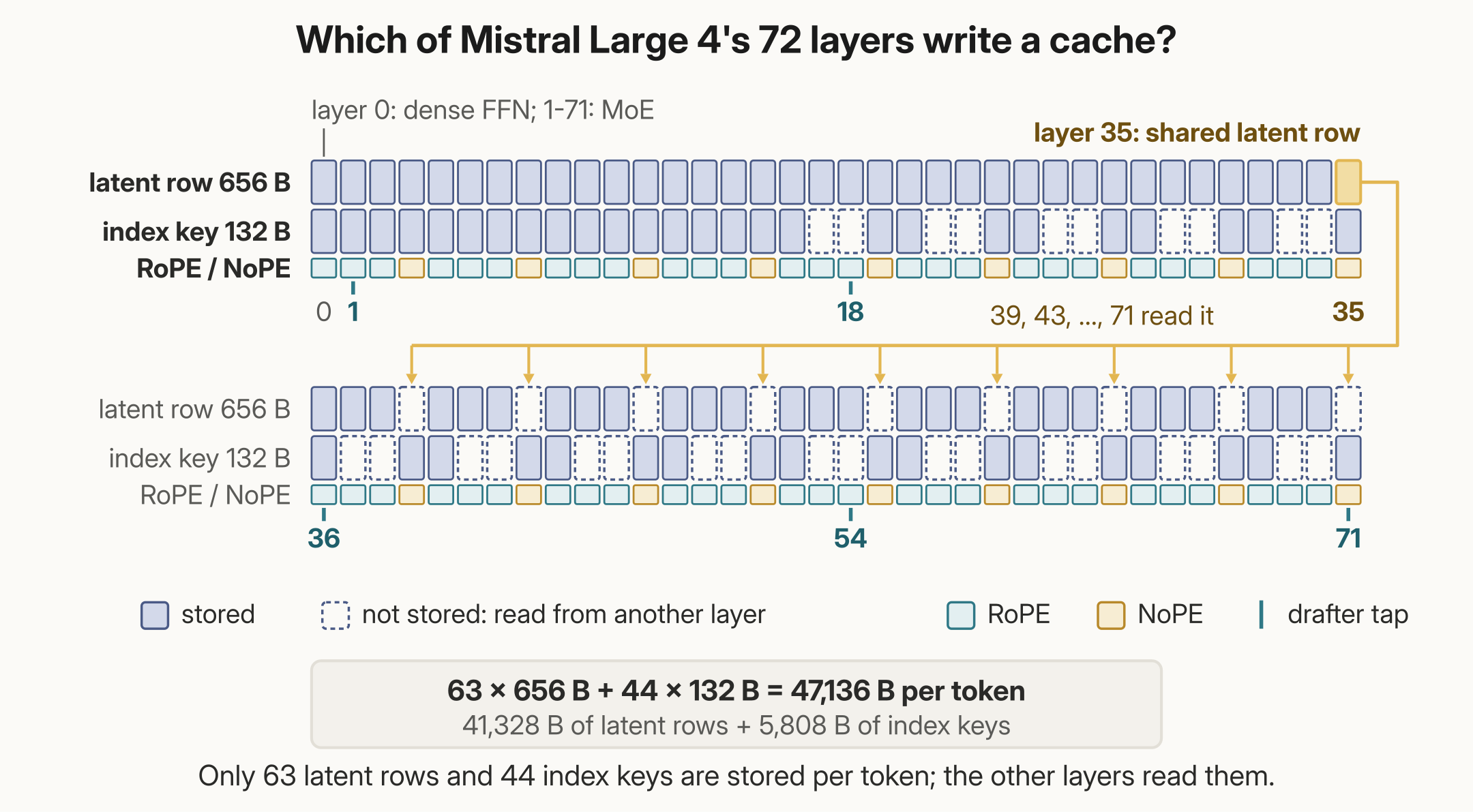
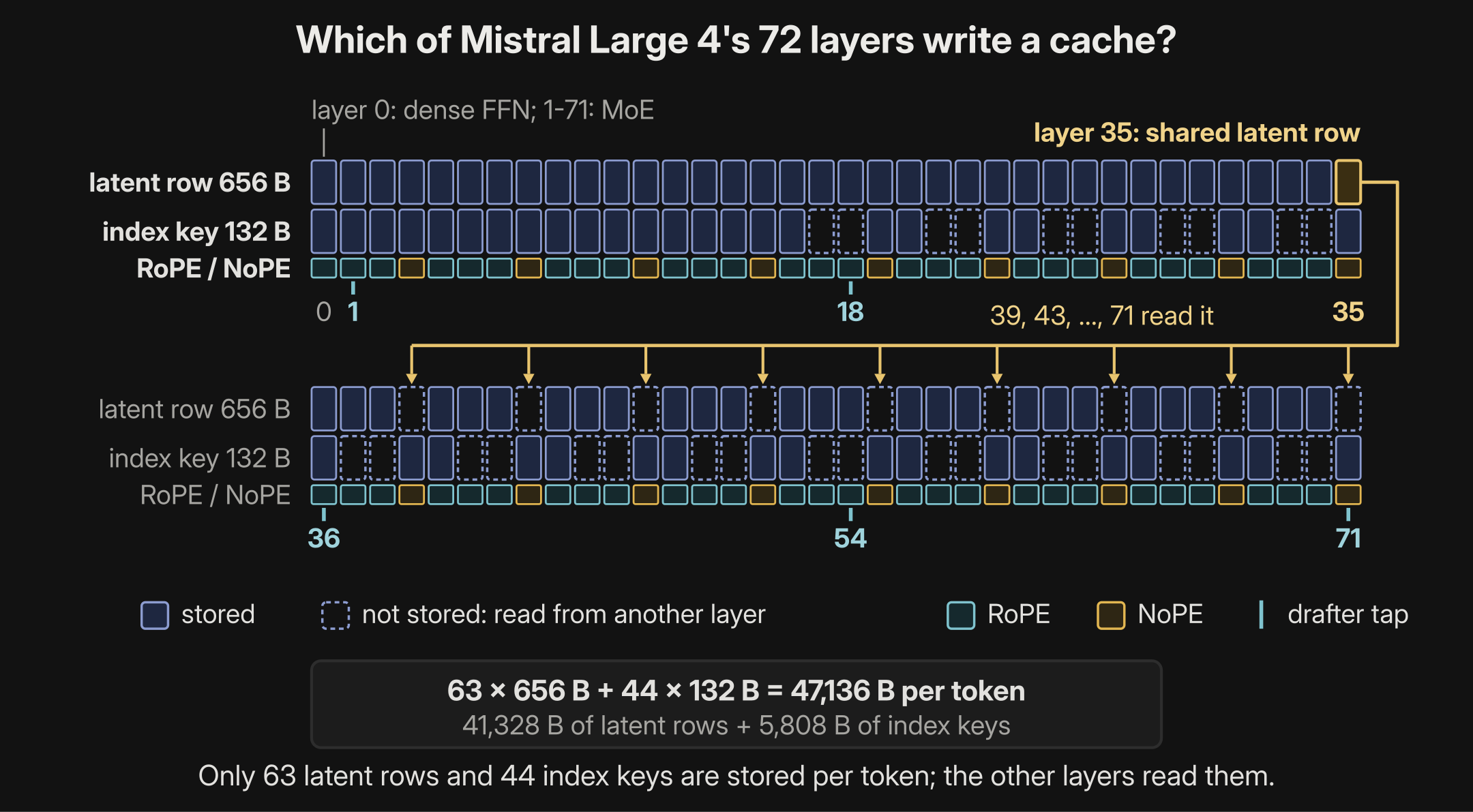
Figure 1: of 72 layers, 63 store a latent row and 44 store an index key. The other reads are free.
Most of this isn't new. MLA with a DSA indexer and vLLM's fp8_ds_mla layout come from DeepSeek V3.2 and already run in GLM-5.3; Mistral Large 3 was DeepSeek-V3's design, with no indexer and no sharing (its params.json; drawn in DeepSeek-V3). Large 4 adds latent-KV sharing across layers, top-k sharing between indexers, SSMax (a length-dependent query scale), LeRoPE (YaRN with a learned multiplier per frequency) and the in-checkpoint drafter. Only the two sharing schemes change the cache.
Bytes per token, computed
Per token, an owner layer stores one fp8_ds_mla row: 512 FP8 latent values, four FP32 scales and the 64 RoPE dimensions in BF16, 656 bytes. An indexer owner stores one FP8 key of 128 values plus an FP32 scale, 132 bytes:
latent   63 × 656 = 41,328 B
indexer  44 × 132 =  5,808 B
total             = 47,136 B per token   (46.0 KiB; 46.0 GiB at 1,048,576 tokens)
That is vLLM's number, to the byte. Without sharing, all 72 layers would store both: 56,736 bytes. Layer 35's nine readers save 5,904 bytes, the 28 top-k reusers 3,696, together 17%. It is the move of the hybrid models in When Most Layers Stop Caching, made inside MLA: some layers simply stop writing.
The GQA formula of The KV Cache, Sized fails here because MLA caches no per-head K and V: the 64 heads each up-project the same latent at attention time, so the "64 KV heads" in params.json describe the computation, not the storage. A calculator that multiplies by KV heads overstates this cache 50 times.
Other layouts change only the row:
| Layout | Latent row | Per token | Where |
|---|---|---|---|
fp8_ds_mla |
656 B | 47,136 B | vLLM default on NVIDIA |
| Plain FP8 (E4M3) | 576 B | 42,096 B | vLLM on ROCm; SGLang's trtllm DSA path |
| BF16 | 1,152 B | 78,384 B | --kv-cache-dtype bfloat16 (the index keys stay FP8) |
78,384 / 42,096 is the "1.86x vs BF16" in vLLM's AMD section. The drafter keeps its own BF16 cache: three layers × 2,048 tokens × 1,152 bytes, 7.1 MB per request, small next to a long context's 4.7 GB at 100k tokens.
mistral_large4_kv.py rebuilds the layer map from params.json and prints these numbers (standard library, no GPU). With --params it reads a local file and stops; the plain run also reads both repos' safetensors headers for the next section (about 85 seconds):
$ python3 mistral_large4_kv.py --params params.json
# … (excerpt)
latent KV owners 63, consumers [39, 43, 47, 51, 55, 59, 63, 67, 71] -> layer [35]
fp8_ds_mla       : 63 x 656 + 44 x 132 = 41,328 + 5,808 = 47,136 B per token (46.03 KiB; 46.03 GiB per 1,048,576 tokens)
without KV sharing 53,040 B, without top-k sharing 50,832 B, without either 56,736 B; sharing saves 16.9%
Capacity per GPU, and the "1.5x"
The pool is what the engine leaves after weights: pool per GPU = budget − weights per GPU, and tokens = pool / 47,136. Both terms need care.
Weights per GPU are not the checkpoint divided by TP. vLLM's port replicates some tensors on every rank: the latent down-projection (attention.py), the indexer's projections (indexer.py), the router, the drafter's target projection and the Pixtral vision encoder. From the safetensors headers (HTTP range requests, no weights), the script finds 6.0 GB replicated, 3.4 GB of it the vision encoder:
| Checkpoint | TP | Weights per GPU | vLLM recipe |
|---|---|---|---|
| FP8 (1,060.5 GB) | 8 | 137.8 GB (128.4 GiB) | ~128 GiB |
| FP8 | 4 | 269.6 GB | does not fit |
| NVFP4 (610.0 GB) | 8 | 81.5 GB (75.9 GiB) | ~76 GiB |
| NVFP4 | 4 | 157.0 GB |
The budget is calibrated, not derived. NVIDIA lists 288 GB of HBM3e per Blackwell Ultra GPU, and 288 × 10⁹ × 0.85 minus the naive 132.6 GB of FP8 weights lands on vLLM's 2.38M tokens. That match is two errors cancelling: the real weights are 5.2 GB heavier, and 244.8 GB can't hold them plus a 112.2 GB pool. With the real weights, all three capacities vLLM published for GB300 at --gpu-memory-utilization 0.85 imply one budget, about 250 GB per GPU:
| Configuration | Weights | Pool at 250 GB | Tokens | vLLM published |
|---|---|---|---|---|
| FP8, TP8 | 137.8 GB | 112.2 GB | 2.38M | 2.38M |
| NVFP4, TP8 | 81.5 GB | 168.5 GB | 3.57M | 3.60M |
| NVFP4, TP4 | 157.0 GB | 93.0 GB | 1.97M | 1.97M |
vLLM fits weights, cache and activations inside total memory × utilization, so it saw at least 294 GB per GPU; we found no public figure for what a GB300 reports as its total. Use 250 GB for GB300 at 0.85. For your own GPUs, calibrate from one startup: vLLM logs Available KV cache memory (GiB per GPU) and GPU KV cache size: N tokens, and the budget is weights per GPU plus that pool (--budget-gb in the script).
The "1.5x the KV" of NVFP4 is the weights. Both checkpoints store the same 47,136-byte FP8 rows. NVFP4's experts free 56 GB per GPU at TP8, and (250 − 81.5) / (250 − 137.8) = 1.50. The ratio belongs to TP8 on a 288 GB GPU: at TP4 the FP8 checkpoint doesn't fit, and with less headroom the ratio grows. It doesn't stack with a KV dtype change, because none happened; the only real one in the recipes is Dynamo's nvfp4_ds_mla on Vera Rubin, which asks you to re-run accuracy checks.
The engines size different pools. SGLang's cookbook gives 2.49M tokens with the FP8 cache and 1.34M with BF16 on 8x B300 at --mem-fraction-static 0.85. Both fit a 105 GB pool if SGLang's FP8 row is 576 bytes (2.49M × 42,096 = 104.8 GB; 1.34M × 78,384 = 105.0 GB). Only its trtllm, HIP and TileLang DSA paths keep that raw row (kv_cache_configurator.py), and we haven't established SGLang's default DSA backend for TP8 on B300, so the 576 bytes are a fit, not a fact. Compare engines in tokens, on your workload, not in "GB of KV".
Under TP the cache is copied; DCP divides it. MLA has one latent per token, so every TP rank stores all 47,136 bytes; TP8 holds more than TP4 only because weights shrink. Decode context parallelism stores each token on one rank of the group (Context Parallelism for Long-Context Serving), and vLLM shards every row this model writes, index keys included: bytes per token divide by exactly 8 at DCP8. The published FP8 gain is 7.93x (2.38M to 18.88M) because the pool shrinks by about 0.9 GB per GPU (18.88M × 47,136 / 8 is 111.2 GB, against 112.2 GB without DCP); NVFP4 loses about 0.2 GB and gets 7.99x. DCP's symmetric-memory buffers don't explain the gap (the top-k inbox is 256 KiB per batch row, 32 MiB at 128 rows), and we can't attribute the rest without the machine. Plan on 7.9x.
Choosing the shape
One inequality decides between plain TP and TP with DCP:
sessions × average context ≤ tokens per GPU at TP × DCP size
Plain TP if the left side stays under about 80% of the TP pool, leaving room for bursts; otherwise the smallest DCP that fits. Take vLLM's agentic run on a 4-GPU GB300 decode node with NVFP4: 32 sessions of about 100k tokens is 3.2M tokens, 150.8 GB of cache. Plain TP4 holds 1.97M tokens, 19 such sessions: the node "ran out of KV", in vLLM's words, and TTFT p50 climbed to 14.95 s. DCP2 would hold about 3.9M, 32 sessions at 81% of the pool, borderline; DCP4 holds about 7.9M, 78 sessions, and kept TTFT at 0.72 s.
The widget opens on that decode node at 131K (its nearest step to 100K) with TP4 NVFP4's 86 GiB pool; switch DCP to 4:
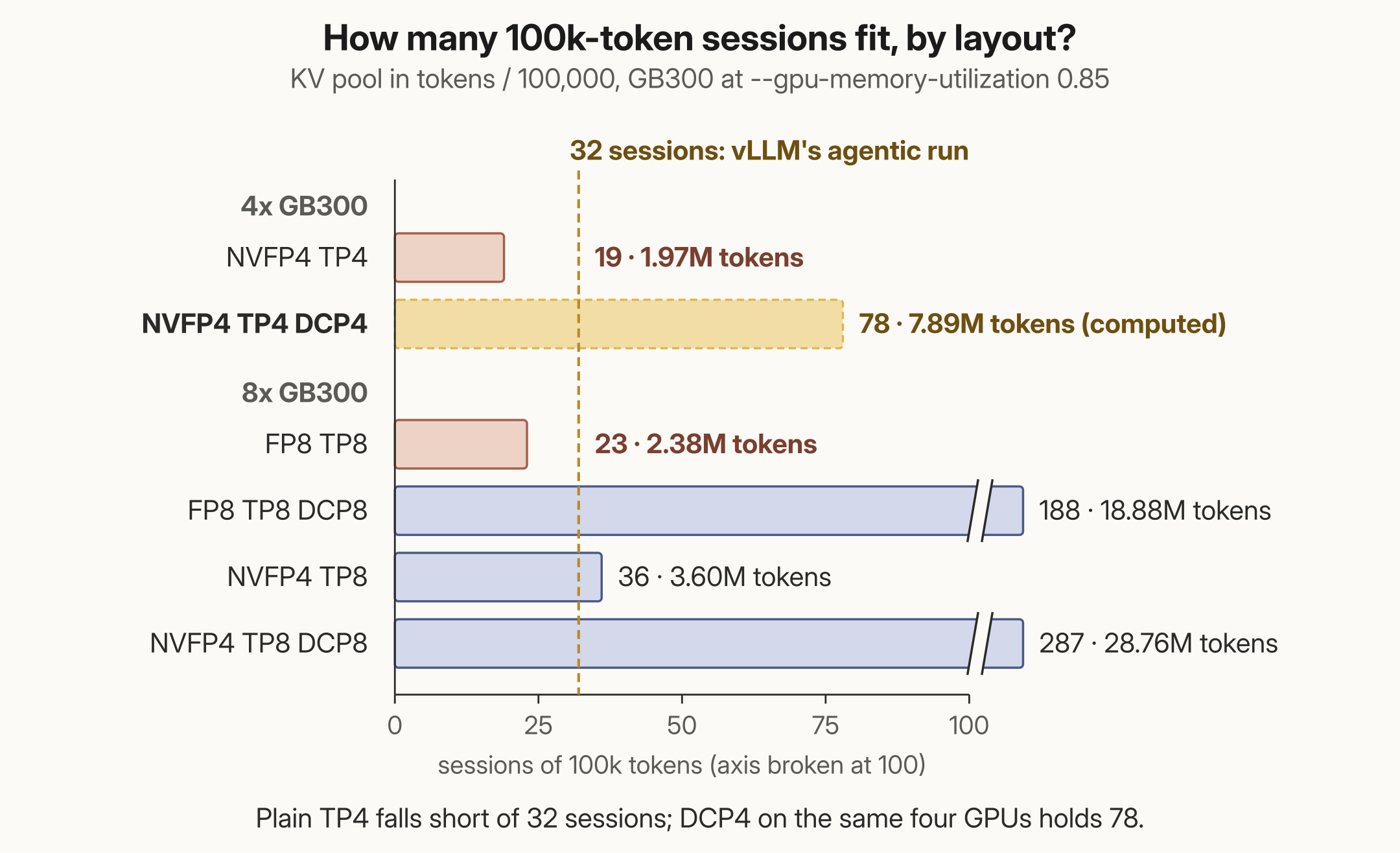
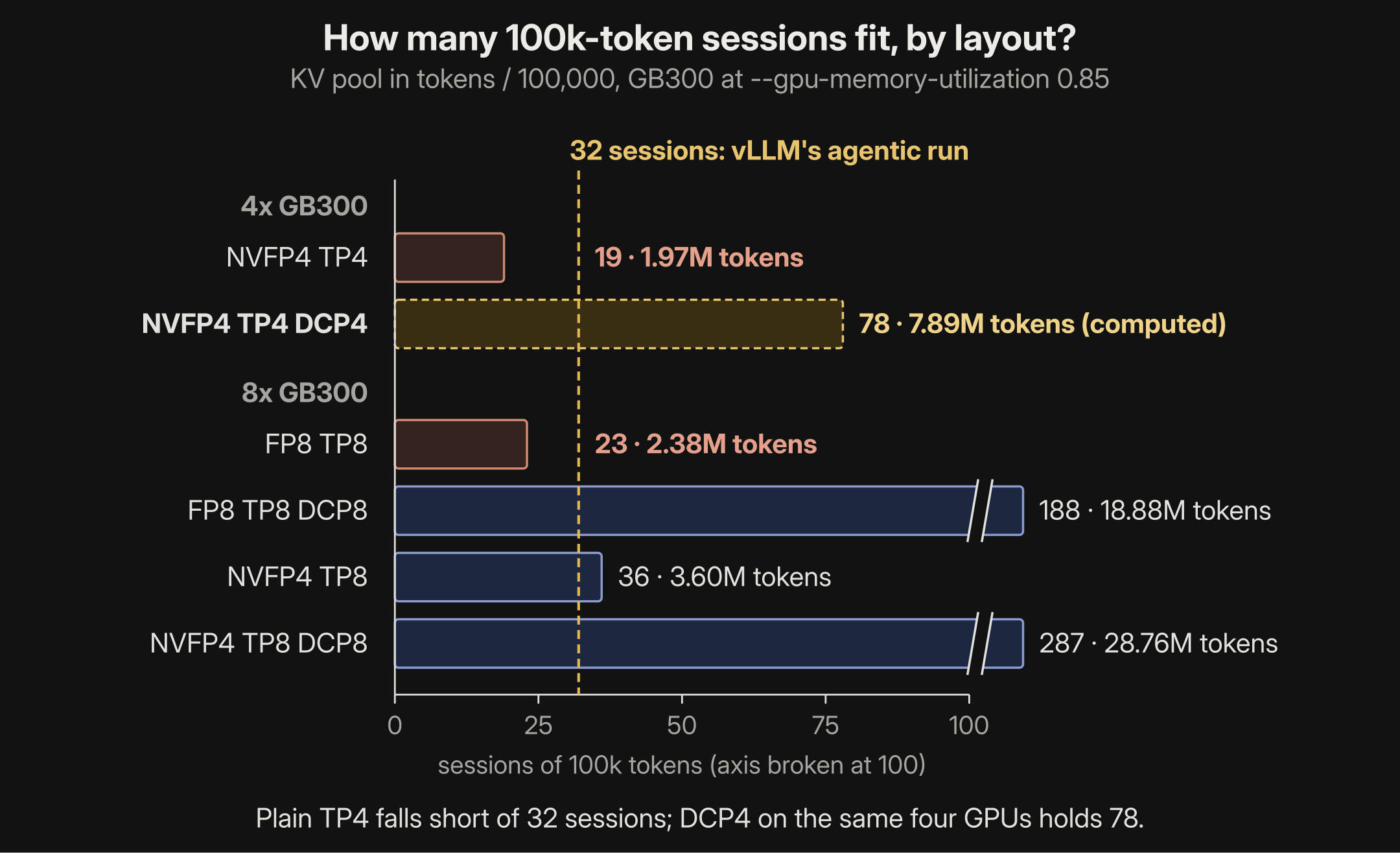
Figure 2: plain TP4 holds 19 sessions of 100k tokens; the same four GPUs with DCP4 hold 78. Capacities are vLLM's for 8x and 4x GB300 at 0.85, except DCP4, computed.
DCP isn't free. On 8x GB300 with NVFP4 and no speculative decoding, DCP8 decoded 25 to 28% slower per token than TP8 at the two points vLLM published (c1 TPOT 11.1 vs 8.7 ms at 8k input, 11.4 vs 9.1 ms at 60k). In its sweeps of up to 128 requests of 8k to 60k input, TP8 delivered more throughput, its 3.6M-token pool "never the bottleneck". That is plain at 8k (128 × 9k is 1.2M tokens); at 60k the pool holds about 59 requests, and the blog doesn't say where that sweep stopped. Don't turn DCP on for headroom you don't use.
The other answer to "out of cache" is a second replica. Two TP4 replicas hold 2 × 19 = 38 sessions of 100k at full decode speed on eight GB300s; one TP4 DCP4 node holds 78 on four, at a decode cost vLLM hasn't published for DCP4. Take DCP when you're short of sessions, not tokens per second.
Two other levers act on different limits:
- P/D splits fix interference, not capacity (Disaggregated Serving covers when they pay). In vLLM's recipe, 1P1D on 4+4 GB300 beats colocated serving on 8 GPUs in output throughput per GPU by 1.8 to 2.2x at 8k input and 4 to 5x at 32k and 60k, because colocated decode shares its steps with prefill chunks. The best 8k results ran prefill as DP4 with expert parallelism. The split adds a second pool to size: in the agentic run the decode node is the one that ran out.
- HiSparse keeps the full latent in pinned host memory and only the working set on the GPU, since each query reads 2,048 tokens. On one GB300 TP4 node with a 440 GiB host pool it admits 8.77M tokens at startup and holds up to 11.25M, against 1.97M on the GPU alone; 440 GiB over the 41,328 latent bytes per token is 11.4M, because the nine readers bind to layer 35's host copy. vLLM rejects HiSparse with DCP (
vllm.py): pick one.
The smallest deployments the engines validated, with the script's weights per GPU:
| Checkpoint | Smallest validated | Engine | Weights per GPU | Pool |
|---|---|---|---|---|
| NVFP4 (610 GB) | 4x GB300, TP4 | vLLM, SGLang | 157.0 GB | 1.97M tokens (vLLM) |
| NVFP4 | 8x B200, TP8 | vLLM | 81.5 GB | not published |
| FP8 (1,061 GB) | 8x GB300 or 8x B300, TP8 | vLLM; SGLang on B300 | 137.8 GB | 2.38M (vLLM, GB300); 2.49M (SGLang, B300) |
| FP8 | 16x H200, TP16 or PP2 × TP8 | vLLM, no performance numbers | 71.9 GB at TP16 | not published |
| FP8 with MXFP4 experts, or AMD's Quark MXFP4 (578 GB) | 4x MI350, TP4 | vLLM on ROCm | not published | not published |
Sources: the vLLM recipe, the SGLang cookbook and the vLLM blog.
Hugging Face's Inference Endpoints recipe runs the FP8 checkpoint on 8x H200 with tensor and expert parallelism and DSpark, and advertises 131K of context and 16 requests at a time; it doesn't publish its flags. 137.8 GB of weights per GPU on a 141 GB H200 leave little or nothing for cache, while 16 full 131K contexts need 98.9 GB per GPU under TP8, or 12.4 GB with DCP8: DCP multiplies what's left by eight, and it is still little. Its published measurements use 1K and 16K prompts. Read 8x H200 as a few long sessions at most, and vLLM's 16 H200s as the floor for real concurrency on Hopper.
The same post's vLLM line, NVFP4 on eight Blackwell GPUs, sets --decode-context-parallel-size 8, --max-num-seqs 16, --max-model-len 131072 and --enforce-eager without saying why. On a GB300 the inequality doesn't ask for DCP (16 × 131K is 2.1M tokens against TP8's 3.6M), and --enforce-eager saves CUDA-graph memory but gives up the breakable graphs vLLM credits with about 6x over eager. Check both against your pool before copying the line.
What "day 0" means in the engines
Both engines shipped a Docker image and an open pull request, not a release.
vLLM ships support in vllm/vllm-openai:mistral-large-4 (ROCm: vllm/vllm-openai-rocm:mistral-large-4). The code is PR #64534, 170 files and 22,757 added lines at head bd4fa26, which its description calls "not meant to be merged as is". Neither v0.32.0 nor v0.33.0 (tag of 1 November, commit 4ba787e, on PyPI; GitHub shows its release entry under v0.33.0rc3) contains vllm/models/mistral_large4. Of the generic parts going upstream, MLA KV sharing (#64095) and DSpark windowed drafts and DSpark under DCP (#63795, #63796) are open; only the all-to-all DCP combine, #61285, merged (13 October). The model runs only on model runner V2, without torch.compile. The launch lines are from the vLLM blog; comments ours:
# NVFP4 on 4 Blackwell GPUs (--tensor-parallel-size 8 on 8)
$ vllm serve mistralai/Mistral-Large-4-1T-A52B-NVFP4 \
    --tensor-parallel-size 4 \
    --speculative-config '{"method": "dspark", "num_speculative_tokens": 3}' \
    --tool-call-parser mistral --enable-auto-tool-choice \
    --reasoning-parser mistral

# FP8 on 8 GPUs; add --decode-context-parallel-size 8 when the inequality says so
$ vllm serve mistralai/Mistral-Large-4-1T-A52B \
    --tensor-parallel-size 8 \
    --speculative-config '{"method": "dspark", "num_speculative_tokens": 3}' \
    --tool-call-parser mistral --enable-auto-tool-choice \
    --reasoning-parser mistral
No KV-cache flag is needed: the port picks fp8_ds_mla from the checkpoint (config.py). The speculative depth is fixed at 3 by the checkpoint.
SGLang ships lmsysorg/sglang:mistral-large-4 and PR #47271, open at 2fefd84; v0.5.23 (tagged 29 October, released on GitHub 2 November) doesn't include it. Its cookbook generates commands for 8x B300 (FP8, TP8) and 4x GB300 (NVFP4, TP4). At startup it rejects prefill CP combined with DCP and --enable-kv-cache-sharding, which can't follow cross-layer sharing.
Pin the image by digest, not by tag, and record the PR head it was built from. When support lands in a release, re-check capacity before you upgrade: the KV-sharing and DSpark allocation code is what is being rewritten upstream, and vLLM has announced a separate draft block pool.
Gotchas
SGLang stores the readers' cache under P/D or HiCache. It drops the nine consumers' latent buffers only without HiCache and P/D, whose host backup and transfer copy every latent layer (kv_cache_configurator.py). Then 72 rows are stored, and the same pool holds about 11% fewer tokens. Size a SGLang P/D deployment with 72 latent layers.
DCP needs the FP8 cache. The vLLM blog says of --decode-context-parallel-size: "It requires the default FP8 KV cache." If you opted out with --kv-cache-dtype bfloat16 for accuracy, you also gave up DCP.
DSpark and DCP don't combine everywhere yet. In vLLM, DSpark doesn't run on a DCP decode node in P/D. Colocated DSpark under DCP8 keeps 0.69x of the capacity at 64k, because draft and target layers share one block pool (kv_cache_planning.py) and each 64-token draft block holds a block ID worth 512 target tokens. SGLang's DCP rejects P/D on DSA models and needs SGLANG_RAGGED_VERIFY_MODE=static with DSpark.
Prefix hits with DSpark need one KV group. NVIDIA's Dynamo recipe runs vLLM with --disable-hybrid-kv-cache-manager: otherwise target and draft layers form two KV cache groups, a prefix hit needs both, and agentic continuations miss.
1M positions, 256K validated. The checkpoint advertises 1,048,576 positions; vLLM and SGLang's PR validated 256K (262,144). Run your own long-context evals before you go higher.
Pipeline stages must keep layer 35 with its readers. Both engines refuse a split between layer 35 and layers 39 to 71 (SGLANG_PP_LAYER_PARTITION=35,37 in SGLang, VLLM_PP_LAYER_PARTITION in vLLM, whose stages must also start on an indexer layer: model.py).
Reasoning can't be turned off. Efforts are low, medium and high (default). With the Transformers chat template, reasoning_effort: "none" silently reasons at high; SGLang returns HTTP 400. Send low instead, as Mistral advises.
Verdict
Compute sessions × average context against the TP pool: under about 80% of it, serve plain TP (DCP8 decoded 25 to 28% slower than TP8); above it, add the smallest DCP that fits, which beats a second replica when you're short of sessions rather than tokens per second (DCP4: 78 sessions of 100k on four GB300s; two TP4 replicas: 38 on eight). Split prefill from decode when long prompts slow decode, and size the decode side with the same inequality. The smallest node is four GB300s with NVFP4 (1.97M tokens, 19 sessions of 100k), four MI350s with MXFP4 experts on ROCm, eight B300s or GB300s with FP8, and sixteen H200s for FP8 on Hopper. Pin the image, because neither engine has released this support yet.
DSpark roughly doubles this model's output throughput at TP8; Speculative Decoding from First Principles shows where that gain comes from and when concurrency erases it.
Sources
- Mistral AI, "Le Chonk: Built for Coders, Trusted by Defenders" (open weights, 2026-10-29).
- Model repos: mistralai/Mistral-Large-4-1T-A52B @
af26e78(2026-11-02), -NVFP4 @bb6d00f(2026-10-29); Mistral-Large-3-675B-Instruct-2512 @383ffea. - vLLM team, "Day 0 support for Mistral Large 4 on vLLM" (2026-10-29); Mistral-Large-4-1T-A52B recipe (read 2026-11-03).
- vLLM PR #64534 at
bd4fa26; releases v0.32.0 (2026-10-18) and v0.33.0 (tag of 1 November, commit4ba787e, on PyPI; GitHub release entry under v0.33.0rc3). - SGLang, Mistral Large 4 cookbook (read 2026-11-03); PR #47271 at
2fefd84; release v0.5.23 (tagged 29 October at297e54fd, released on GitHub 2 November). - NVIDIA, Dynamo recipe: Mistral Large 4 (dev docs, read 2026-11-03); "Inside NVIDIA Blackwell Ultra".
- Hugging Face, "Welcome Le Chonk: Mistral Large 4 on Hugging Face" (2026-10-29), including its Inference Endpoints recipe (8x H200, FP8).