In this series / On this page· 6 of 18
- 1. Disaggregated Serving: Dynamo, llm-d, and When Splitting Prefill from Decode Pays
- 2. TTFT, ITL, Goodput: Measuring What Users Feel
- 3. Benchmark an Inference Server Without Lying to Yourself
- 4. Expert Parallelism, and What DeepEP Does for It
- 5. Serving Kimi K3.1 Pro: The State per Request, the Indexer's Cost, and Where 1M Tokens Fit
- 6. Other Users' Data in the KV Cache: What Cloudflare's GLM-5.3 Incident Teaches Operators
- 7. Flow Control in the Serving Stack: What llm-d, Dynamo and AIBrix Do When the Fleet Is Full
- 8. Context Parallelism for Long-Context Serving: PCP and DCP in vLLM and SGLang
- 9. Several Models, One GPU: Time-Slicing, MPS, MIG, and What CUDA 13.4's Memory Caps Change
- 10. Serving Mistral Large 4: What Its Cache Costs and Where It Fits
- 11. Prefix-Aware Routing Across Replicas: Kubernetes Service, Dynamo's KV Router, the llm-d EPP and Kinference
- 12. Serving Ripple-65B: What a Dense Model with 1M Context Costs, and When It Beats an MoE
- 13. Cost per Million Tokens, Computed: GPU-Hours, Utilization, and the Cache
- 14. Kinference at alpha.7: What Buoyant's Inference Control Plane Does, and What It Reuses
- 15. Splitting Off the Vision Encoder: When Encoder Disaggregation Pays in vLLM
- 16. The Cache Hit That Changed the Answer
- 17. Prefix Caches That Collapse Under Bursts, and the Session Cap That Prevents It
- 18. MLPerf Endpoints v1.0: How to Read an Agentic Inference Benchmark
Other Users' Data in the KV Cache: What Cloudflare's GLM-5.3 Incident Teaches Operators
A KV pool smaller than the context leaked prompts on Workers AI: the two SGLang bugs behind it, and the startup check vLLM enforces.
From 27 August to 9 September, 155 answers from GLM-5.3 on Cloudflare's Workers AI contained pieces of other customers' prompts, each with HTTP 200 and the right prompt_tokens; the only signal an operator could see was speed, an answer that arrived faster than prefill over that many tokens can run. Cloudflare's report and SGLang's, published together on 26 October, explain the mechanism candidly. Read with the upstream history, they show where your protection has to come from: one check on every node, not the release notes.
What happened
- The deployment: GLM-5.3 served by SGLang with prefill and decode on separate GPU pools (disaggregated serving), the KV cache moving between them over RDMA with Mooncake. Advertised context: 1,048,576 tokens. KV pool on the prefill nodes: 681,280 tokens. Cloudflare knew about the gap and expected the engine to return an error for prompts that didn't fit; in its own words, it "only validated HTTP response codes and engine performance at long contexts, without validating model output and coherence."
- The exposure: 27 August (launch) to 9 September. 155 responses affected, all to prompts longer than 681,280 tokens. No sign of deliberate exploitation.
- The report: 8 September, 23:11 UTC, through HackerOne, by Gadi Evron of Knostic. Cloudflare reproduced it with two accounts the next day, took the model private 38 minutes after declaring the incident, had every prefill node on a corrected configuration by 14:52 UTC, and restored the model that evening with an engine patch of its own.
Why a page can hold someone else's data
An engine keeps the KV cache in a pool of fixed-size pages (paged attention). A request gets pages on admission and returns them when it finishes; the next request overwrites them. Nothing zeroes a page in between, a practice Cloudflare calls common among engines and necessary for the best performance. So the engine's bookkeeping is the only thing that keeps request B from reading what request A left. On one machine that bookkeeping is local. In disaggregated serving, a page on the decode GPU is reserved by decode but written by prefill, on another machine, over RDMA: ownership spans two processes that only agree through messages.
Two facts about pool size make that gap easy to open without noticing. SGLang sizes the pool at startup from whatever memory is left after the weights and the CUDA graphs, so it moves with every change of quantization, parallelism or memory fraction; and the context length is a separate setting. How big the KV cache gets is predictable; whether it fits in what's left isn't checked for you.
Bug one: the rejected request that wasn't
SGLang checks a prompt twice. The tokenizer rejects anything longer than the context length with a plain error. The scheduler then checks it against max_req_input_len, derived from whichever is smaller, the pool or the context (max_req_len = min(context_len - 1, kv_capacity - 1) in tp_worker.py, a silent clamp). A prompt between the two limits, here from about 681,280 tokens to 1,048,576, is rejected by the scheduler, and the rejection doesn't stop the request. It shrinks it:
# python/sglang/srt/managers/schedule_batch.py @ v0.5.22 (Req.set_finish_with_abort, lines 2137-2142)
# ... (logs the error, releases multimodal inputs, drops the grammar)
self.origin_input_ids = array(
    "q", [0]
)  # set it to one token to skip the long prefill
self.return_logprob = False
self.logprob_start_len = -1
self.to_finish = FINISH_ABORT(error_msg, status_code, err_type)
The error waits in to_finish while the one-token stub drains through the normal batch machinery. On a single node, the batch finishes and the client gets the error. In disaggregated mode, before the fix, the admission queues on both sides asked whether a request was finished, and to_finish is not finished_reason: the rejected request still looked alive.
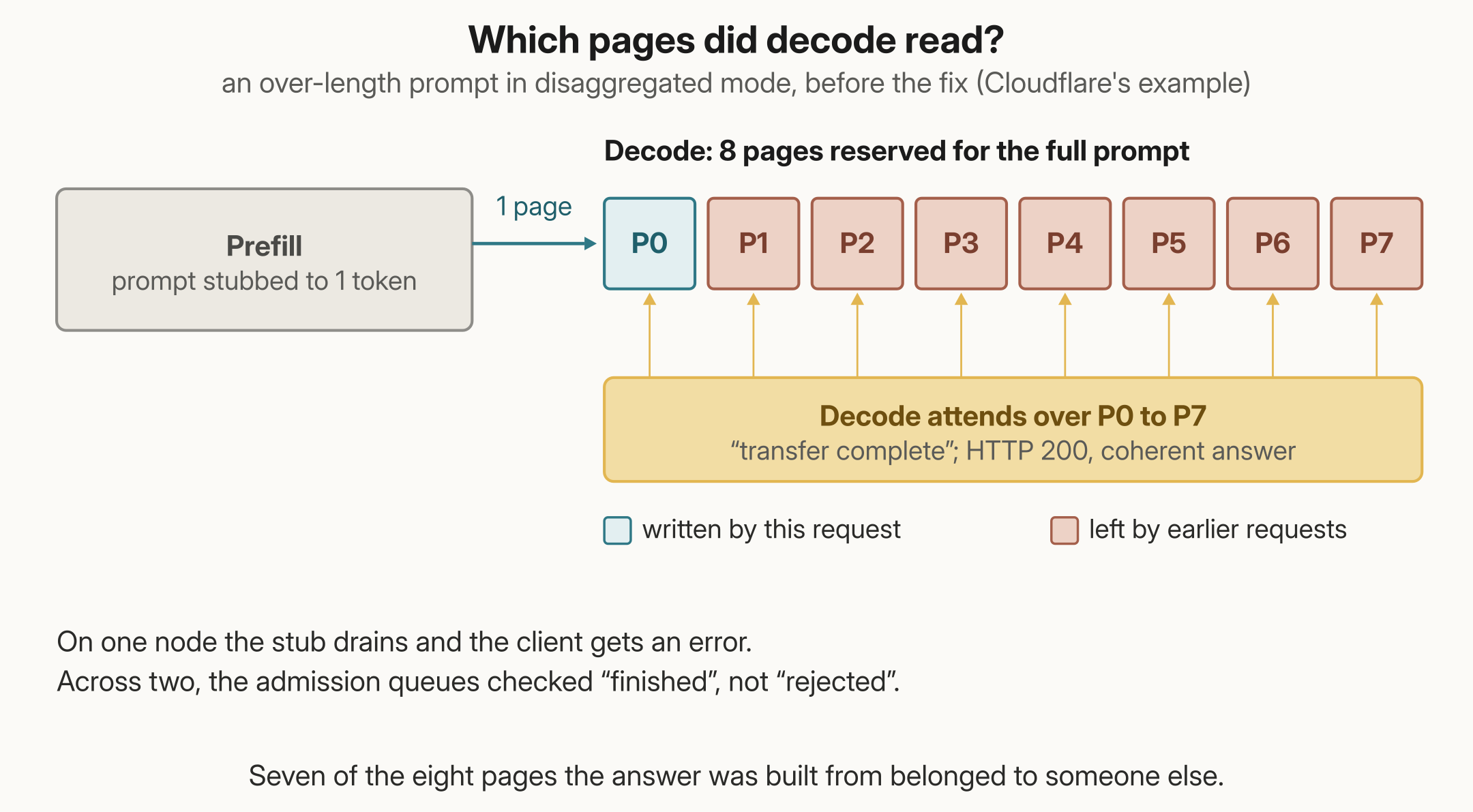
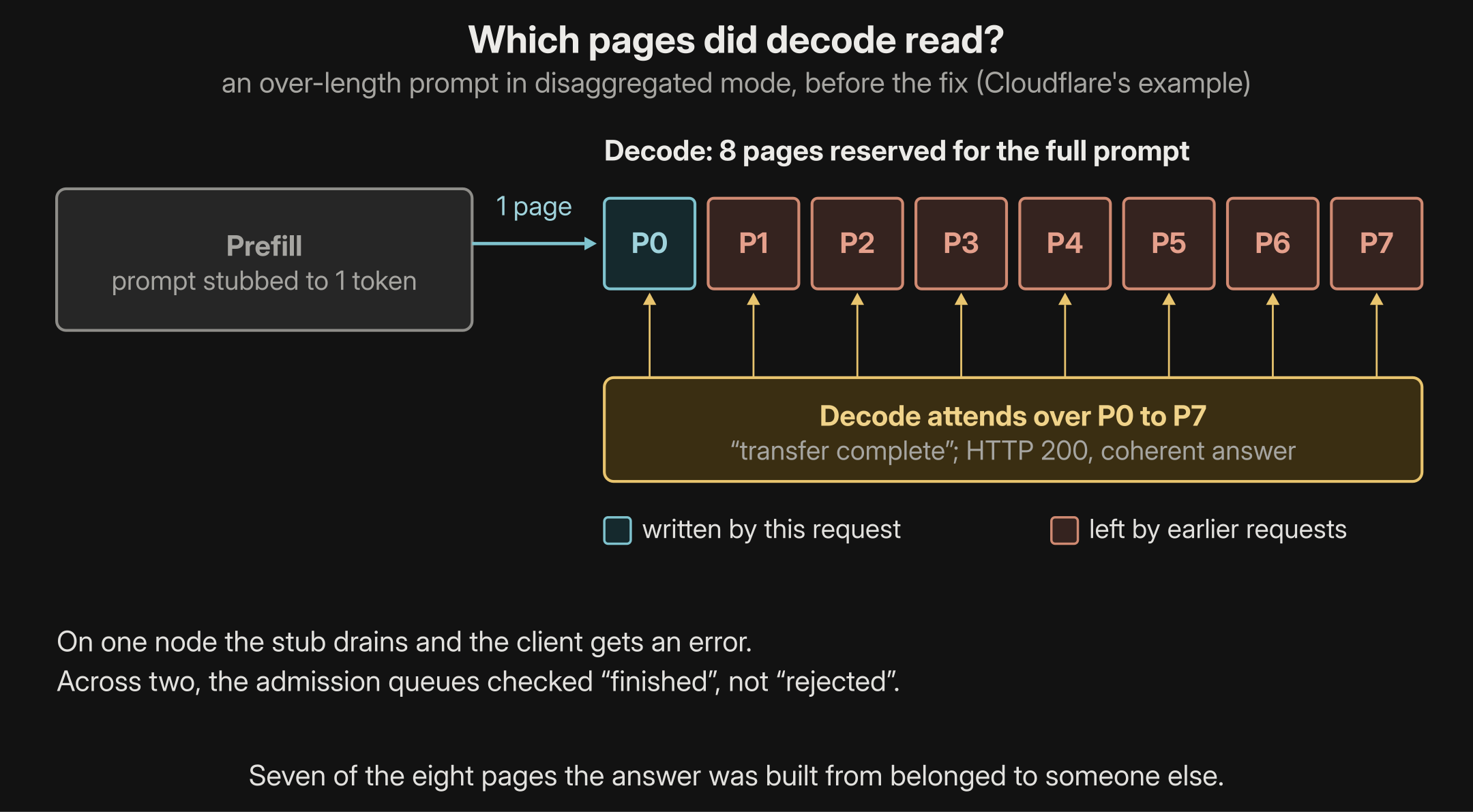 Figure 1: decode reserved pages for the full prompt; prefill computed the one-token stub and wrote one page; decode attended over all eight, seven of them still holding earlier requests' keys and values.
The client got a coherent answer to a prompt the model never read, built partly from other requests' cache, with prompt_tokens equal to the long prompt. Every request over the threshold behaved this way; it was not a race.
Bug two: the distributed use-after-free
An abort can leave writes in flight into pages decode has already given to someone else. Cloudflare had been chasing this second family with the SGLang team for several months; the incident accelerated the work. When a request is aborted mid-transfer (a client disconnect, a timeout, a transport fault), prefill can stop queuing chunks, but it can't recall writes already posted to the network card: RDMA has no call that cancels a posted write, and one-sided writes never notify the receiving CPU. If decode returns the request's pages to the allocator at abort time, the allocator can hand them to request B, and A's late writes land inside B's cache. SGLang calls it what it is: a distributed use-after-free, where the dangling pointer is a write sitting in a network card's queue on another machine.
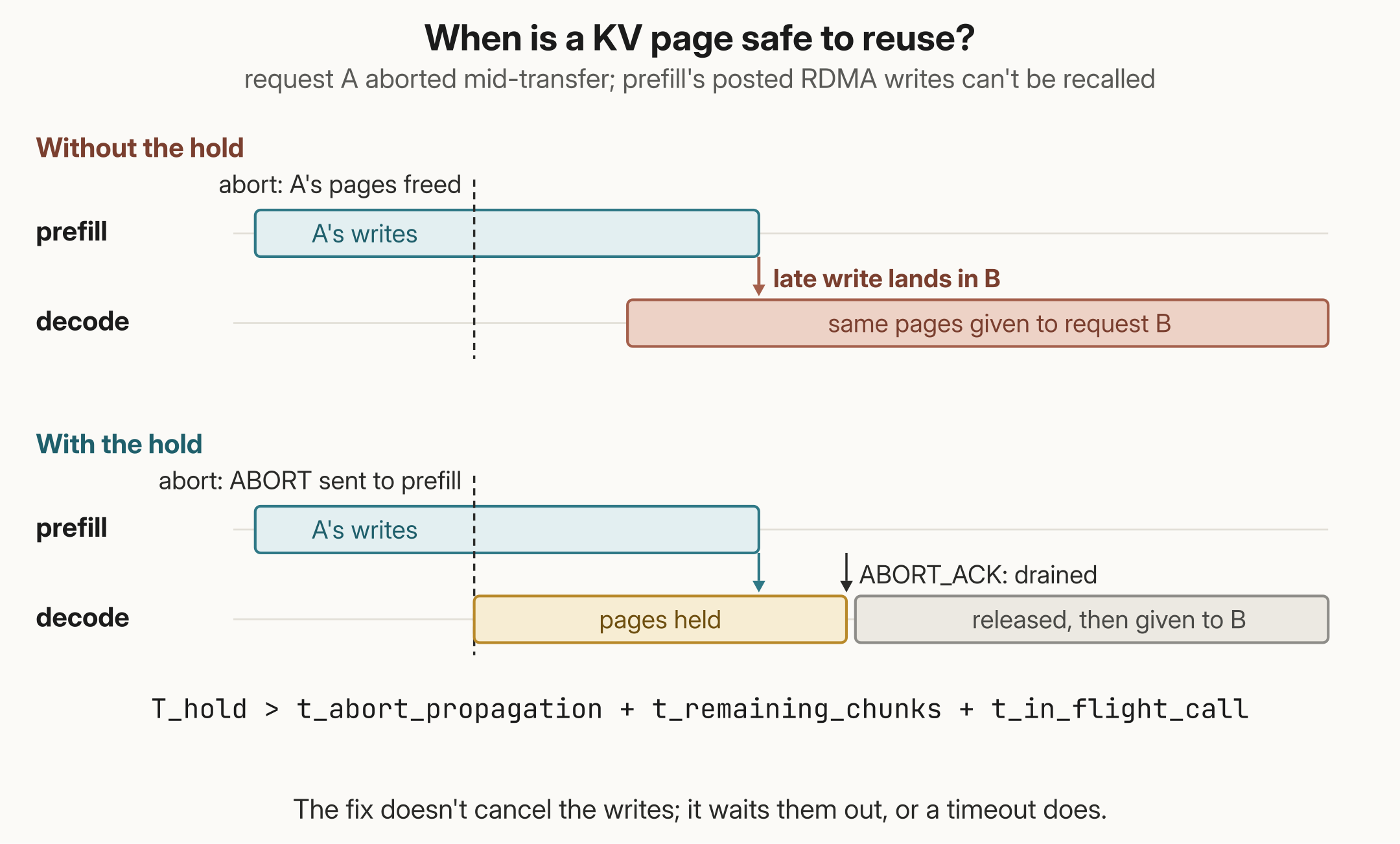
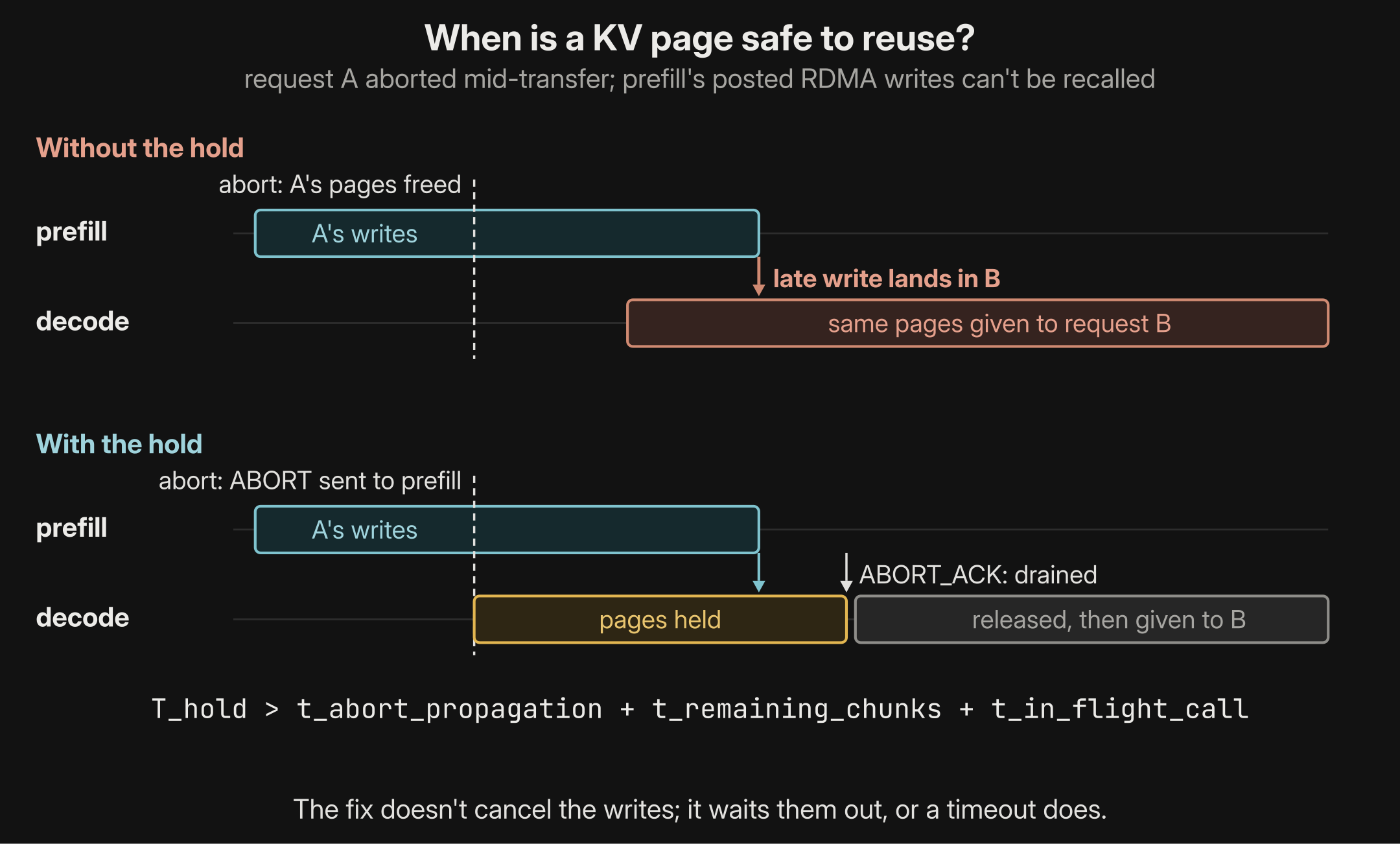 Figure 2: the fix doesn't cancel writes; it waits them out. Decode holds the pages until every prefill rank acknowledges that its writes drained, or a timeout expires.
The rule that makes it safe is an inequality the hold time has to satisfy on every abort path, T_hold > t_abort_propagation + t_remaining_chunks + t_in_flight_call, and the long-context angle is what makes it urgent: an 800,000-token request moved 30 GB in a single Mooncake call in the tests of #32758, so the window during which an abort leaves writes in flight grows from milliseconds to seconds or minutes, exactly where clients time out and disconnect. Deferred release became the default in v0.5.21; SGLang measured no throughput cost (within ±2% over 21 runs on two H100s, one prefill and one decode over Mooncake, 1,024 requests at concurrency 256). An optional checksum (--disaggregation-enable-kv-checksum, Adler-32 computed on the GPU, off by default) catches late writes that land before decode starts.
The upstream story
| Date | Event |
|---|---|
| 6 July | Issue #30233: a user on v0.5.11 with GLM-5.2 and Mooncake reports this mechanism, framed as garbage output rather than a data exposure: a 284,937-token prompt over a 284,928-token pool, aborted, stubbed to one token, one token sent while decode allocated 284,937, and a proposed fix |
| 27 August | GLM-5.3 launches on Workers AI with the gap |
| 8 July | A community fix, #30551 "propagate pre-queue aborts to decode", is opened against the issue; it is reviewed in September and is still open |
| 5 September | Issue #30233 is closed automatically for inactivity |
| 6 September | #36988 merges, "[VLM] Retire aborted disaggregated prefill results": generic cleanup for aborted requests in disaggregated prefill, scoped to malformed vision-encoder results. It retires the aborted request when its prefill result comes back, so decode never commits the one-token handoff; Cloudflare credits it with stopping the exposure |
| 8 September | The researcher's report reaches Cloudflare |
| 9 September | Cloudflare opens #38704 upstream (16:55 UTC), rebuilds the deployment with that patch and a corrected configuration (19:04), and restores the model (19:40) |
| 10 September | Cloudflare and the SGLang maintainers at RadixArk meet and agree on upstream fixes |
| 16 September | #38935 rejects such requests at both admission queues, before any handoff state exists, following the approach of Cloudflare's draft. Its own description, which corrects an earlier version that said otherwise: "a waste-and-latency fix, not a correctness fix. The stale-KV and wrong-status symptoms ... are pre-#36988 and do not reproduce on main" |
| 18 September | v0.5.20 ships #36988 |
| 2 and 19 October | v0.5.21 (admission fix, deferred release on by default, checksum) and v0.5.22 (MORI support, failed Mooncake sends held, release metrics); held failed sends for NIXL and MORI follow in v0.5.23 (29 October) |
The fix at the admission door is a few lines:
# python/sglang/srt/disaggregation/utils.py @ v0.5.22 (lines 1854-1880, docstring omitted)
def is_unadmitted_reject(req: Req) -> bool:
    return is_aborted(req) and not (
        req.is_retracted
        or req.kv.holds_kv
        or req.kv.holds_mamba
        or req.metadata_buffer_index >= 0
        or req.kv.retraction_backup is not None
    )
The check is not just is_aborted(req): a retracted or preempted request comes back through the same door carrying a pending abort while it still owns KV, and must not be retired as if it held nothing.
Two lessons. The mechanism was diagnosed in public seven weeks before launch, but as garbage output, not as one user's data reaching another; nobody, reporter, fix author or maintainers, had connected it to tenant isolation; the issue was closed by a bot while its fix PR waited for review. And the fix that ended the leak was filed as a vision-model cleanup (#36988 was written to stop a scheduler restart on leaked KV), then the hardening shipped in v0.5.20 to v0.5.22 under coordinated disclosure, as it should. Every one of those PRs appears in the release notes under its plain title; none is in the notes' Security section. Reading the Security section would have told you nothing until 26 October.
The same mistake in vLLM and SGLang
We gave both engines Cloudflare's misconfiguration in miniature, on one GPU: Qwen3-0.6B (114,688 bytes of KV per token in BF16), an advertised context of 32,768 tokens, and a KV pool far smaller.
| Engine and setting | Pool | What happened |
|---|---|---|
vLLM 0.32.0, --max-model-len 32768, --kv-cache-memory-bytes 1073741824 |
1.0 GiB, 9,344 tokens usable | Refuses to start: "To serve at least one request with the model's max seq len (32768), (3.5 GiB KV cache is needed, which is larger than the available KV cache memory (1.0 GiB). Based on the available memory, the estimated maximum model length is 9344." |
vLLM 0.32.0, --max-model-len -1, same pool |
9,344 tokens usable | Starts with the context cut to fit ("Auto-fit max_model_len: reduced from 40960 to 9344"); a 12,000-token prompt gets HTTP 400 |
SGLang 0.5.22, --context-length 32768 --max-total-tokens 8192 |
8,192 tokens | Starts. 4,000 tokens: 200. 12,000 tokens, over the pool but under the context: 400, "Input length (12000 tokens) exceeds the maximum allowed length (8186 tokens)". 40,000 tokens: 400 from the tokenizer's context check |
Measured 28 October 2026 on an NVIDIA GB10 (128 GB unified memory), one engine at a time; script scripts/gx10/kv-pool-check.sh. Single node only: the disaggregated path needs two GPUs with RDMA, so its behavior here is from the source.
vLLM checks the condition that would have stopped this at startup and names the largest length that would fit (_check_enough_kv_cache_memory at v0.32.0). The check runs in every instance, with or without a KV connector, so a prefill node configured like Cloudflare's would not have come up, whether the context is set or left to the model's default. The one way around it is --max-model-len -1: vLLM then fits the context to the pool and starts with the smaller value. SGLang starts, clamps the limit through the min() above, and enforces it per request. The 12,000-token rejection came from exactly the path of bug one: the scheduler's validate_input_length fails, set_finish_with_abort stubs the request to one token, and the error waits in to_finish. On a single node that path ends in a clean 400; in disaggregated mode before the fix, it ended in the leak.
You can run the same check on your own nodes. SGLang prints both numbers on one startup line (scheduler.py at v0.5.22); this is ours:
$ python3 -m sglang.launch_server --model-path Qwen/Qwen3-0.6B \
    --context-length 32768 --max-total-tokens 8192 --mem-fraction-static 0.30
...
[2026-10-28 07:57:41] max_total_num_tokens=8192, chunked_prefill_size=8192, max_prefill_tokens=16384, max_running_requests=2048, context_len=32768, available_gpu_mem=105.96 GB
The deployment check fails when max_total_num_tokens is smaller than context_len, on any prefill or decode node. The scheduler's own limit is a few tokens lower still: max_req_input_len is the smaller of the two minus one, minus five (tp_worker.py), hence the 8,186 in the error.
The startup check covers bug one's trigger, not bug two. SGLang's maintainers note that the abort race applies to any engine that moves KV with asynchronous RDMA, push or pull. vLLM's default NIXL transfer is pull-based (0.32.0 also ships a push connector), and under pull the hazard sits at both ends: prefill's source blocks must stay put until decode's reads complete, and decode must not hand its destination blocks to another request while its own reads are still posted. vLLM covers the first with a lease: prefill holds the blocks until decode reports done or kv_lease_duration (30 seconds) expires; failed loads follow kv_load_failure_policy (default fail). We have not traced how it handles the second on abort. We found no transfer checksum in vLLM.
The neighboring tenant-isolation problem is prefix caching, where the risk is a side channel rather than a bug; Prefix Caching covers vLLM's per-tenant cache_salt, which isolates tenants only if each gets its own salt.
Checklist
For disaggregated SGLang, from both posts:
- Prove the pool holds the context, on every prefill and decode node, from the startup log (
max_total_num_tokens), after every change to weights, quantization, parallelism or memory fraction. If it doesn't, lower the context. - Run v0.5.23 (v0.5.22 is enough on Mooncake; on NIXL or MORI, failed sends are held only from #45973, in v0.5.23, out on 29 October), and upgrade prefill and decode together: mixed acknowledgment formats fall back to the timeout on every abort. There are no backports to older branches. If you can't upgrade yet: on v0.5.19 and v0.5.20, set
SGLANG_DISAGGREGATION_DEFERRED_DECODE_KV_RELEASE=1on both roles (and on v0.5.20,SGLANG_MOONCAKE_MAX_TRANSFER_BATCH_INDICESand a 60 to 120 sSGLANG_DISAGGREGATION_DEFERRED_DECODE_KV_RELEASE_TIMEOUT); it covers decode-initiated aborts only. - Keep deferred release on (default since v0.5.21), bound Mooncake batches (
SGLANG_MOONCAKE_MAX_TRANSFER_BATCH_INDICES) for very long contexts, and watchsglang:decode_deferred_kv_release_total{outcome}: most holds should enddrained, nottimeout. - Turn on
--disaggregation-enable-kv-checksumon both roles where your model supports it (not yet GLM 5.3, GLM 5.3 Flash or DeepSeek V4, per Cloudflare). The checksum costs an extra GPU read of the KV per transfer, so measure it, then check the logs to confirm requests are verified. - Run a router that cancels both halves of a request (sgl-router's PD mode), and don't let the load balancer abort on client disconnect before the first token.
- Test long contexts on content, not status codes. Put a canary string in the prompt and check the answer uses it.
For vLLM P/D:
- Don't pass
--max-model-len -1on P/D instances unless your gateway reads the context back from the engine; with a fixed or default value, the startup check refuses a pool that can't hold it. - Size the NIXL lease (
kv_lease_durationinkv_connector_extra_config) for how fast prefill should reclaim blocks after decode stops heartbeating; heartbeats renew it during a transfer. Leavekv_load_failure_policyatfailunless you have measuredrecompute. - Test long contexts on content with a canary, as above: there is no transfer checksum to catch a bad handoff.
Gotchas
--max-model-len -1 moves the gap to your gateway. vLLM then fits the context to the pool and starts; the gateway must advertise what the engine reports, or a proxy promises what the engine can't hold.
A 200 is not a pass. Cloudflare's pre-launch tests returned 200s at long context and nobody read the answers. A response faster than its prefill should take is a bug report.
Pool size is an output, not a setting. It changes when anything else in the deployment changes. A check that ran at launch is stale after the next quantization.
The fix can arrive without its name. The PR that closed this leak was titled [VLM] Retire aborted disaggregated prefill results. Track the bug class (issues mentioning abort, KV transfer, stale pages), not only the release notes.
Isolation in the engine is bookkeeping. Pages aren't zeroed (a draft PR from Cloudflare, #46435, would make it optional), and Cloudflare's page-tag check, which cost under 1% of throughput and tail latency on GLM 5.2 (August post), was disabled for reliability. Until one of those ships by default, every ownership bug is a potential leak.
Verdict
The leak took two failures. The engine's had been diagnosed in public in July and was already closed on main by the time the researcher wrote in. The one that made it reachable was a known gap between pool and context, trusted to the engine and tested by status code only, as Cloudflare's report says itself. If you run disaggregated SGLang, upgrade to v0.5.23 (v0.5.22 is enough on Mooncake) and turn on the checksum where your model supports it, but the control that would have prevented this incident is a line in your deployment check: pool size on every node, compared to the context you advertise. vLLM runs that comparison at startup and refuses to boot when the pool is short, unless you ask it to shrink the context with -1; SGLang logs both numbers on one line, clamps without a warning, and leaves the comparison to you.
Next: Prefix Caching, for the other way tenants can learn about each other's prompts, and Disaggregated Serving, for when splitting prefill from decode is worth the extra moving parts.
Related reading
- How an LLM Request Becomes TokensPrefix Caching: When It Pays and How to Design Prompts for ItExplainer
- Inference EnginesvLLM 0.34: Three Changes to Re-check Before You UpgradeGuide
- The GPU for Inference EngineersMegakernels for Decode: What a Kernel Boundary Costs, and When Fusing a Layer PaysDeep dive