In this series / On this page· 18 of 18
- 1. Disaggregated Serving: Dynamo, llm-d, and When Splitting Prefill from Decode Pays
- 2. TTFT, ITL, Goodput: Measuring What Users Feel
- 3. Benchmark an Inference Server Without Lying to Yourself
- 4. Expert Parallelism, and What DeepEP Does for It
- 5. Serving Kimi K3.1 Pro: The State per Request, the Indexer's Cost, and Where 1M Tokens Fit
- 6. Other Users' Data in the KV Cache: What Cloudflare's GLM-5.3 Incident Teaches Operators
- 7. Flow Control in the Serving Stack: What llm-d, Dynamo and AIBrix Do When the Fleet Is Full
- 8. Context Parallelism for Long-Context Serving: PCP and DCP in vLLM and SGLang
- 9. Several Models, One GPU: Time-Slicing, MPS, MIG, and What CUDA 13.4's Memory Caps Change
- 10. Serving Mistral Large 4: What Its Cache Costs and Where It Fits
- 11. Prefix-Aware Routing Across Replicas: Kubernetes Service, Dynamo's KV Router, the llm-d EPP and Kinference
- 12. Serving Ripple-65B: What a Dense Model with 1M Context Costs, and When It Beats an MoE
- 13. Cost per Million Tokens, Computed: GPU-Hours, Utilization, and the Cache
- 14. Kinference at alpha.7: What Buoyant's Inference Control Plane Does, and What It Reuses
- 15. Splitting Off the Vision Encoder: When Encoder Disaggregation Pays in vLLM
- 16. The Cache Hit That Changed the Answer
- 17. Prefix Caches That Collapse Under Bursts, and the Session Cap That Prevents It
- 18. MLPerf Endpoints v1.0: How to Read an Agentic Inference Benchmark
MLPerf Endpoints v1.0: How to Read an Agentic Inference Benchmark
MLPerf Endpoints replays agent conversations and plots throughput against interactivity: what each metric counts, and why NVIDIA's 10x is 3x on its official run.
NVIDIA says Vera Rubin NVL72 serves Kimi K3 at more than 10 times the throughput per kilowatt of GB300 NVL72 on MLPerf Endpoints v1.0. NVIDIA's own official Vera Rubin result on the same benchmark gives 3 times. Both numbers follow the rules. The difference is which points you compare, and the board shows you all of them.
What the benchmark sends
MLPerf Endpoints tests a serving endpoint, not a chip. A reference client talks to an OpenAI-compatible API and measures what comes back; whatever sits behind the endpoint (engine, router, disaggregated prefill and decode, prefix caches) is part of the system under test. The client is open source (mlcommons/endpoints).
The official agentic dataset holds 613 conversations, replayed one or more full times per run: 113 coding trajectories from the DeepSWE dataset and 500 enterprise workflow traces from Workato (dataset page), which Workato describes as "synthetic but modeled on Workato's real-world experience running these agents for enterprise customers". Each conversation alternates model turns, tool calls and tool results, and the client waits each trace's recorded tool delay before sending the next turn. Contexts grow long: in NVIDIA's analysis of the 230 trajectories with more than 10 model responses, the median context goes from about 30,000 tokens at the first response to about 200,000 by response 300.
With contexts that long, a turn the server can't serve from cache is mostly prefill, so prefix caching carries these results, and the benchmark rules how much it may help. The client adds a short salt to the prompts, so reuse is "fully allowed within a trajectory", the system prompt may be reused within one pass over the dataset, and nothing carries over between passes (example README). A system can't win by caching the whole dataset on the first pass and replaying it.
What each number counts
Every published point carries the same metrics (TTFT and interactivity, defined). Here is what each one includes, from the client's code:
| Metric | What it counts | What it leaves out |
|---|---|---|
| System TPS | Output tokens per second over the measured window, for the whole system | Input tokens; prefill shows up only as lost time |
| E2E average interactivity | Output tokens divided by the summed latency of every turn, measured by the client from send to last token | Tool delays: the client waits those between turns, outside the clock |
| TPS per user | System TPS divided by concurrency | Anything per request: it is an average over slots |
| TTFT P90 | Time to first token, 90th percentile | What happens after the first token |
| Power | The system's provisioned kilowatts, scaled by the share of nodes engaged at that point; sometimes an MLCommons estimate ("MLC Estimated Power") | What the system drew: nothing is metered during the run |
Two traps sit in that table. Interactivity and TPS per user are different numbers. Interactivity counts the time each turn is in flight, queueing and prefill included; TPS per user spreads the same output over every conversation slot, including the time each conversation waits on its tool delays. At Vera Rubin's headline point, interactivity is 50.4 tokens per second and TPS per user is 40.4. And power is provisioned, per point: the client's validation scales the system's provisioned power by the share of its nodes a point engages (submission.py). NVIDIA's GB300 submission shows 90 kW at some concurrencies and 60 kW, two thirds of it, at others, so throughput per kilowatt can jump between neighboring points of one curve. Nothing is metered during the run: a per-kilowatt ratio compares two declared or estimated figures, so check that both sides used the same method before you trust the quotient.
A result is a curve, not a number. Each submission runs 7 to 32 fixed concurrency levels, at least 600 seconds each, and 2,400 seconds above a concurrency of 32 for the agentic workload (MLCommons; the reference repo's validation rules). Four of the points must fall in mandatory regions spread across the submitter's own range, from a concurrency of 32 or less up to its maximum, so a system can't publish only the point it likes best. Plotted, the curve trades throughput (more concurrent conversations) against interactivity (faster answers for each one); the figure below plots three of them.
Every point also passes accuracy gates. The client matches each completed model turn against the expected turn recorded in the dataset (the README calls it inline accuracy), and checks that the mean output length per turn over the run stays within a band; every point must pass both. On top, 200 pinned SWE-bench Verified tasks are scored once in each of the four mandatory regions, and the mean of the four must clear its threshold. Each threshold sits just below the score of the reference run, shown in parentheses:
| Model | Inline accuracy | Mean output tokens per turn | SWE-bench Verified, 200 pinned tasks |
|---|---|---|---|
| Kimi K3 | ≥ 58.32% (58.9%) | 425 to 520 (472) | ≥ 93.5% (94.83%) |
| Qwen3.6-35B-A3B | ≥ 55.86% (56.43%) | 344 to 422 (383) | ≥ 69% (71.7%) |
| DeepSeek-V4.1-Flash | ≥ 52.36% (53.16%) | 793 to 970 (882) | ≥ 96.4% (97.5%) |
A system that speeds up by quantizing too hard, or by cutting answers short, fails the point. That gate is the main thing MLPerf Endpoints adds over a plain load test.
Reading a headline: 10x or 3x
NVIDIA's claim compares the best throughput per kilowatt each system reaches while keeping interactivity at 50 tokens per second or more (NVIDIA, footnotes 1 and 2). The two points it picks, from the results published on endpoints.mlcommons.org:
- Vera Rubin NVL72, provisional (32 GPUs, TensorRT-LLM with Dynamo, published 9 November): 1,024 concurrent conversations, 41,414 tokens per second, interactivity 50.4, 100.89 kW, so 410.5 tokens per second per kW.
- GB300 NVL72, official (48 GPUs, TensorRT-LLM with Dynamo, published 4 November): 48 concurrent conversations, 2,210 tokens per second, interactivity 56.2, 60 kW, so 36.8 per kW.
The ratio is 11.2. But the board holds a third curve: NVIDIA's official Vera Rubin result, submitted on 16 October and published on 4 November, alongside the GB300 one. Its best point at 50 or more is 256 conversations, 11,260 tokens per second, interactivity 55.2, at the same 100.89 kW: 111.6 per kW, 3.0 times GB300. At 1,024 conversations, that official run reached 23,261 tokens per second with interactivity down to 27.1.
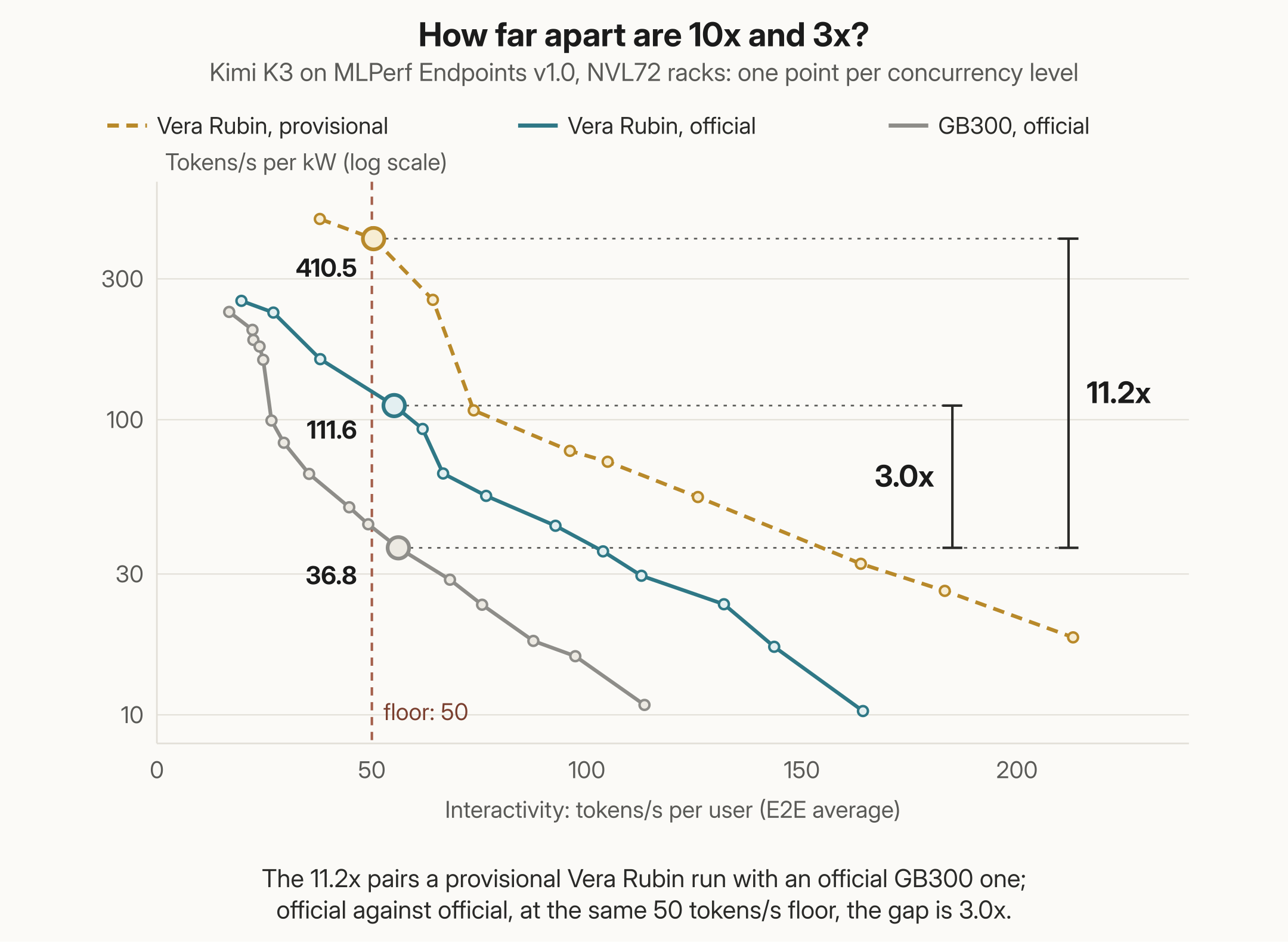
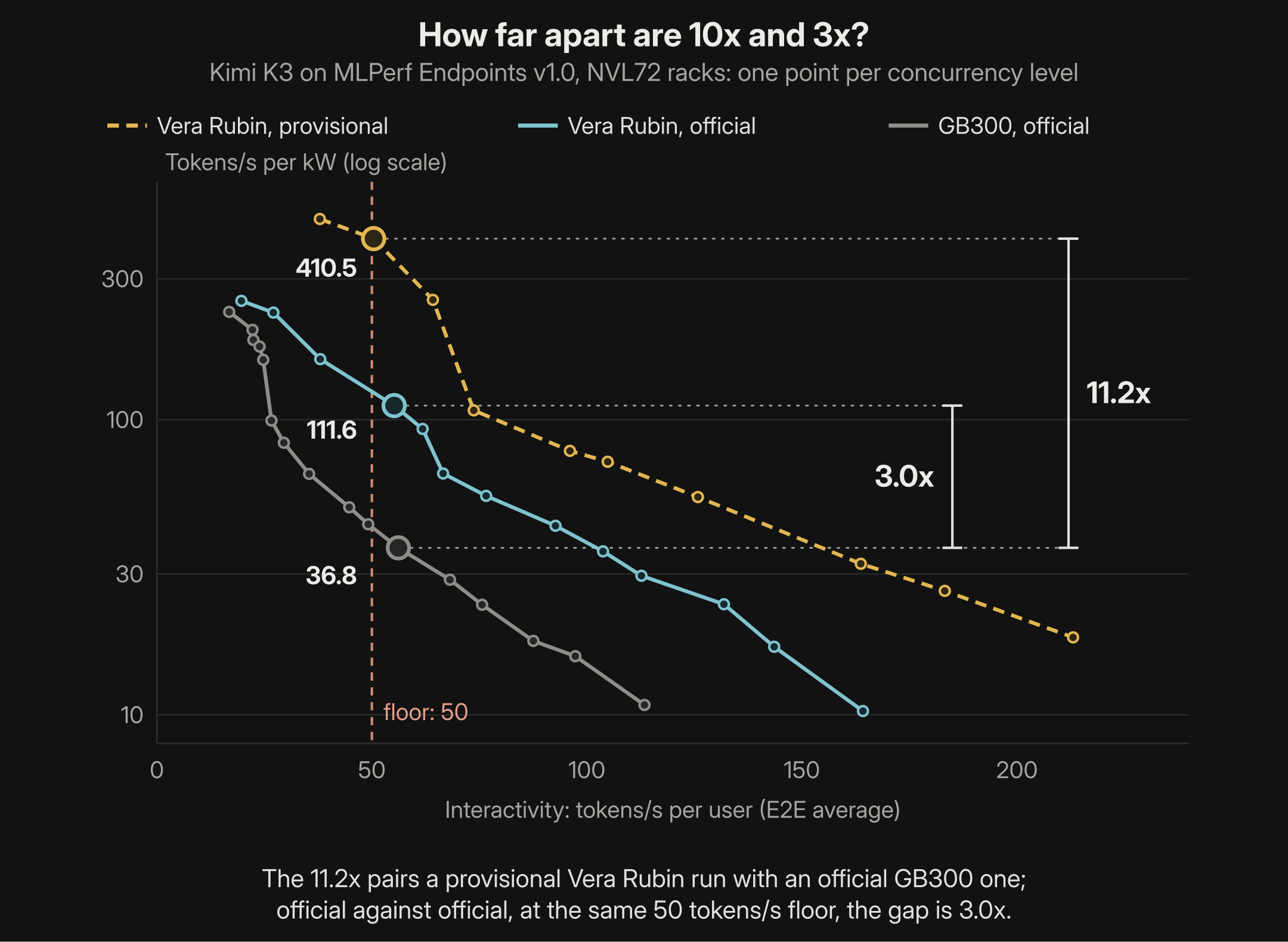
Same chip, two submissions: the ratio depends on which Vera Rubin curve you pick.
Same chip, same model, same benchmark: the provisional run, submitted three weeks later, gets 1.8 times the throughput of the official one at 1,024 conversations, with nearly twice the interactivity. The difference is the submission, its software and its configuration, not the hardware. NVIDIA's post lists the software work (context-aware routing in Dynamo, disaggregated prefill and decode, model-specific kernels, multi-token prediction) without separating what changed between the two runs.
The floor matters as much as the curves. Near it the curves are steep, so a few tokens per second move the ratio a lot: raise the floor from 50 to 55 and the provisional point at 1,024 conversations drops out, Vera Rubin's best provisional point becomes 254.6 per kW at 512 conversations, and the ratio falls from 11.2 to 6.9. The official ratio stays at 3.0. The other two headlines need the same reading. The DeepSeek-V4.1-Flash "9x" compares a provisional run on 24 Vera Rubin GPUs, 1,408 conversations and 75.67 kW, with an official one on 4 GB300 GPUs, 16 conversations and 7.50 kW; the Qwen3.6-35B-A3B "5x" compares a provisional point at 320 conversations with an official one at 36. Per-kilowatt normalization makes the system sizes comparable; it doesn't fix the choice of points. NVIDIA's official 4-GPU Vera Rubin results for both models were published on 18 November, two days after its post. Official against official, at the same floors, they give 3.0 times GB300 on Qwen3.6-35B-A3B and 1.3 times on DeepSeek-V4.1-Flash.
None of this makes NVIDIA's numbers wrong. The provisional result may well pass review. It makes the ratio a choice of two points, and the benchmark publishes everything you need to choose your own: pick the interactivity your users need, then compare each system's best official point above it.
Labels that change the meaning
- Official or Provisional. Provisional means "pending MLCommons Association verification, results are subject to change pending peer review". Of the 20 agentic submissions published by 20 November, 12 are official and 8 provisional.
- Available, Preview or RDI. The availability of the system: Available, Preview, or RDI (research, development and internal). A Preview or RDI system is not something you can order today.
- Division and deployment. Every agentic result so far is in the Standardized division, where "results use the same model and rules, so they compare directly", and every one is Available, with the client run on premises (the board's other option is "Client over Network").
- MLC Estimated Power. The power figure was estimated by MLCommons rather than declared by the submitter. Google's and Microsoft's GB300 points for Kimi K3 carry it; NVIDIA's don't. Comparing across submitters mixes the two.
Not the only agent benchmark. SemiAnalysis's InferenceX AgentX also replays multi-turn agent sessions against serving stacks: 393 sessions shaped after opt-in Claude Code traces, with subagent branches and contexts up to 1M tokens, and it compares systems along the same throughput-interactivity curve. Its payloads are synthetic tokens that keep the shape of each request but not its content, so, in its own words, it "cannot tell whether the model wrote correct code". MLPerf replays the conversations' full text (synthetic for the Workato workflows, as Workato says), gates every point on accuracy and has results peer reviewed before they turn official. Use AgentX for subagent-heavy coding traffic and frequent independent runs, MLPerf for results that also had to stay correct.
Run it yourself
The client runs against any OpenAI-compatible server. For the Qwen3.6-35B-A3B agentic example, at commit 8b6069c of the repository:
Start the server with the README's reference SGLang command:
sglang serve \
  --model-path Qwen/Qwen3.6-35B-A3B \
  --served-model-name Qwen/Qwen3.6-35B-A3B \
  --port 30000 \
  --host 0.0.0.0 \
  --tool-call-parser qwen3_coder \
  --reasoning-parser qwen3 \
  --weight-loader-prefetch-checkpoints \
  --mem-fraction-static 0.95
Then run the client:
git clone https://github.com/mlcommons/endpoints.git
cd endpoints
uv sync
CONFIG=examples/10_Agentic_Inference/qwen_agentic_benchmark.yaml
uv run inference-endpoint benchmark from-config --config "$CONFIG"              # performance and inline accuracy
uv run inference-endpoint benchmark from-config --config "$CONFIG" --mode both  # plus SWE-bench
Before the first run, download the official dataset (the README links it, with its SHA-256) to the path the config expects, and set the model name and endpoint URL in the YAML. The SWE-bench part needs a separate evaluation service with Docker, described in the same README. Two things to know before you start. The example config sends all 613 conversations with a cap of 10 hours per run, and each point of a curve is a run of its own, so a curve of seven points can take days on one machine. And a run of your own is a load test with MLPerf's workload, not an MLPerf result: only reviewed submissions carry the name. What it gives you is a realistic agentic workload, with honest prefix-cache rules and an accuracy check, to compare two configurations of your own stack.
Verdict
MLPerf Endpoints is the agent-serving benchmark to read when correctness matters: every point passed accuracy gates, the cache rule keeps reuse honest, and the whole curve is public, so you can pick your own comparison. Read it point by point. Fix the interactivity your users need, take each system's official points above it, check whose power figure is declared and whose estimated, and treat any single headline ratio, NVIDIA's 10x included, as one choice among the points the board already shows.
To apply the same discipline to your own server, start with Benchmark an Inference Server Without Lying to Yourself; to turn a tokens-per-kilowatt point into a price, Cost per Million Tokens, Computed.
Sources
- MLPerf Endpoints results, endpoints.mlcommons.org, read on 20 November 2026; benchmark page; dataset page.
- MLCommons reference client, mlcommons/endpoints at commit 8b6069c (14 November 2026, UTC): agentic example README,
metrics/report.py. - NVIDIA, Vera Rubin NVL72 Leads Agentic Inference Performance on MLPerf Endpoints v1.0, 16 November 2026.
- Workato, announcement of its MLPerf workflow traces, BusinessWire, 8 July 2026.
- SemiAnalysis, Agentic Benchmark for LLM Inference: Metrics and Methodology (AgentX v1.0).
Related reading
- How an LLM Request Becomes TokensPrefix Caching: When It Pays and How to Design Prompts for ItExplainer
- Inference EnginesEngines Built for a Few Models: What Coding Agents Changed, and What to TrustDeep dive
- Inference EnginesvLLM, SGLang and DeepInfer: What "Matches the Vendor's Engine" MeansDeep dive