In this series / On this page· 14 of 18
- 1. Disaggregated Serving: Dynamo, llm-d, and When Splitting Prefill from Decode Pays
- 2. TTFT, ITL, Goodput: Measuring What Users Feel
- 3. Benchmark an Inference Server Without Lying to Yourself
- 4. Expert Parallelism, and What DeepEP Does for It
- 5. Serving Kimi K3.1 Pro: The State per Request, the Indexer's Cost, and Where 1M Tokens Fit
- 6. Other Users' Data in the KV Cache: What Cloudflare's GLM-5.3 Incident Teaches Operators
- 7. Flow Control in the Serving Stack: What llm-d, Dynamo and AIBrix Do When the Fleet Is Full
- 8. Context Parallelism for Long-Context Serving: PCP and DCP in vLLM and SGLang
- 9. Several Models, One GPU: Time-Slicing, MPS, MIG, and What CUDA 13.4's Memory Caps Change
- 10. Serving Mistral Large 4: What Its Cache Costs and Where It Fits
- 11. Prefix-Aware Routing Across Replicas: Kubernetes Service, Dynamo's KV Router, the llm-d EPP and Kinference
- 12. Serving Ripple-65B: What a Dense Model with 1M Context Costs, and When It Beats an MoE
- 13. Cost per Million Tokens, Computed: GPU-Hours, Utilization, and the Cache
- 14. Kinference at alpha.7: What Buoyant's Inference Control Plane Does, and What It Reuses
- 15. Splitting Off the Vision Encoder: When Encoder Disaggregation Pays in vLLM
- 16. The Cache Hit That Changed the Answer
- 17. Prefix Caches That Collapse Under Bursts, and the Session Cap That Prevents It
- 18. MLPerf Endpoints v1.0: How to Read an Agentic Inference Benchmark
Kinference at alpha.7: What Buoyant's Inference Control Plane Does, and What It Reuses
Kinference's picker, KV index and policies, read at alpha.7 and run on two vLLM replicas: what works today, what it borrows from Dynamo.
Kinference's launch shows three YAML policies: send easy prompts to a cheaper model, keep PII inside the cluster, burst to a cloud provider when the GPUs are busy. At v0.1.0-alpha.7 the Kubernetes API server refuses the first, the second sends every prompt to the provider whenever one resolves, because its PII tag never arrives, and the third works only with OpenAI-format providers. What does work is the part the launch spends least time on: a cache-aware picker built on Dynamo's KV index, which we ran on two vLLM replicas and caught both choosing right and predicting hits the engine did not have.
Kinference in four lines
- A picker and a policy engine behind a gateway. One Rust Deployment (router, fleet, controller) that Buoyant's gateway asks "which endpoint?" for every request, over its own gRPC service
kinference.v1.Picker(kinference.protoL54-L63). Not an engine, not a pod scheduler, not an autoscaler. - Dynamo's KV index inside. The cache index is Dynamo's
dynamo-kv-routercrate, pulled as a git dependency at a pinned Dynamo commit (Cargo.tomlL39). The README says so; neither launch post does. - Not a Gateway API Inference Extension endpoint picker. It speaks neither GAIE's ext_proc endpoint-picker protocol nor its
InferencePool(it has its own CRD of the same name), so it does not drop into an llm-d or Dynamo EPP gateway. - Alpha, in practice. Tags only (alpha.5 to alpha.7, no GitHub release), and a getting-started page that lists token rate limits and semantic classification, which the code does not have. On 10 November 2026,
v0.1.0-alpha.7(4 November) is still the newest tag, and the Buoyant gateway's newest is stillv0.1.0-alpha.6.
The parts
Kinference sits beside the data path, not in it: the gateway proxies the bytes, Kinference only answers where they go.
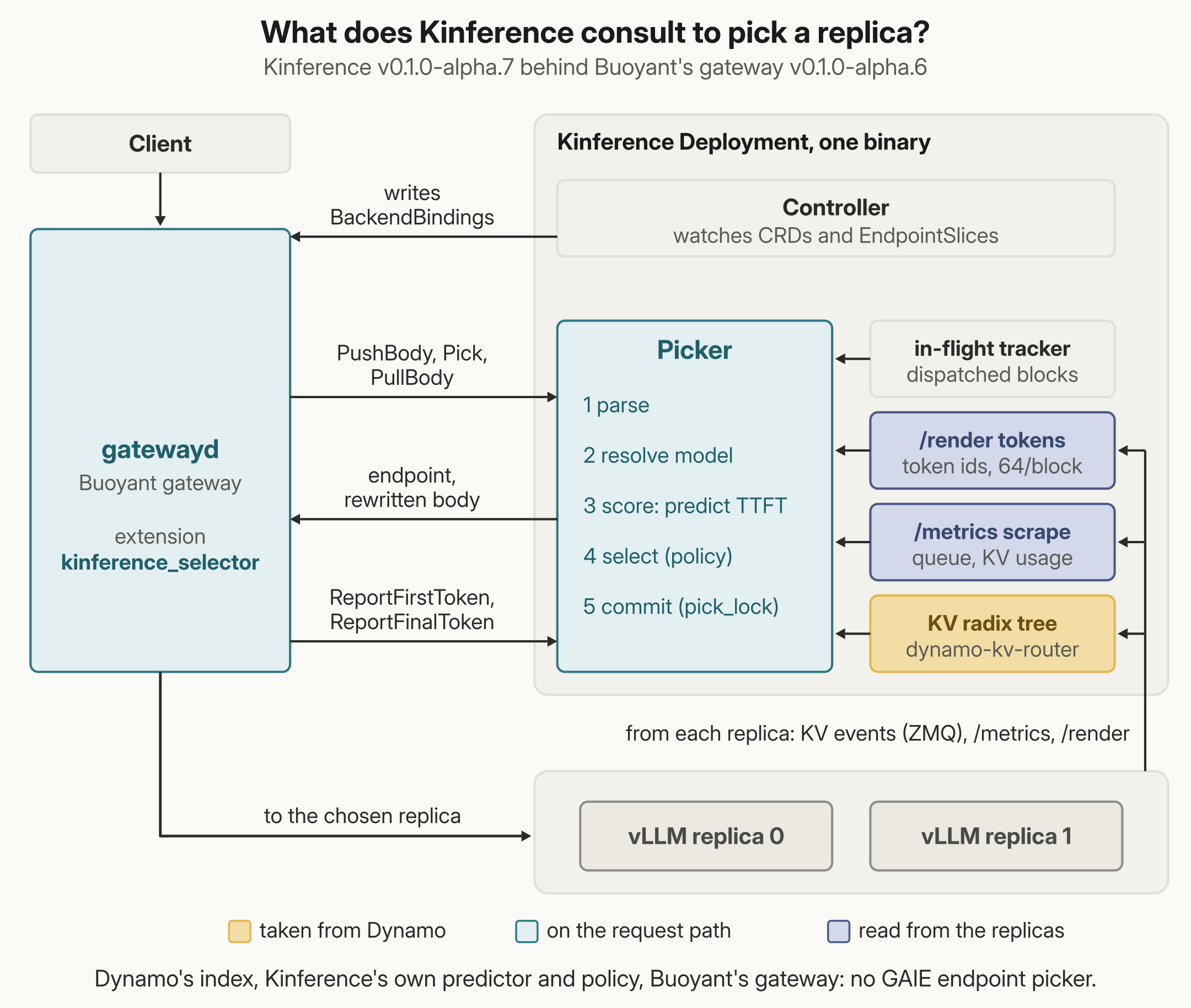
 Kinference's pick is Dynamo's index plus its own predictor and policy, behind its own gateway and outside the GAIE endpoint-picker interface.
- gatewayd and gateway-cp, Buoyant's Gateway API implementation in Rust. gateway-cp provisions one
<gateway>-gatewaydDeployment perGateway. Kinference attaches as anExtensionof classkinference_selector, which the Kinference chart creates. The extension reads the tenant from one configured header and sends an empty string without it (kinference.rsL244-L250 @ gateway v0.1.0-alpha.6); QoS is a fixed per-extension setting. - The Kinference Deployment. The router answers
Pick. The fleet holds one ZMQ subscriber per worker for vLLM's KV events and scrapes each worker's/metricsand/v1/models. The controller watches the CRDs and EndpointSlices, writes status and oneBackendBindingper pool for the gateway. An unauthenticated admin listener on 9001 serves/metricsand/api/policy/simulate(admin.rsL96-L107). - Worker identity is a pod UID. Discovery reads the Service's EndpointSlices and keys each worker on a hash of
targetRef.uid(discovery.rsL17); an endpoint without atargetRefUID is skipped (L246). Keep that in mind for the restart below.
InferenceWorkerSet wraps a Service, InferencePool lists destinations and at most one policyRef; InferencePolicy and InferenceProvider come later. The block size is the one value you must get right:
# attachments/kinference-pool-gateway.yaml (worker set and pool; Gateway and HTTPRoute trimmed)
apiVersion: kinference.buoyant.io/v1alpha1
kind: InferenceWorkerSet
metadata: {name: gx10, namespace: default}
spec:
  profile: default
  kvBlockSize: 64
  serviceRef: {name: qwen-gx10, port: http}
  kvEvents: {port: kv-pub, replayPort: kv-replay}
  models:
    - {name: Qwen/Qwen3-8B}
---
apiVersion: kinference.buoyant.io/v1alpha1
kind: InferencePool
metadata: {name: gx10, namespace: default}
spec:
  destinations:
    - {kind: InferenceWorkerSet, name: gx10}
An HTTPRoute then names the pool as its backendRef (group: kinference.buoyant.io, kind: InferencePool), and the gateway calls Kinference for every request on that route.
One pick, step by step
Three calls before the engine sees a byte (PushBody, Pick, PullBody), two after (ReportFirstToken, ReportFinalToken); Abort frees everything (docs/request-flow.md).
We traced it on real engines: two vLLM 0.33.0 replicas of Qwen/Qwen3-8B (BF16) on one NVIDIA GB10, each with --block-size 64, prefix caching on and KV events published over ZMQ, behind Kinference v0.1.0-alpha.7 and the Buoyant gateway v0.1.0-alpha.6 in a Kind cluster on a laptop (kindest/node v1.31.12, Gateway API v1.5.1). Every request is a streamed chat completion with the same synthetic system prompt of about 5,120 tokens and a short question, 16 output tokens, one request at a time. The chart's default profile is used as shipped.
- Parse and resolve. Unknown fields are kept and only
modelis required; aliases andautoresolve against what the worker sets declare, and streams getstream_options.include_usageforced on so the final report has token counts. - Score. Kinference tokenizes the request through the worker's
/v1/chat/completions/render(the defaultrendermode), hashes the token ids into 64-token blocks, matches them against the pool's radix tree, and reads each worker's last scrape. Forr2: 5,131 prompt tokens, 80 full blocks, 79 of them on replica 0. - Select. With a
policyRef, the policy chooses among the scored candidates; without one, the built-in route minimizes predicted TTFT and breaks exact ties at random. The log line:"trace": "rule=<unmatched> considered=2 survivors=2 tier=0 objective_ms=404.7". - Commit under the pool's
pick_lock: in-flight +1, prefix marked dispatched.
The prediction is a TTFT in milliseconds (TTFT, ITL, Goodput), a sum of terms (picker.rs L172-L230): a base, a queue term (the remaining prefill of Kinference's own in-flight picks plus waiting requests it did not send), uncached prefill, cache pressure, a running-request penalty and decode contention. Uncached prefill is the one that sees the cache (L61-L76):
$$ \text{prefill_ms} = a \cdot n_{\text{uncached}} + c \cdot n_{\text{uncached}} \cdot n_{\text{total}} $$
with the chart's default a = 2.3 ms per uncached block, c = 0.03 ms per uncached block per total block, and a base of 400 ms. For the cold replica, 80 uncached blocks of 80: 2.3 × 80 + 0.03 × 80 × 80 = 184 + 192 = 376 ms. For the warm one, 1 uncached block: 2.3 + 2.4 = 4.7 ms. The router logs the whole table at TRACE level:
# kinference.jsonl, run 20261109T205620, request r2-warm (lifecycle "score table", trimmed to the overlap and cost columns)
   name                 expect_ms  base_ms     q_ms  prefill_ms  ...  overlap/total
*  default/gx10-vllm-0      404.7    400.0      0.0         4.7  ...         79/80
   default/gx10-vllm-1      776.0    400.0      0.0       376.0  ...          0/80
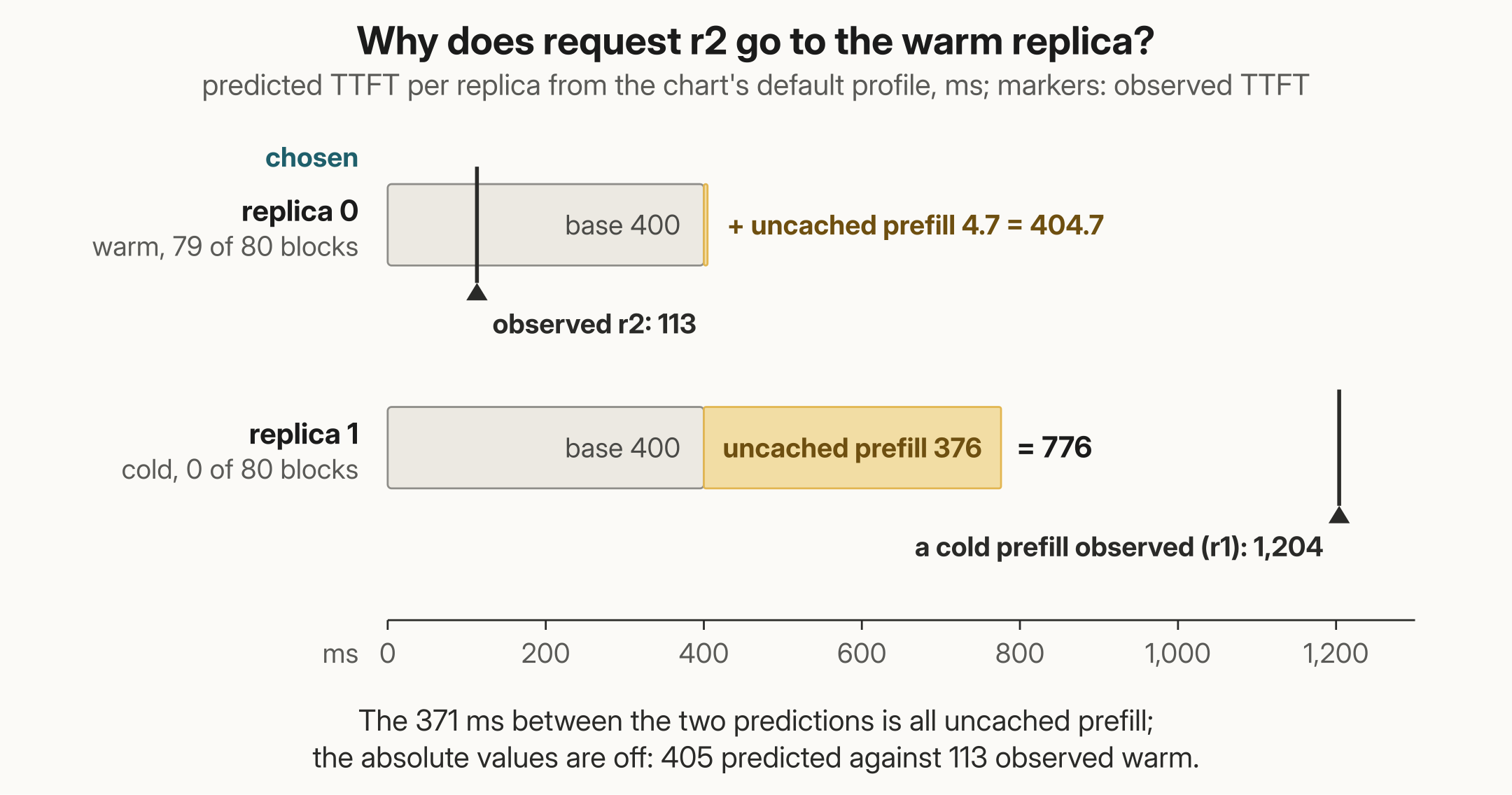
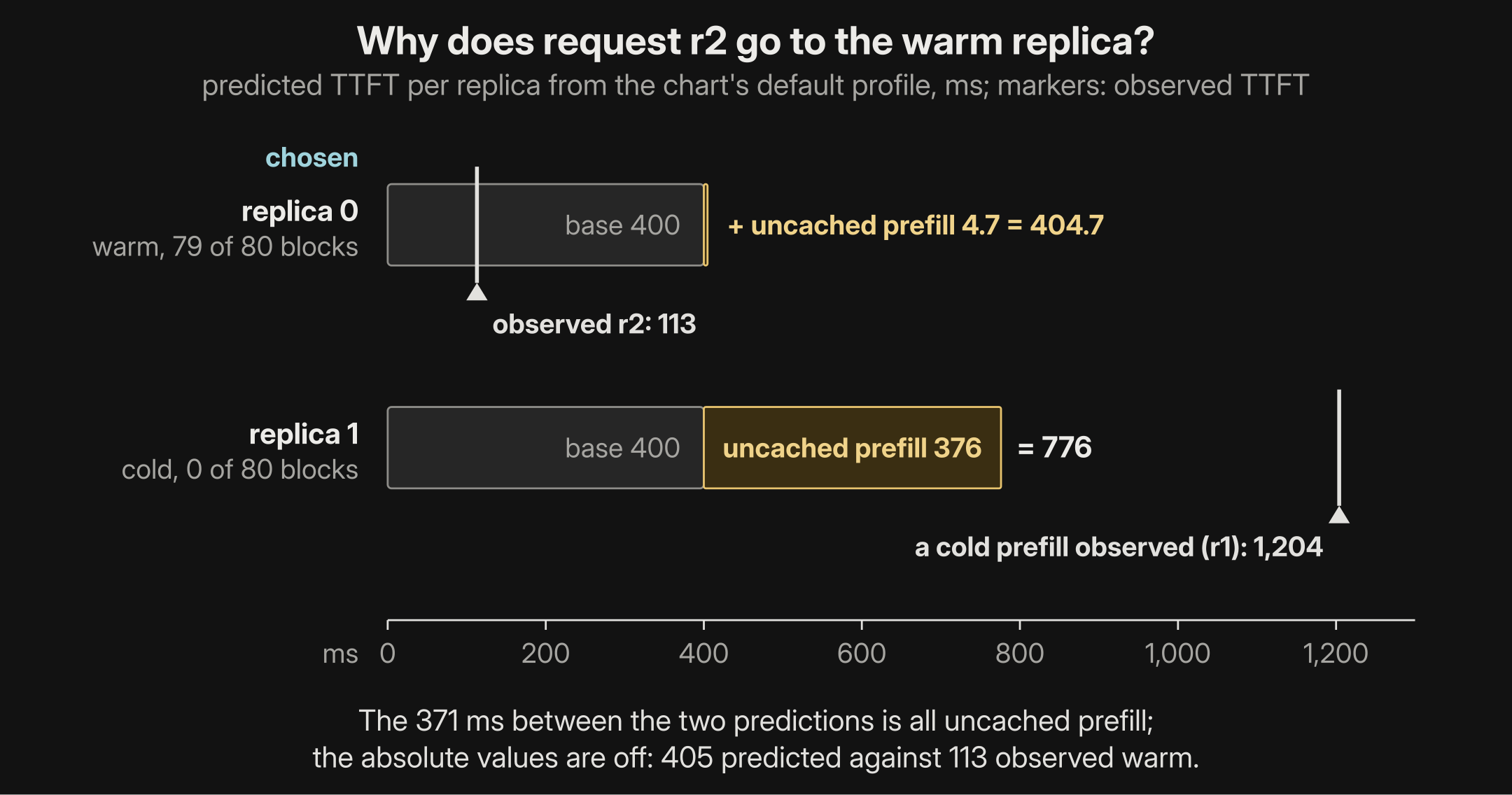 The warm replica wins on the uncached-prefill term alone; the 400 ms base is the same everywhere and larger than the warm request's real TTFT, which is what an uncalibrated profile looks like.
The ranking is right: the warm replica is chosen, and vLLM confirms the hit with "cached_tokens":5056 (79 blocks × 64) in the final usage chunk and a 113 ms TTFT against 1,204 ms for the cold r1. The absolute numbers are not: the default profile predicted 776 ms for a cold prefill that took 1,204 ms and 405 ms for a warm one that took 113 ms. The chart says these values are "starting points; refit from this profile's observation events" (values.yaml L105-L110), and the refit is offline: the live pick does not learn from observed TTFT.
Hot-prefix replication, a redirect to a cold worker within 10% of the best (L530-L607), did not fire at 776 against 405 ms.
The report loop closes the pick. ReportFirstToken finalizes the observation, releases the in-flight count and logs one kinference::observation event, predicted against observed, for the chosen worker only. Request r2's event, trimmed (endpoint field dropped):
{"message":"first token observed","req":"kinfk-r2-warm-1794254419","worker":"default/gx10-vllm-0",
 "predicted_ms":404.70001220703125,"observed_ms":113,
 "residual_ms":-291.70001220703125,"base_ms":400.0,"prefill_ms":4.699999809265137,
 "overlap_blocks":79,"total_blocks":80,"replication_fired":false,"target":"kinference::observation"}
Four requests: what the index gets right and wrong
A prefix pays only on the replica that holds it (Prefix Caching), so the index is only as good as the events that feed it, and two common events never reach it. We sent four requests through the same cluster, with both prefix caches reset before the first:
| Request | What changed | Kinference matched | Replica | vLLM cached_tokens |
Observed TTFT |
|---|---|---|---|---|---|
r1 |
cold caches | 0 / 80 blocks (tie, 776 ms both) | 0 | 0 | 1,204 ms |
r2 |
same prefix, new question | 79 / 80 | 0 | 5,056 | 113 ms |
r3 |
r2's body plus "cache_salt": "tenant-b" |
80 / 80 | 0 | 0 | 1,112 ms |
r4 |
r2's body, after restarting replica 0 |
80 / 80 | 0 | 0 | 1,123 ms |
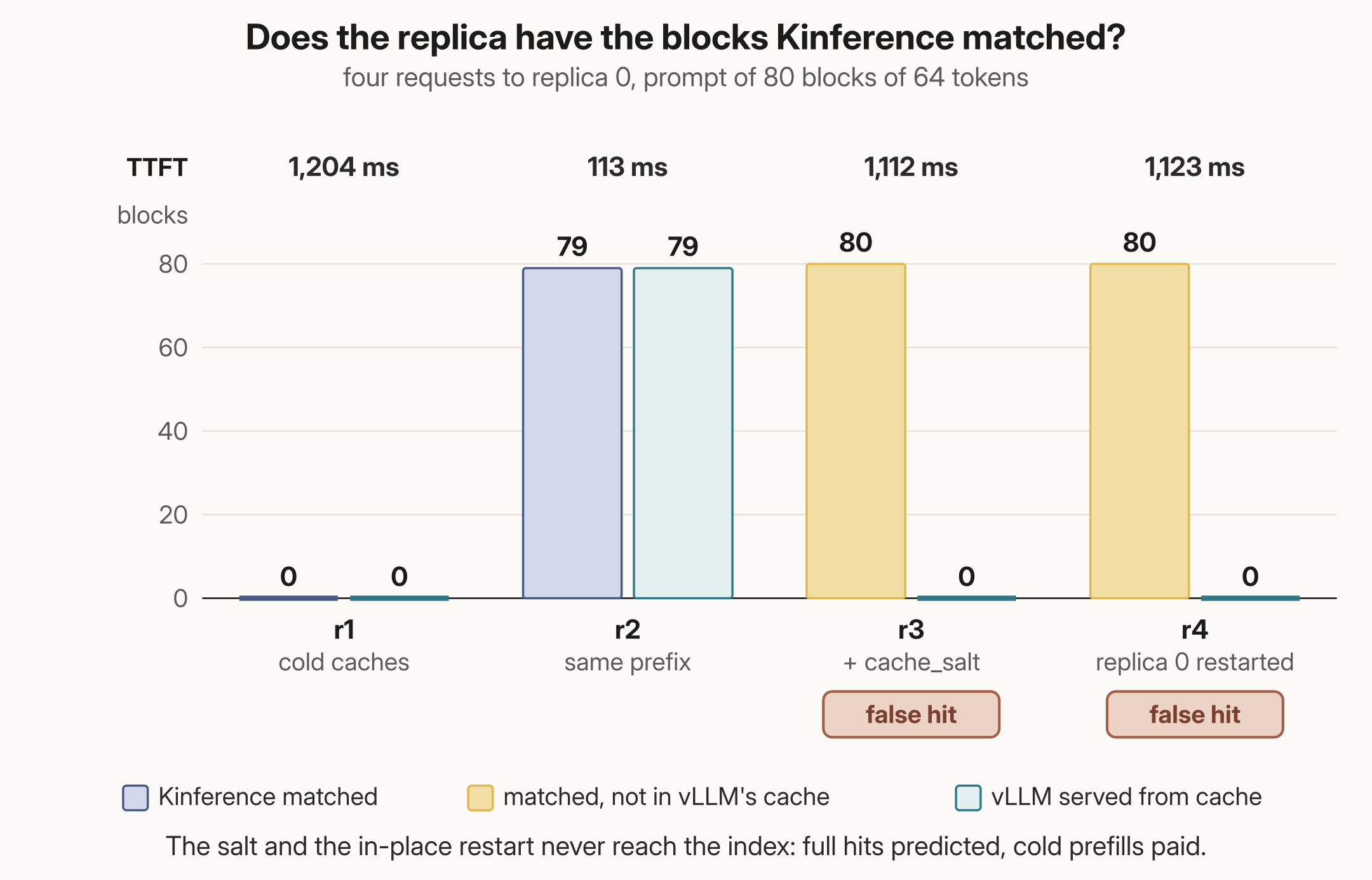
 Kinference predicted a full hit twice where vLLM had nothing: a salted request and a restarted replica both pay a cold prefill on a replica the router believes is warm.
r3: the salt is ignored. vLLM folds cache_salt into the first block's hash, so a salted request shares no blocks with an unsalted one. Kinference never reads the field (there is no reference to it in the source at the tag) and hashes tokens only, so it predicted 80 of 80 blocks and 400 ms. The engine served 0 from cache. The index counters agree: vLLM published 80 new blocks for the salted request (kinference_index_blocks_stored_total went from 81 to 161), while the index size stayed at 81 blocks. The cost is latency, not isolation: the engine still misses, and tenants that salt their requests for the reasons in Other Users' Data in the KV Cache get routed on hits they cannot have.
r4: a restart the index does not see. We restarted replica 0's engine on the same address (102 s), keeping its EndpointSlice and targetRef UID. That is what a container restart in place looks like (an OOM kill or a failed liveness probe keeps the pod and its UID), and also an engine outside the cluster. Kinference logged two scrape failures and nothing else: no removed or cleared event, the index kept its 81 blocks, and the next pick predicted 80 of 80 on an empty cache. The restarted engine's own new events were not ingested either: kinference_index_blocks_stored_total stayed at 161 after r4, while vLLM prefilled and cached all 80 blocks again. Its sequence numbers restart below the last one Kinference applied, and such frames are dropped as stale (ingest.rs L436-L445); that is an inference from the code and the metrics, since the drop logs at trace level only. A deleted and recreated pod gets a new UID and starts as a new, empty worker, which is correct. Replay could resynchronize, but it is off in the chart and documented as a source of "phantom cache hits" itself (ingest.rs L53-L58).
Neither replica held usable blocks for r3 and r4, so the wrong belief cost nothing here; the error is the prediction (400 ms against about 1,100 observed), and under load it sends more traffic to the replica the router wrongly thinks is warm.
Policies: what the grammar says, and what runs at alpha.7
An InferencePolicy is an ordered list of rules; the first whose matches hold routes the request. A match can test model, input tokens, max tokens, tenant, QoS and tag. A route generates candidates (consider), drops some (exclude), then walks ordered select tiers, where "the first with a surviving candidate wins" (crd.rs L664-L665), and falls to onEmpty. A request no rule matches is served locally by default: unmatched: ServeLocal "is fail-open" (L602-L603).
Two facts change what the launch examples do: nothing sets tags ("the router sends an empty set for now", crd.rs L648-L650), and providers must speak OpenAI's format (resolve.rs L932-L935).
We applied the three policies from the vLLM blog's post verbatim apart from the namespace (inference changed to default), on the same Kinference version (this part ran on the simulated fleet; policies do not depend on the engines). The first one never gets in:
$ kubectl apply --dry-run=server -f launch-smart-semantic-routing.default.yaml
The InferencePolicy "smart-semantic-routing" is invalid: spec.rules[0]: Invalid value: "object": PredictedTTFT is Local-only: constrain the tier or the candidate set to Local, or use EstimatedTTFT
kinfctl check 0.1.0-alpha.7, the linter the launch posts present, passed the original file (inference/smart-semantic-routing: ok): it does not evaluate the CRD's CEL rules, so run a server-side dry run too.
The second, pii-stays-local, applies. Its only guard is exclude: if: {tag: pii-detected}, and its first tier is type: Provider, order: [databricks]. With the simulate endpoint and a hand-written provider candidate, the untagged request, which is every live request, chose databricks; the same request with tags: ["pii-detected"] dropped the provider through the exclusion and chose a local replica. As written, at alpha.7, the serve rule (its exclusion is named pii-never-leaves-cluster) sends every prompt, PII or not, to the provider whenever one resolves.
The third, burst-policy, applies and its exclusion works: with three idle local candidates simulate chose a local replica; with each at five queued prompts, drop-overloaded-workers removed all three and the provider tier won. But bedrock cannot be declared: kubectl apply --dry-run=server on an InferenceProvider with api: Bedrock answered Unsupported value: "Bedrock": supported values: "OpenAI". Only databricks, if it speaks OpenAI's format, can ever serve the burst.
The live side of the tag gap is one request. We pointed the pool at a one-rule policy that serves only complexity-low requests and rejects the rest (kinference-tag-demo.yaml); the policy reached InForce, and r5, on the real replicas, came back in 31 ms:
HTTP/1.1 403 Forbidden
content-length: 36
date: Mon, 09 Nov 2026 20:02:45 GMT

no rule matched and unmatched=Reject
Simulate with tags: ["complexity-low"] on the same policy reports "matched": true for the rule (no candidates were given, so the verdict is rejected_on_empty). The grammar is ready; the request path does not feed it.
Launch claims against the code
Status at v0.1.0-alpha.7, checked against the source on 10 November 2026:
| Claim | Where it is claimed | Status | Evidence |
|---|---|---|---|
| KV-cache-aware load balancing | both launch posts | Works | dynamo-kv-router (Cargo.toml L39) (read); our r2 (ran) |
Model aliases, classes, auto |
Buoyant post, docs | Works | request-flow.md step 2 (read, not exercised) |
| Policies checked before they ship | both posts | Works, partly: kinfctl check misses CEL rules |
kinfctl check passed a policy the API server refuses (ran) |
| Tenant usage and cost tracking | both posts | Works once extension.tenantHeader is set; token counters, no prices |
extension.yaml L21 (read); our run (ran: 5,056 cached tokens for tenant-a, 0 for tenant-b) |
| TTFT, ITL, duration histograms | both posts | Works | kinference_ttft_ms, kinference_itl_ms, kinference_request_duration_ms in our run's /metrics (ran) |
| Queue sizes and "historical performance" as signals | both posts | Queue and in-flight: yes. History: offline refit only | picker.rs L172-L230; request-flow.md L149-L158 (read) |
| Token rate limiting | both posts; docs "Token rate limits" | Not implemented | Kinference serves only Picker; RateLimiter and TokenReview exist only in the gateway's copy of the proto; README "Rate limiting" (read) |
| Semantic classification (PII, complexity) | both posts; docs | Not implemented: tag predicates compile, nothing sets tags | crd.rs L648-L650; README "Semantic classifiers" (read); our r5 (ran) |
| OpenAI- or Anthropic-compatible traffic | both posts | OpenAI only | README: no /v1/messages (read) |
| Burst to providers "like OpenAI, Anthropic, Databricks" | vLLM post | OpenAI-format providers only | CRD enum [OpenAI], our Bedrock dry run (ran); resolve.rs L932-L935 (read) |
| The three example policies | vLLM post | #1 refused at admission; #2 applies, its exclusion never fires; #3 applies, OpenAI providers only | our dry runs and simulate traces (ran) |
| A scalable control plane | Buoyant post's title | One replica supported | README "Support for multiple replicas"; deployment.yaml L1-L10 (read) |
The README's "Known limitations" (L58-L69) lists the same four gaps; the launch posts and the getting-started page run ahead of it.
The vendor numbers are claims we did not reproduce: Buoyant reports median TTFT down 95% and median end-to-end latency down 45% against a plain Kubernetes Service, and the vLLM post and Buoyant's benchmark post 7.4× (shared prefix) and 3.5× (multi-turn) goodput, on 2 × 3 L40S with vLLM 0.31.0 against kube-proxy's random pick. Neither states the Kinference version or profile. The baseline is a random pick, so these figures measure cache-aware routing against none, not Kinference against llm-d or Dynamo.
Where Kinference sits
All five at their latest releases on 10 November 2026:
| Kinference alpha.7 | llm-d 1.0 | Dynamo 1.6.2 | AIBrix 0.8 | Production Stack 0.1.14 | |
|---|---|---|---|---|---|
| Request-path interface | own gRPC Picker behind Buoyant's gateway |
GAIE ext_proc EPP | Dynamo frontend with its KV router; an EPP for GAIE | Envoy Gateway ext_proc plugins | Python router service |
| Cache-state source | vLLM KV events through dynamo-kv-router, plus dispatched-prefix credit |
its own history, or vLLM KV events (precise scorer) | worker KV events, or approximate | its own history (prefix_cache) |
own hash trie (prefixaware), or LMCache (kvaware) |
| Scoring | predicted TTFT: base, queue, uncached prefill, load | weighted scorers | prefill blocks minus overlap, plus decode blocks | one algorithm per request | one routing logic per deployment |
| Rules across models and providers | declarative InferencePolicy; aliases; OpenAI-format providers |
none in the router (InferenceObjective sets request priority) |
none declarative | routing-strategy header picks the algorithm |
none |
| Admission and limits | none (a tier can reject) | flow-control queue, bands, fairness | policy-class queues | Redis rate limiter, per-replica in-flight cap | none in the router (the priority routing logic steers high-priority requests to the least-loaded engine; no queue) |
| P/D disaggregation | no | yes | yes | yes | yes |
| Release status | alpha tags | 1.0 | stable | 0.8 | 0.1.14 |
The flow-control row has its own piece: Flow Control in the Serving Stack.
What is new is the policy layer: rules over model, tenant, QoS and load that choose among local models and external providers, with predicted TTFT as a selection term, and kinfctl check plus a simulate endpoint to review them before they ship. None of the other four exposes that as a declarative rule set.
What is not new is the routing on KV events. llm-d's precise scorer reads vLLM's ZMQ events, and Dynamo's router does it with the very crate Kinference imports. If cache-aware routing is all you need, you already have it.
Running it yourself
You need two or more vLLM replicas that publish KV events, and a Kind cluster that can reach them. Each replica, from our launch script (abridged: --revision and --host omitted):
$ VLLM_SERVER_DEV_MODE=1 vllm serve Qwen/Qwen3-8B \
    --served-model-name Qwen/Qwen3-8B \
    --port 8201 \
    --gpu-memory-utilization 0.25 \
    --max-num-seqs 8 \
    --block-size 64 \
    --enable-prefix-caching \
    --enable-prompt-tokens-details \
    --enable-scale-out \
    --max-model-len 16384 \
    --kv-cache-memory-bytes 4294967296 \
    --kv-events-config '{"enable_kv_cache_events":true,"publisher":"zmq","endpoint":"tcp://*:5557","replay_endpoint":"tcp://*:5567","topic":"kv@<engine-host>:8201@Qwen/Qwen3-8B"}'
--enable-scale-out registers vLLM's /render endpoints, which Kinference's default tokenize mode calls; without it, picks fall back to load only (cli_args.py L216-L222 @ v0.33.0); Kinference's guide does not mention it. --enable-prompt-tokens-details puts cached_tokens in the usage block. --served-model-name sets the model_name label on /metrics, which Kinference filters on (scrape.rs L813-L827); without it, the log says "no metrics match the model_name label". With --kv-cache-memory-bytes set, vLLM reserves exactly that much KV and uses --gpu-memory-utilization only as a startup free-memory check, which let two replicas share the GPU with another resident vLLM. VLLM_SERVER_DEV_MODE=1 exposes /reset_prefix_cache, which we called before r1; leave it off in production.
Then the Gateway API CRDs and the four charts, in the order we installed them:
$ kubectl apply --server-side --force-conflicts -f https://github.com/kubernetes-sigs/gateway-api/releases/download/v1.5.1/standard-install.yaml
$ helm upgrade -i kinference-crds oci://ghcr.io/kinference-ai/charts/kinference-crds --version 0.1.0-alpha.7
$ helm upgrade -i gateway-crds oci://ghcr.io/buoyantio/charts/gateway-crds --version 0.1.0-alpha.6
$ helm upgrade -i gateway oci://ghcr.io/buoyantio/charts/gateway --version 0.1.0-alpha.6 \
    --set controlPlane.image.repository=ghcr.io/buoyantio/gateway-cp \
    --set dataPlane.image.repository=ghcr.io/buoyantio/gatewayd
$ helm upgrade -i kinference oci://ghcr.io/kinference-ai/charts/kinference --version 0.1.0-alpha.7 \
    -f kinference-values.yaml
The three files, frozen as they ran: kinference-values.yaml (JSON logs, the observation and score-table log targets, tenantHeader: x-tenant), kinference-engines.yaml (a selector-less ClusterIP Service with one hand-written IPv4 EndpointSlice per replica; discovery skips endpoints without a targetRef UID, so these carry synthetic ones) and kinference-pool-gateway.yaml (worker set, pool, Gateway, HTTPRoute). Put your replicas' address in the second, apply the last two, then restart gateway-cp once:
$ kubectl apply -f kinference-engines.yaml -f kinference-pool-gateway.yaml
$ kubectl rollout restart deployment/gateway-cp
The requests are plain chat completions; x-tenant sets the tenant and x-request-id the id Kinference logs:
{"model": "Qwen/Qwen3-8B", "stream": true, "stream_options": {"include_usage": true}, "max_tokens": 16,
 "chat_template_kwargs": {"enable_thinking": false},
 "messages": [{"role": "system", "content": "engine0 pool1 tenant2 latency3 batch4 queue5 ..."},
              {"role": "user", "content": "Question B: and now?"}],
 "cache_salt": "tenant-b"}
On llm-d-inference-sim v1.1.0 replicas, Kinference matched 0 of 1,824 requested blocks and never indexed a worker, so the simulator shows the policy path, not routing. Upstream's own GPU-free path, tests/e2e/smoke.sh, runs a CPU vLLM with dummy weights on Kind; we did not run it, but it exercises the real KV event path that the simulator did not.
Alpha, operationally
What bit us, beyond the false hits measured above:
- One replica. The chart uses
Recreate(values.yamlL3-L7), so an upgrade leaves no picker while the new pod starts, and with replay off it starts from an empty index. kvBlockSizemust equal what the engine publishes, which is not always--block-size. A mismatch drops every event, the tree stays empty and picks degrade to load-only "with no error" (crd.rsL68-L84); after three consecutive mismatchedBlockStoredevents the endpoint is evicted (ingest.rsL714-L717).- One gateway-cp restart. A gateway-cp 0.1.0-alpha.6 started before the
Gatewayexisted provisioned no gatewayd until we restarted it. Its startup warningbackendRef of an unsupported kind; its share answers 500for theInferencePoolappeared in every run, including the ones that routed, so it is not the diagnosis. - Only inference routes go through.
GET /v1/modelsthrough the gateway answered HTTP 400 on 120 of 120 attempts in our first two runs; health checks and model listings must go to the engines. - Tenants need the header. The chart ships
extension.tenantHeader: "", so every request is tenantdefaultuntil you set it (values.yamlL69). Kinference warns at startup that tenant label values are unbounded; set an allowlist. - Failed requests still log an observation (
upstream_status: 400, 0 blocks, a 43 ms "TTFT" in our first run): filter onupstream_statusbefore you refit a profile. - Time from the observation events, not curl: the gateway sends headers before the first token (39 to 50 ms to first byte on every request).
- Pin the chart version: the docs install with
--develand no version, which takes whatever is newest.
Verdict
Kinference v0.1.0-alpha.7 is a working cache-aware picker on Dynamo's index with a policy grammar ahead of its request path.
- Try it now if you want declarative routing across local vLLM models and OpenAI-format providers and will read the code before you trust a rule. Refit the profile from your own observation events first.
- Wait if you need token rate limits, Anthropic-format traffic or providers, tag- or classifier-driven rules, an HA control plane, or tenants that use
cache_salt. - Stay where you are if cache-aware routing is the whole requirement and you run llm-d or Dynamo: you already have it, and both handle prefill/decode disaggregation, which Kinference does not (Disaggregated Serving).
Before pointing salted tenants at any cache-aware router, read why the salt exists in Other Users' Data in the KV Cache.
Sources
- Buoyant, "Kinference: Scalable Inference Control Plane for Kubernetes", 2026-11-04
- vLLM blog, "Introducing Kinference", 2026-11-04
- Buoyant, "Distributed Inference Benchmarks: Kinference vs. Kubernetes", 2026-11-04
- Kinference source, tag
v0.1.0-alpha.7(a9e15df), 2026-11-04 - Buoyant gateway source, tag
v0.1.0-alpha.6(3fcb8d5), 2026-11-04 - Kinference docs, Getting started, alpha.7
- kinfctl binaries, 0.1.0-alpha.7, 2026-11-04
- vLLM v0.33.0,
--enable-scale-out - Placement: llm-d v1.0.0 (2026-10-20), Dynamo v1.6.2 (2026-11-05), AIBrix v0.8.0 (2026-10-13), vLLM Production Stack vllm-stack-0.1.14 (2026-11-07)