In this series / On this page· 15 of 19
- 1. Disaggregated Serving: Dynamo, llm-d, and When Splitting Prefill from Decode Pays
- 2. TTFT, ITL, Goodput: Measuring What Users Feel
- 3. Benchmark an Inference Server Without Lying to Yourself
- 4. Expert Parallelism, and What DeepEP Does for It
- 5. Serving Kimi K3.1 Pro: The State per Request, the Indexer's Cost, and Where 1M Tokens Fit
- 6. Other Users' Data in the KV Cache: What Cloudflare's GLM-5.3 Incident Teaches Operators
- 7. Flow Control in the Serving Stack: What llm-d, Dynamo and AIBrix Do When the Fleet Is Full
- 8. Context Parallelism for Long-Context Serving: PCP and DCP in vLLM and SGLang
- 9. Several Models, One GPU: Time-Slicing, MPS, MIG, and What CUDA 13.4's Memory Caps Change
- 10. Serving Mistral Large 4: What Its Cache Costs and Where It Fits
- 11. Prefix-Aware Routing Across Replicas: Kubernetes Service, Dynamo's KV Router, the llm-d EPP and Kinference
- 12. Serving Ripple-65B: What a Dense Model with 1M Context Costs, and When It Beats an MoE
- 13. Cost per Million Tokens, Computed: GPU-Hours, Utilization, and the Cache
- 14. Kinference at alpha.7: What Buoyant's Inference Control Plane Does, and What It Reuses
- 15. Cold Starts: Where the Minutes Go Before a New Replica Serves
- 16. Splitting Off the Vision Encoder: When Encoder Disaggregation Pays in vLLM
- 17. The Cache Hit That Changed the Answer
- 18. Prefix Caches That Collapse Under Bursts, and the Session Cap That Prevents It
- 19. MLPerf Endpoints v1.0: How to Read an Agentic Inference Benchmark
Cold Starts: Where the Minutes Go Before a New Replica Serves
Where the minutes go between an autoscaler's decision and a new inference replica's first token, and what pre-pulling, compile caches, checkpoint-restore and warm pools remove.
Ask an autoscaler for one more replica of gpt-oss-120b on a B200 and, if nothing is cached on the node, the replica answers its first request about six minutes later. Restored from a snapshot on a node that has the image, it answers in about 40 seconds; a pod already warm answers at once. The difference is which of four waits you still pay, and each fix on the market removes a different one.
Four waits in a row
A new replica waits for four things, one after the other: a pod (scheduled, its container started), the image (pulled and unpacked if the node doesn't have it), the weights (copied from wherever they live), and the engine's own initialization (loading the weights into GPU memory, compiling, capturing CUDA graphs, sizing the KV cache).
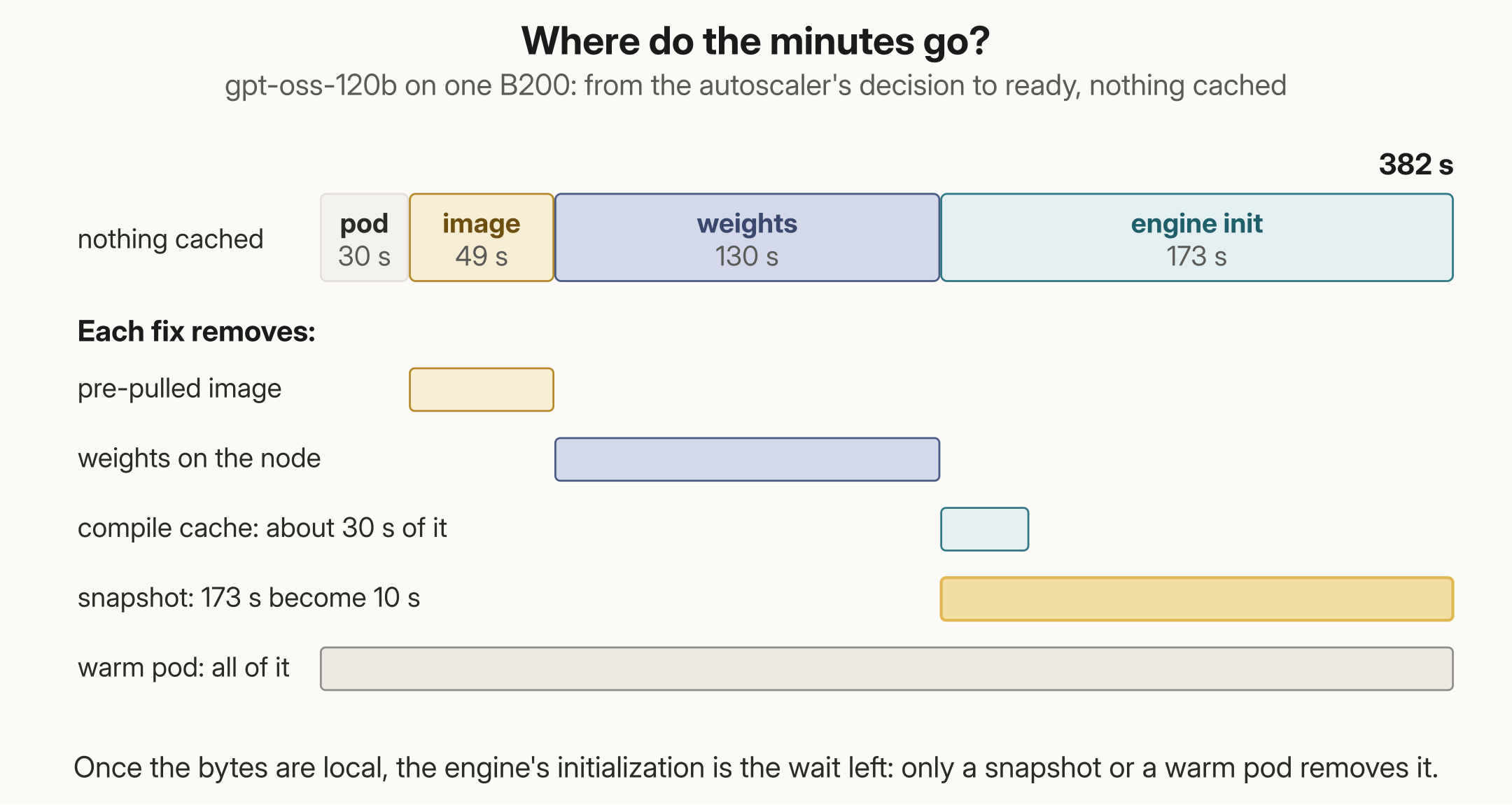
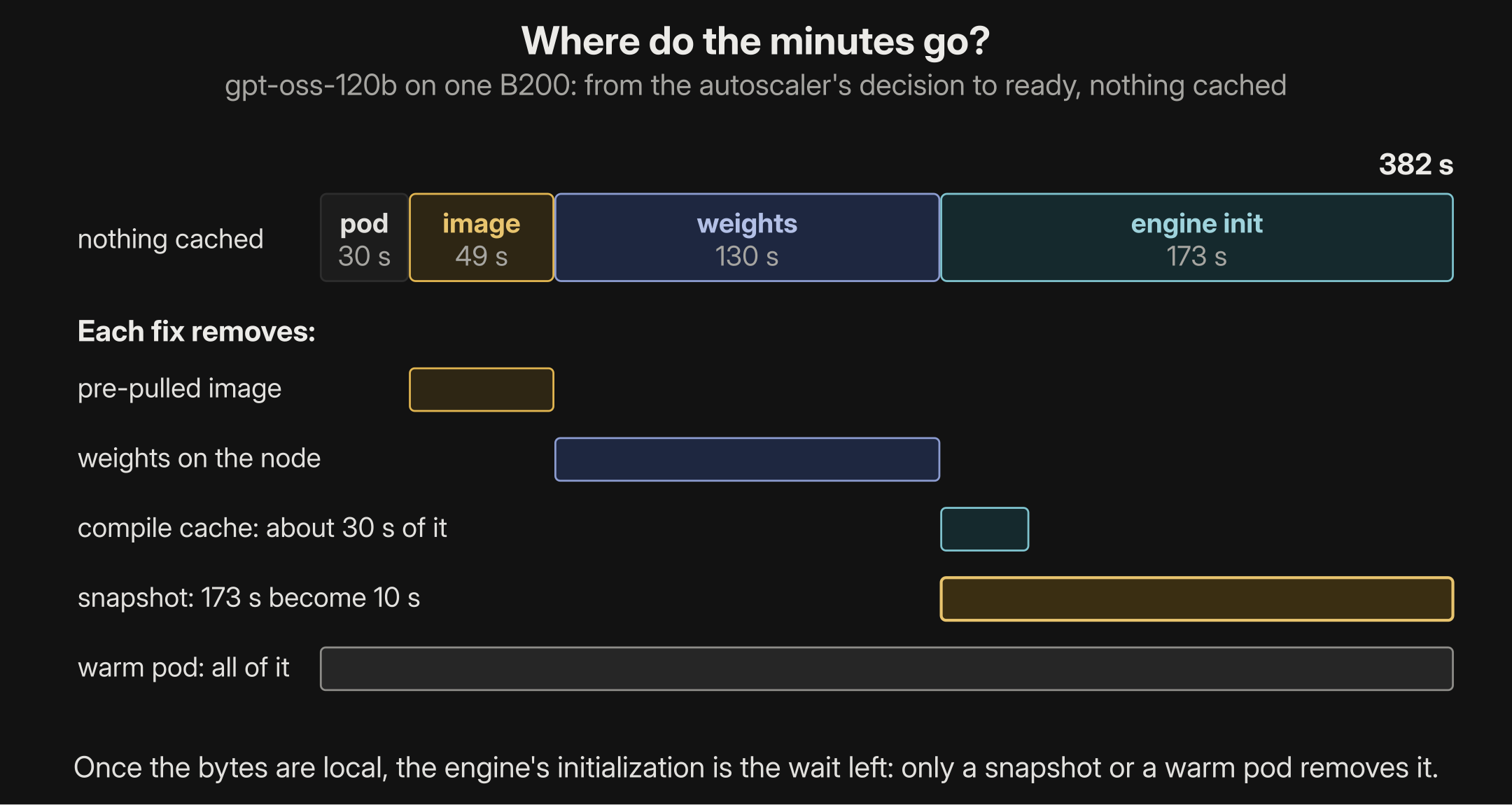
Here is the budget for that example, from cold_start_budget.py. The engine numbers are NVIDIA's own measurements for Snapshot (vLLM 0.31.0, one B200, weights already on fast shared storage); the pod start is LinkedIn's figure for its GPU sandbox pods (20 to 35 s with the image cached), used here as a stand-in; the image is vllm/vllm-openai:v0.33.0, 9.74 GB compressed, newer than the engine NVIDIA timed. A warm compile cache is credited with the saving we measured on one GB10: init went from 93 to 62 s when only the compile step was cached. The transfer rates are assumptions you should replace with yours: 0.2 GB/s to pull and unpack the image, 0.5 GB/s from a model hub, 2 GB/s from a bucket in the same region.
| What is already on the node | Time to ready |
|---|---|
| Nothing: pull the image, download 65 GB of weights from the hub, full init | 382 s (6.4 min) |
| The image; weights from an in-region bucket; full init | 235 s (3.9 min) |
| The image and the weights; full init | 203 s (3.4 min) |
| Same, with a warm compile cache | about 173 s (2.9 min): the compile part only |
| The image and a snapshot to restore | 40 s |
| A warm pod, already running | 0 s: route to it |
Two things stand out. Once the bytes are local, the engine's initialization is the largest single wait, and faster storage trims only its weight-load part (39 of the 173 s here), not the compilation, profiling and capture after it. And every row above the snapshot pays most of it again, every time the fleet grows.
Moving fewer bytes
Images. An inference image is 10 to 15 GB compressed (9.74 GB for vLLM v0.33.0, 14.55 GB for SGLang v0.5.23 with EFA), and larger once unpacked. Pulling it once per node, ahead of time, removes the image wait entirely: a DaemonSet that pulls the serving image on every GPU node, or a node image that already contains it. Pin the tag, or a new release silently brings the wait back on the next rollout.
Lazy pulling (stargz-snapshotter, SOCI, Nydus) starts the container before the image is local and fetches files on first read, which makes a weight-carrying image start almost independently of its size. A paper of 9 November shows the catch: the node cache it fills has no byte bound, and the kubelet cannot see it. With the cache pre-filled to 90%, upstream stargz-snapshotter failed to read 273 of 280 model files; pods that were already Ready and serving started failing reads while a readiness probe built to catch it stayed green (272 of 280 files unreadable). Under disk pressure, the kubelet freed none of the cache's bytes and evicted 26 other pods instead. The author's fix (a byte budget the cache enforces itself, and a failed cache write that never fails the read) is open source and proposed upstream. Until a bounded cache is what you run, don't put weights behind a lazy-pulling snapshotter.
Weights. Keep them close: a local NVMe cache on the node, or a bucket in the same region, never a model hub on the critical path. Then make the engine read them fast. vLLM v0.33.0 has several options (load.py):
--safetensors-load-strategy eagerreads whole files into RAM instead of memory-mapping them, andprefetchreads them into the page cache ahead of the workers: both suit network filesystems, and the default already prefetches on NFS when the checkpoint fits in 90% of available RAM.--load-format runai_streamerstreams safetensors from object storage or disk with concurrent reads;instanttensorloads with direct I/O and pipelined prefetching.vllm preloadkeeps the post-quantized weights resident in GPU memory in a small daemon per GPU, and an engine started with--load-format ipc_cachemaps them through CUDA IPC instead of reading them: for restarts on the same node, the weight wait drops to almost nothing. The price is that the GPU memory stays taken while no engine runs: it is a warm pool for weights.
$ vllm preload --model openai/gpt-oss-120b
$ vllm serve openai/gpt-oss-120b --load-format ipc_cache
The engine's own wait
With the bytes local, initialization is what is left, and it grows with model size and parallelism, unevenly. In Snapshot's measurements on B200, vLLM took 173 s for gpt-oss-120b on one GPU and 1,111 s for DeepSeek-V4.1-Flash on eight, of which 785 s were compilation, autotuning and CUDA graph capture. What each phase does is the subject of CUDA Graphs and torch.compile; for the fleet, what matters is which parts a cache can keep.
- Compilation is cacheable. vLLM writes its torch.compile artifacts under
VLLM_CACHE_ROOT(by default~/.cache/vllm, in the container's filesystem, which a new pod starts without). Put it on a persistent volume shared by replicas of the same model, engine version and GPU. - Graph capture and the memory profile are not. They run on the GPU each time; the levers there are fewer captured batch sizes and vLLM's opt-in
VLLM_ENABLE_STARTUP_PLAN=1, which skips the memory profile on the next boot with the same model and config.
Measured on one GB10, a warm cache took the compile step of Qwen3.6-35B-A3B from 21.5 s to 1.2 s, but the whole post-weights phase only from 93 to 62 s: that third is what the table credits it with.
Restoring instead of starting
NVIDIA Snapshot, open source (Apache 2.0) and presented by NVIDIA on 10 November, two days after its v0.3.0 release, skips initialization altogether. It checkpoints a pod whose engine is fully initialized, CPU and GPU memory included, with CRIU and cuda-checkpoint, and starts new pods from that image. The restored process resumes as if it had just finished starting: weights in GPU memory, kernels compiled, graphs captured.
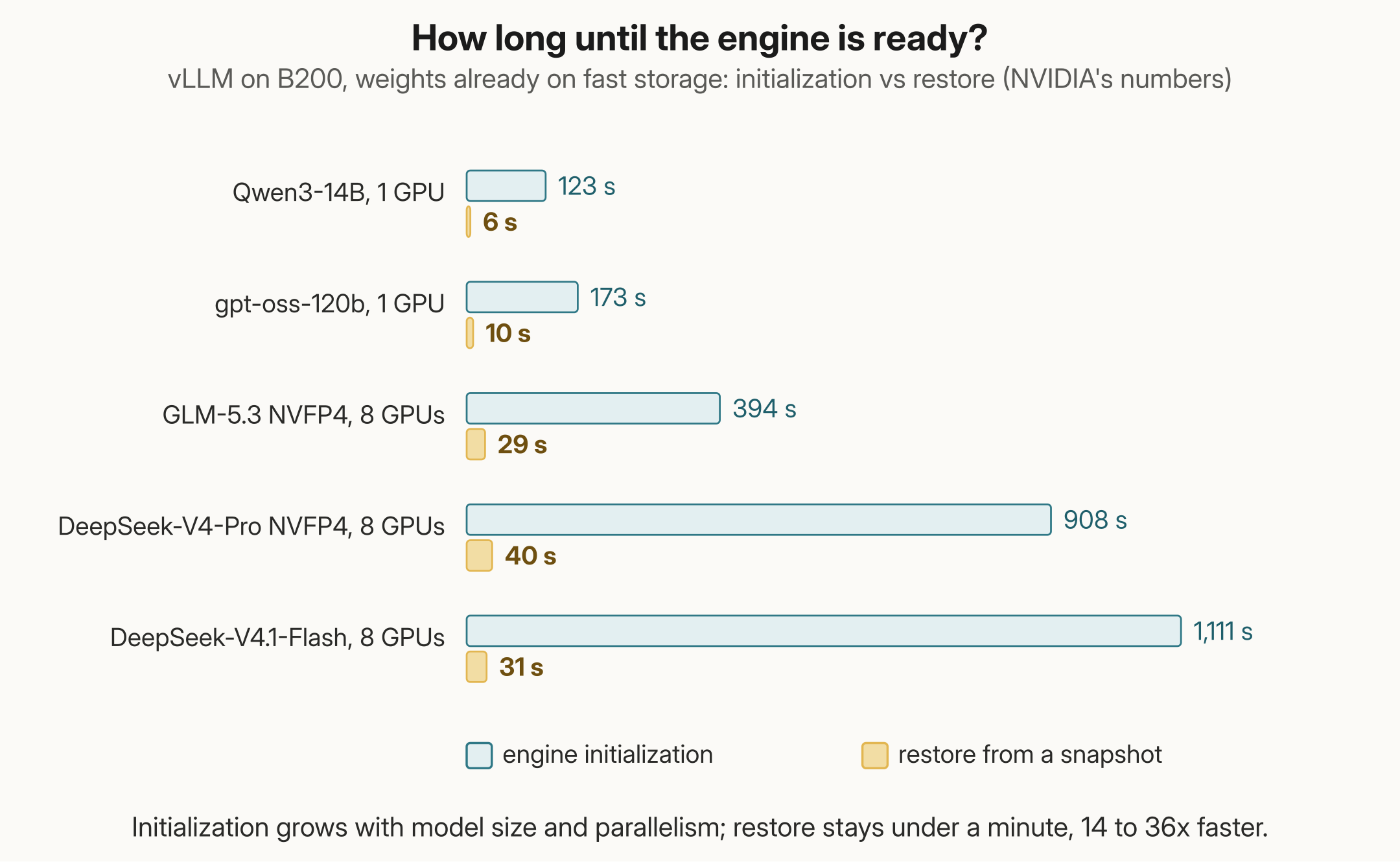
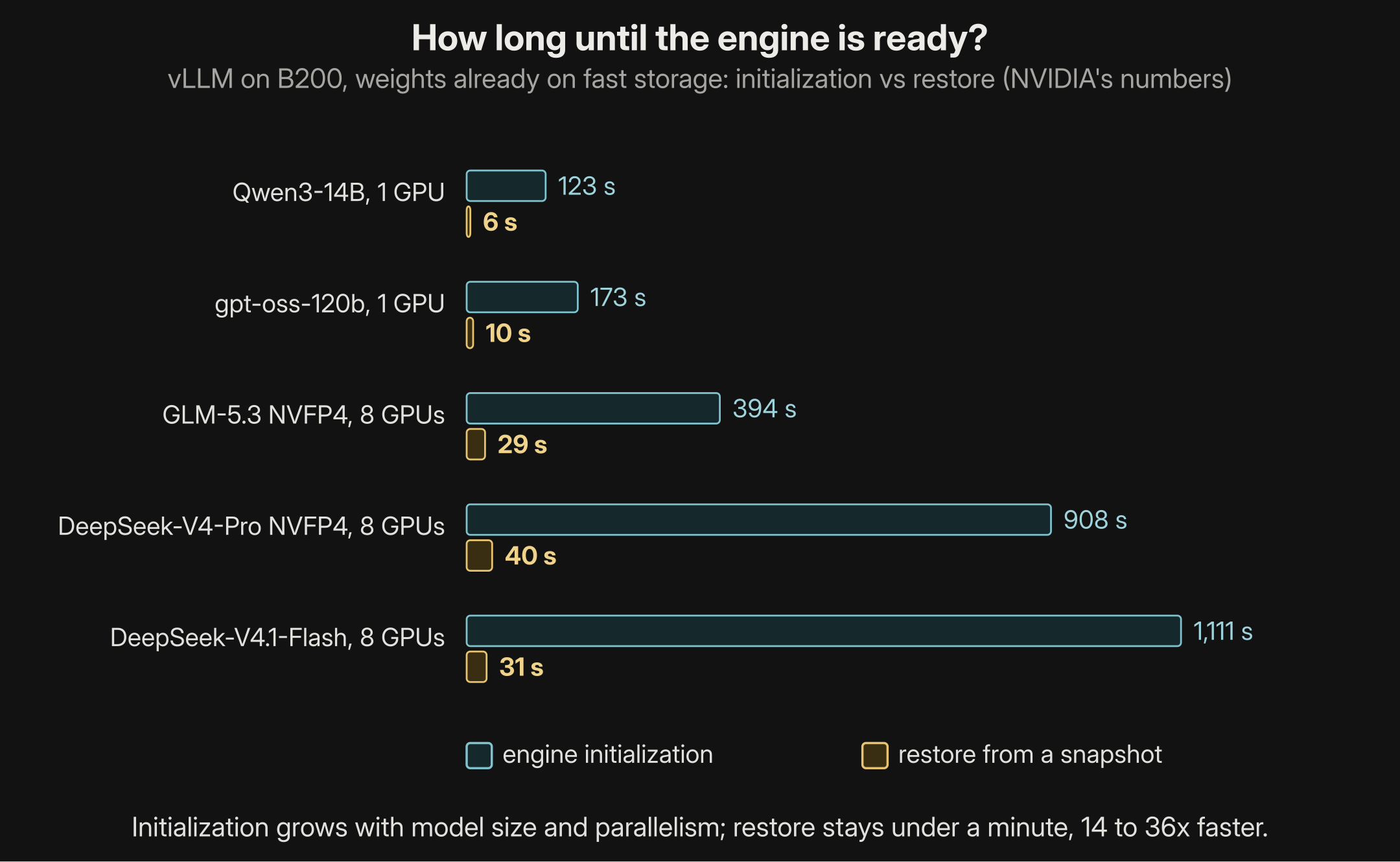
The speedups NVIDIA reports, 8 to 36x over 22 configurations of vLLM, SGLang and TensorRT-LLM, are for the engine step alone; the clock starts after scheduling, image pull and container start. The announcement adds two whole-path figures from design partners on HGX B300: Crusoe's pods for GLM-5.3 ready in 31 seconds instead of about 8 minutes, and Saturn Cloud's vLLM starts in 6 to 34 seconds instead of 2 to 8.5 minutes. Three costs come with it:
- A snapshot is bigger than the weights. It holds the process's whole memory: 81.6 GB for gpt-oss-120b's 65.3 GB of weights on vLLM, 997 GB for DeepSeek-V4-Pro's 913 GB. The engines are asked to release their KV cache before the checkpoint; even so, SGLang's gpt-oss snapshot on four GPUs was 694 GB, 5.8 times vLLM's for the same model, a gap NVIDIA does not explain. Restore time then follows storage: gpt-oss came back at an effective 8 GB/s, DeepSeek-V4-Pro at about 25 GB/s across eight GPUs.
- A snapshot is tied to its hardware. It restores only on the same GPU type with the same driver, on one node (multi-node is on the roadmap), with a privileged agent on every GPU node. A driver upgrade means new snapshots.
- It is young. The project says its APIs may still change and does not yet recommend it for production-critical workloads. NVIDIA Dynamo already integrates it.
Not starting at all
The fastest start is a replica that is already running. Firepool, LinkedIn's broker for short agentic and reinforcement-learning jobs on H200 nodes, keeps pods started and hands them out: at a sampled production peak, 94.7% of 3,206 pod requests were served from warm or standby capacity, and warm reuse cut p90 start latency from 59.1 s (a fresh reuse tag per job) to 3.5 s. Its standby pods hold no GPU memory and no CUDA context, parked in fractional GPU shares (51 s of handover became 0.94 s), and a keep-alive matched to the jobs' pauses kept the latency benefit while holding about half the capacity of an always-on pool (local and simulated runs).
Those are short GPU jobs, not inference replicas: a standby with no GPU memory would still have to load the weights and initialize the engine when promoted. For inference, the standby that pays off is one that already holds the engine, or a snapshot ready to restore.
On a single server, vLLM's sleep mode is the same idea at small scale: with --enable-sleep-mode, level 1 moves the weights to CPU memory and drops the KV cache, level 2 drops both, and waking up level 1 is a copy back rather than a start. The /sleep and /wake_up routes are in vLLM's development router, enabled with VLLM_SERVER_DEV_MODE=1, so treat them as a building block rather than an operator-facing API.
Which fix for which fleet
| Your situation | Biggest wait | Do this first |
|---|---|---|
| Steady traffic, occasional scale-up | image and weights | pre-pull the image, cache weights on the node or in-region, persistent compile cache |
| Spiky traffic, scale-up within a minute | engine init | a warm pool sized to the spike, or restore from snapshots |
| Many models, each idle most of the day (scale to zero) | everything, on every wake | snapshots per model, or sleep mode if they share a node |
| Large MoE on 8 GPUs (DeepSeek-V4-class) | compile and graph capture, 10+ minutes | compile cache and fewer captured batch sizes at minimum; snapshots pay off most here |
| Frequent restarts on the same node (rollouts, crashes) | weight load | vllm preload with --load-format ipc_cache |
Gotchas
Readiness is not "can serve". A probe that checks a port or a file can pass while the weights are unreadable (the lazy-pull case) or while the engine is still capturing graphs. Probe with a one-token generation, as Snapshot's own benchmark does after every start.
Caches are keyed by more than the model. A compile cache or a snapshot made with one engine version, GPU type, driver, TP size or flag set is useless, or refused, with another. Key the volume or the snapshot name by all of them, and rebuild on upgrade as part of the rollout, not on the first scale-up after it.
The autoscaler's signal comes early, the capacity late. Scaling on queue length with a six-minute cold start means the queue has already timed out by the time the replica arrives. Size the trigger to your real time to ready, or keep the warm headroom that covers it; what the serving stack does with requests while capacity is late is in Flow Control in the Serving Stack.
Once replicas arrive in seconds, the next question is how many models can share the GPUs they land on: GPU Sharing for Inference covers time-slicing, MPS and MIG on the same machines.
Sources
- Start and Restore GPU Workloads in Seconds with NVIDIA Snapshot, NVIDIA, 10 November 2026
- NVIDIA Snapshot and its performance page (benchmark with Snapshot v0.2.0-rc.2, November 2026)
- Firepool: Brokering Warm GPU Capacity for Agentic and RL Workloads at LinkedIn, arXiv, 7 November 2026
- Why Kubernetes Cannot Contain a Full Lazy-Pulling Cache, arXiv, 9 November 2026
- vLLM v0.33.0:
config/load.py,cli/preload.py
Related reading
- How an LLM Request Becomes TokensHybrid Models and the Memory Split: Why Fixed Pools Strand Your KV CacheExplainer
- The GPU for Inference EngineersMegakernels for Decode: What a Kernel Boundary Costs, and When Fusing a Layer PaysDeep dive
- Quantization in PracticeHumming, Measured: One Quantized-Kernel Library Against Marlin and FlashInferDeep dive