In this series / On this page· 15 of 15
- 1. NVFP4 on Blackwell: Serving a 4-Bit Model End to End
- 2. Quantization, Mapped: Weights, Activations, KV Cache
- 3. How Much Does Each Bit Cost? Size, Speed, and Quality, Measured
- 4. Post-Training Quantization: Rounding, Calibration, and the Outlier Problem
- 5. GPTQ, Explained and Run
- 6. AWQ: Protecting the Weights That Matter
- 7. SmoothQuant and W8A8: Quantizing Activations Too
- 8. Rotations for 4-Bit Activations: QuaRot, SpinQuant, and Friends
- 9. Quantization-Aware Training: When the Model Learns Its Own Precision
- 10. Quantizing the KV Cache: FP8 and Below
- 11. GGUF Quant Types Decoded: K-Quants and I-Quants
- 12. Quantizing Mixture-of-Experts Models
- 13. Measuring the Damage: Evaluations That Catch Quantization Errors
- 14. Quantization Tools Compared: LLM Compressor, ModelOpt, AutoRound
- 15. Humming, Measured: One Quantized-Kernel Library Against Marlin and FlashInfer
Humming, Measured: One Quantized-Kernel Library Against Marlin and FlashInfer
Humming against vLLM's default MoE kernels in three 4-bit formats, batch 1 to 64: mostly a tie, one 9% win, one broken default.

Outside Hopper, vLLM 0.32.0 never chooses Humming for a 4-bit MoE layer, and with weight-only checkpoints that costs you almost nothing: Humming ran within 6% of Marlin, the default, either way, at 1 to 64 requests, with the same KL. With MXFP8 activations on gpt-oss-120b it was 9% faster than Marlin at 64 requests, for a small KL cost. On our NVFP4 build of Qwen3-30B-A3B-Instruct-2507 the default backend scored 60.3% on GSM8K where Humming scored 95.3% on the same weights, because the default trusts the activation scales stored in the checkpoint, they were wrong, and Humming computes its own.
The setup for everything below: one NVIDIA GB10 (compute capability 12.1, 121 GiB of memory shared by CPU and GPU), vLLM 0.32.0 with the humming-kernels 0.1.17 it pins (0.1.18 where stated), 29 to 31 October 2026. Two models: Qwen3-30B-A3B-Instruct-2507 (48 layers, 128 experts, 8 active per token) in two 4-bit formats made from the same BF16 weights, and gpt-oss-120b in its native MXFP4. Quality is the harness from Measuring the Damage: KL divergence and top-1 agreement over 81,880 WikiText-2 positions against BF16 (gpt-oss, which has no BF16 checkpoint, against its default Marlin run), then GSM8K, compared problem by problem. Speed is vllm bench serve, random 512-token prompts and 256 output tokens, at 1, 4, 16 and 64 concurrent requests, one run per point, zero failed requests. We did not measure run-to-run spread, so below a speed gain counts only when it holds at both 16 and 64 requests. SGLang was not measured.
Marlin's successor, not a new idea
Humming is a GEMM library for quantized dense and MoE layers, written at Ant Group and moved under the vLLM project (v0.1.18, 21 October 2026, Apache-2.0). It compiles its kernels at run time with NVRTC, and its README credits Marlin, DeepGEMM, lmdeploy and CUTLASS. Where Marlin only dequantizes weights to 16 bits, Humming also runs W4A8 and W4A4: the activations are quantized too, and the tensor core multiplies 8-bit or 4-bit operands. It reads GPTQ, AWQ, compressed-tensors, ModelOpt and native MXFP4 checkpoints into one weight schema, INT1 to INT8 and arbitrary floating-point weight types. What it does not do yet: quantized all-to-all for expert parallelism, and autotuning (tile choice comes from per-architecture heuristics, humming/tune/sm121.py subclassing SM120's).
It shipped with vLLM five months before the announcement. humming-kernels[cu13] has been a hard dependency since vLLM v0.22.0 in May (requirements/cuda.txt), as the post says; v0.32.0 pins 0.1.17. The announcement's numbers are the authors' GEMM microbenchmarks (M from 1 to 8,192, cold L2): about 2x Marlin for MXFP4 W4A16 MoE on H20 and H200 at medium to large batch, and on SM121, our GPU, about +19% for W4A8 (MXFP4 weights, MXFP8 activations) and +9% for W4A4 NVFP4 over FlashInfer CUTLASS at small batch. NVIDIA's DGX Spark post reports +9.3% decode at batch 1 in SGLang on Ling-3.0-flash, against FlashInfer's MXFP4 MoE backend.
vLLM itself promotes Humming one GPU at a time. priority.py moves it ahead of Marlin only where _HUMMING_PREFERRED_CAPABILITIES = frozenset({90}), Hopper, and an open PR (#63561) would add SM100 for dense INT4 group-128 on the strength of a 3.1x faster 4k prefill with flat decode. We had no Hopper GPU; the Hopper default is read from that file, not run.
Where the 4-bit weight meets the tensor core
The three modes differ in which operand is converted, where, and what the tensor core multiplies.
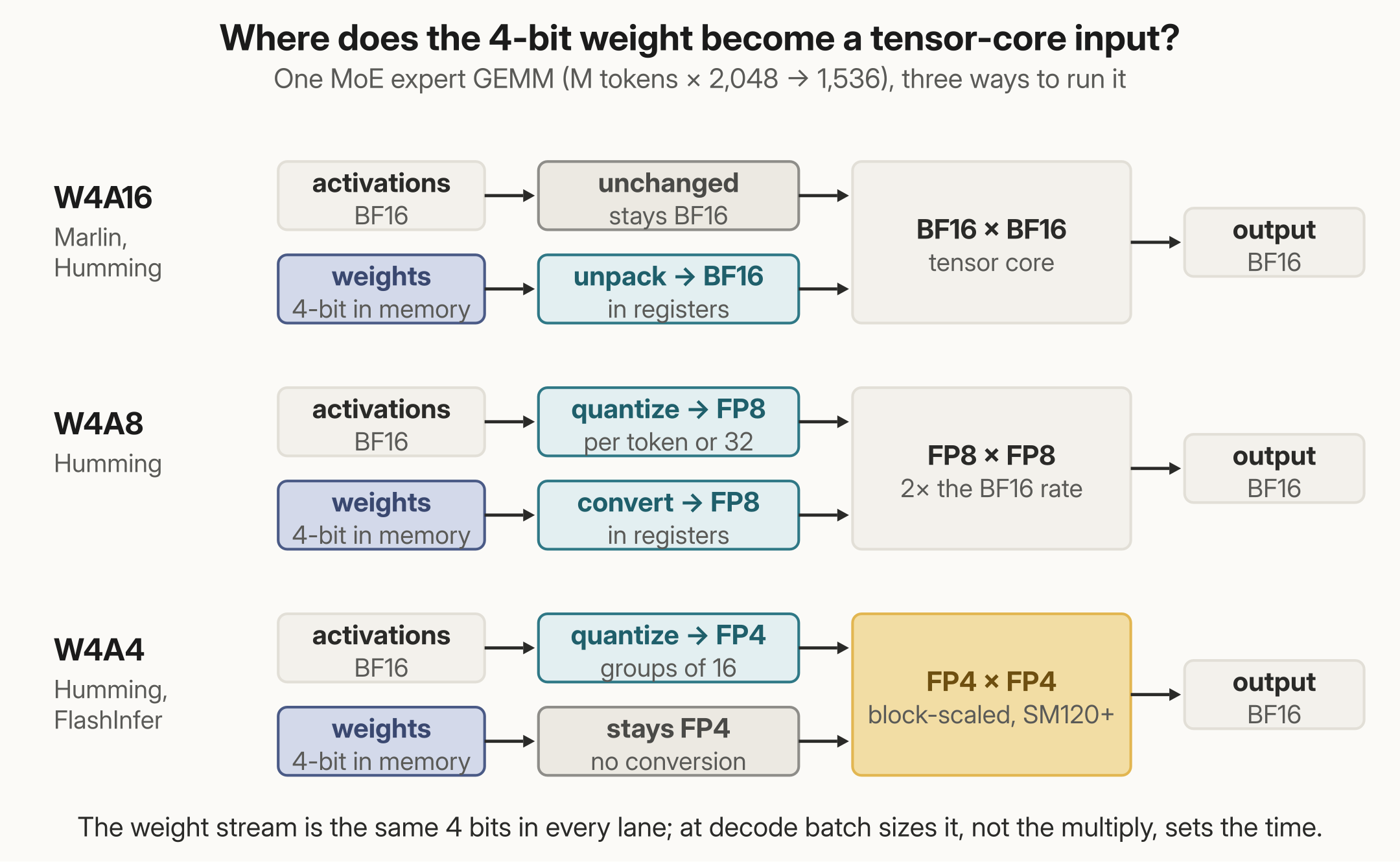
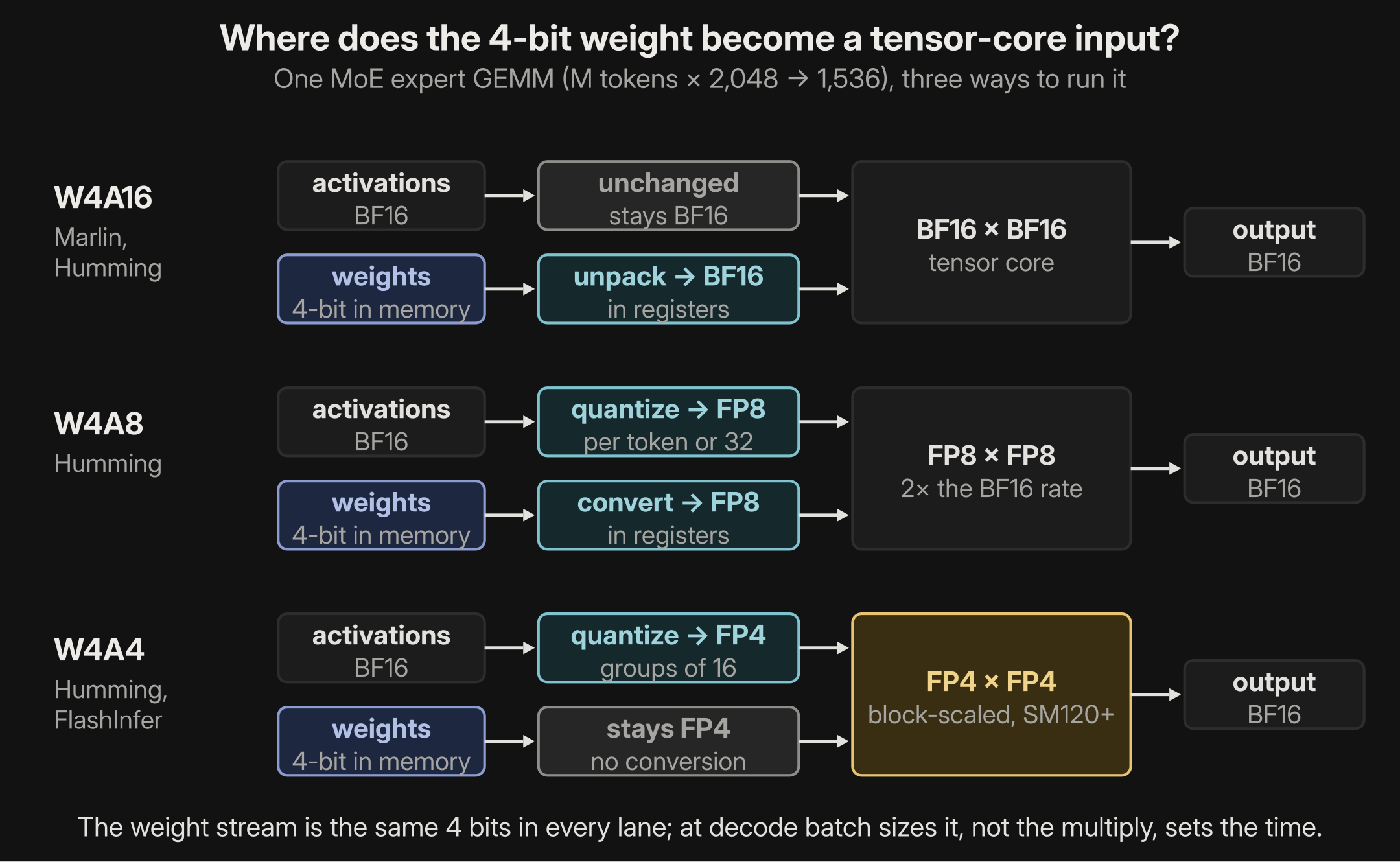
Figure 1: the weight stream is the same 4 bits in all three; what changes is the operand type the tensor core sees and the work done to get there.
W4A16 is Marlin's design: the weights stay 4-bit in memory and are expanded to BF16 in registers just before the multiply. Marlin and Humming both do this; any difference between them is pipelining and tile choice.
W4A8 quantizes the activation at the GEMM input, per token to FP8 for INT4 weights, or to MXFP8 (groups of 32 with power-of-two scales) for MXFP4 weights, and converts the weights to FP8 in registers. FP8 tensor-core throughput is twice BF16's, and the activation read halves; the price is a quantization pass and some accuracy.
W4A4 quantizes the activation to NVFP4 (groups of 16, FP8 E4M3 scales) or MXFP4 and runs the block-scaled FP4 instruction, which exists on SM120 and newer only (README support matrix).
The batch decides how much any of this can matter. In decode, an expert's GEMM has as many rows as tokens routed to it: with 64 requests and 8 of 128 experts per token, 64 × 8 / 128 = 4 rows on average for Qwen3-30B-A3B, and 64 × 4 / 128 = 2 for gpt-oss-120b (4 of 128). At 2 to 4 rows the GEMM is a weight stream, and the multiply's operand type barely shows. Prefill is where W4A8 and W4A4 should pay: an 8,000-token prompt gives each expert about 500 rows. We did not measure prefill; the large gains vendors report (PR #63561's 3.1x 4k prefill on B200, for one) are theirs.
What auto picks, and when the flag is ignored
The backend is chosen per layer type from ordered lists in vLLM's MoE "oracles", and the first entry that supports the GPU and the checkpoint's scheme wins. Read from v0.32.0:
| MoE checkpoint | auto on SM12x (GB10, RTX 50) |
Where Humming sits | What --moe-backend humming does |
|---|---|---|---|
| INT4 / INT8 weight-only (GPTQ, AWQ) | Marlin | after Marlin, batched Marlin and Triton; ahead of Marlin on SM90 only (int_wna16.py) |
Humming W4A16; W4A8 with an env var |
| NVFP4 (compressed-tensors, ModelOpt) | FlashInfer CUTLASS, W4A4 | after FlashInfer, vLLM CUTLASS and Marlin (nvfp4.py) |
Humming with BF16 activations (W4A16) unless the env var is set |
| gpt-oss MXFP4 (native) | Marlin (FlashInfer CUTLASS W4A16 is SM90-only; Triton moved after Marlin on SM12x) | after Marlin (mxfp4.py) |
Humming W4A16; MXFP8 activations with the env var |
| MXFP4 from llm-compressor (compressed-tensors) | Marlin; CUTLASS on SM100 to SM119 only | not a candidate | ignored: Marlin runs (compressed_tensors_moe_w4a4_mxfp4.py); use --quantization humming |
| INT8 W8A8 | MoE Triton; linear layers CUTLASS, which has no INT8 kernel on SM120 (scaled_mm_c3x_sm120.cu) |
the only MoE alternative to Triton | Humming INT8 (not run here) |
SM90 and SM100 behavior is from the same files. The rows we did not run (compressed-tensors MXFP4, INT8 W8A8) are source readings only.
For the dense layers, kernels/linear/__init__.py applies the same Hopper-only promotion to every kernel list (the lists are at L431-L620); Humming is first only for FP8 weight-only layers on GPUs without FP8 compute. --linear-backend humming is a separate flag, and every arm below left the dense layers on auto. In SGLang 0.5.22 the equivalents are --moe-runner-backend humming (or --quantization humming to replace the checkpoint's method) and SGLANG_HUMMING_INPUT_QUANT_CONFIG for activations; its Humming method does not take gpt-oss's MXFP4, and its pinned humming-kernels is older (see Gotchas).
Three behaviors of that table are silent, and two of them change what you are comparing:
- compressed-tensors MXFP4 ignores
--moe-backend. The method consults the flag only for b12x and the MoE-EP megakernels, and otherwise runs Marlin; Humming is reachable only by replacing the quantization method with--quantization humming, which is what vLLM's own CI does fornm-testing/Qwen3-30B-A3B-MXFP4A16. From source; not run. - On an NVFP4 checkpoint,
--moe-backend hummingdrops the activation quantization. The NVFP4 oracle converts the weights for Humming and passes no input schema (nvfp4.py), so the experts run W4A16 next to W4A4 linear layers. A "Humming against FlashInfer" comparison made with the flag alone compares precisions, not kernels. We read it back from the loaded model (below). - The announcement's gpt-oss command drops its activation override on 0.32.0.
--quantization-config.moe.activation mxfp8with--moe-backend humminglogs "Falling back to 'HUMMING' with BF16 activations" (mxfp4.py), and the gpt-oss conversion passes Humming no input schema (L943-L950); PR #62751 fixed it after the release. From source; we used the environment variable instead.
The selection is in the startup log, and it is the first thing to check (lines below from our NVFP4 Humming W4A4 arm, prefixes trimmed):
grep -E "MoE backend|humming moe|Falling back|Using .*Kernel" vllm-server.log
Using FlashInferCutlassNvFp4LinearKernel for NVFP4 GEMM
Using indexed gemm for humming moe
Using 'HUMMING' NvFp4 MoE backend out of potential backends: ['FLASHINFER_TRTLLM', 'FLASHINFER_CUTEDSL', 'FLASHINFER_CUTEDSL_BATCHED', 'FLASHINFER_CUTLASS', 'VLLM_CUTLASS', 'MARLIN', 'HUMMING', 'EMULATION'].
The backend line does not say which activation path runs. For that we loaded each NVFP4 arm offline and read every MoE layer's input_schemas with humming_probe.py: with the flag alone, all 48 report none (16-bit); with the environment variable, float4e2m1.
INT4: Humming ties Marlin
Red Hat's GPTQ build of the model (RedHatAI/Qwen3-30B-A3B-Instruct-2507-quantized.w4a16 at e9c59cd, INT4 in groups of 128), served three ways. The dense layers ran Marlin in every arm.
| Experts | KL | top-1 | GSM8K | TPOT, 1 request | tok/s, 64 requests |
|---|---|---|---|---|---|
Marlin W4A16 (auto) |
0.0735 | 88.6% | 95.5% | 12.60 ms | 850 |
| Humming W4A16 | 0.0736 | 88.6% | 95.2% | 12.51 ms | 805 |
| Humming W4A8 (FP8 per token) | 0.0743 | 88.6% | 95.4% | 12.44 ms | 840 |
KL and top-1 against BF16. GSM8K over 1,319 problems; against BF16's 95.8%, no arm's loss is significant (McNemar p 0.2 to 0.5). TPOT: median time per output token, 8 requests one at a time.
Humming W4A16 computes the same thing as Marlin: KL agrees to the third decimal. It is also no faster. At batch 1 the three arms are within 1.3% (12.4 to 12.6 ms per token), and at 64 requests Humming W4A16 is 5% slower than Marlin (805 against 850 tokens/s; mean time per output token 75 ms against 71). FP8 activations recover most of that (840 tokens/s) and cost almost nothing in KL (0.0743 against 0.0735) or GSM8K. No Humming arm keeps a lead over auto: at 16 requests they were 4% and 8% ahead, at 64 behind.
NVFP4: the default trusted bad scales
We made the NVFP4 checkpoint from the same BF16 weights with llm-compressor 0.14.0.1, using its own recipe for this model family (qwen_30b_a3b.py: 20 calibration samples of up to 2,048 tokens, every expert calibrated, router and lm_head in BF16), 10 minutes, 17 GB; moe_variants.py reproduces it (python moe_variants.py nvfp4 --out <dir>, with --calib-samples to change the count). No published NVFP4 build of the Instruct-2507 model exists.
| Experts | Activations (read back) | KL | top-1 | GSM8K | TPOT, 1 request | tok/s, 64 requests |
|---|---|---|---|---|---|---|
FlashInfer CUTLASS (auto) |
NVFP4, static scales from the checkpoint | 0.319 | 80.4% | 60.3% | 14.67 ms | 788 |
| Humming, flag only | BF16 | 0.047 | 91.3% | 95.8% | 13.84 ms | 763 |
| Humming + env var | NVFP4, groups of 16, scales computed per call | 0.072 | 89.5% | 95.3% | 12.57 ms | 774 |
Dense layers: FlashInfer CUTLASS NVFP4 (W4A4) in all three. GSM8K: the default arm lost 477 of the problems BF16 solved and gained 8 (p < 10⁻¹²⁸); 430 of its 1,319 answers ran into the 1,024-token limit, against 5 to 9 for the Humming arms. The Humming arms' differences from BF16 are not significant.
The default arm is not a slightly worse quantization; it is broken. Its KL is four times Humming W4A4's on the same weights and the same activation format, its 99.9th KL percentile is 9.3 (2.1 for Humming W4A4), and on GSM8K a third of its answers loop until they hit the token limit. Humming W4A4 lands where a working NVFP4 W4A4 should, level with the INT4 W4A16 checkpoint (0.072 against 0.074), and the flag-only arm, with BF16 activations, is better still at 0.047. That last arm is silent case 2 measured: its KL is lower because it is a different precision, and a speed comparison against the default made with the flag alone is one between W4A16 and W4A4.
The cause is the checkpoint's activation scales, not a kernel. An NVFP4 W4A4 checkpoint stores, for each expert's projections, a static input_global_scale measured on the calibration data, and the kernels quantize each group of 16 activations with an FP8 scale relative to it. Humming, configured as above, ignores the stored value and computes its group scales from each call's activations. FlashInfer also shares one stored scale across all 128 experts, their maximum (flashinfer_fp4_moe.py), which was our first suspect: the experts' down-projection inputs spread widely, the widest expert's range 6 times the median expert's in a typical layer and 47 times in the worst (nvfp4_scales.py prints this per layer), so a shared maximum gives the narrow experts a coarse grid. To separate the two, we rebuilt the checkpoint on 31 October with the same recipe and served it four ways, then built it again on more data:
| Experts, rebuilt checkpoint | Activation scales | KL | top-1 |
|---|---|---|---|
FlashInfer CUTLASS (auto) |
stored, max over the 128 experts | 1.195 | 60.1% |
vLLM CUTLASS (--moe-backend cutlass) |
stored, one per expert | 0.989 | 64.1% |
vLLM's reference implementation (--moe-backend emulation) |
stored, max over the experts | 1.166 | 60.3% |
| Humming + env var (W4A4) | computed per call | 0.076 | 89.4% |
| FlashInfer CUTLASS, calibrated on 256 samples instead of 20 | stored, max over the experts | 0.324 | 81.6% |
Same weights in the first four rows. Dense layers in FlashInfer CUTLASS NVFP4 throughout. KL only; GSM8K was not rerun on these builds.
Three implementations that use the stored scales break alike, vLLM's own reference among them. The one that keeps a scale per expert is only slightly better (0.99 against 1.20), so sharing one scale across experts is at most a small part of it. The one that computes its own scales is fine on the same weights. The dense layers, quantized with stored scales by the same recipe and run through FlashInfer in every arm, are fine too, so the problem is in the experts' scales. They are also unstable: llm-compressor's example calibrates on 20 samples drawn from the 512 it loads by an unseeded random sampler, so two builds of the same recipe get different scales, and ours scored 0.319 and 1.195 with the default backend. A build on 256 samples, whose per-layer maximum down-projection ranges came out 1.3 times wider at the median layer (up to 6 times), scored 0.324: no better than our luckier 20-sample build, and still four times Humming's KL. That fits stored ranges too narrow for what the experts see at inference, so their groups saturate; we did not instrument the saturation itself, and one build per setting does not show that more calibration data is enough.
The default backend has no way to know the scales are wrong, and the server starts and answers normally. Check KL before you serve an NVFP4 MoE checkpoint: Red Hat's NVFP4 build of Qwen3.6-35B-A3B ran through the same FlashInfer backend at a KL of 0.056 against its FP8 reference in Quantizing MoE Models, so the backend is not broken in general. A checkpoint that fails can still be served accurately with Humming's run-time scales.
On speed, Humming W4A4 is the fastest NVFP4 arm at batch 1: 14% less time per token than the default, more than the announcement's +9% for the GEMM alone. Not all of it is the FP4 multiply: Humming with BF16 activations is already 6% faster than the default at batch 1. The lead is gone by 16 requests: at 64 the three arms are within 3% (763 to 788 tokens/s), the default ahead.
gpt-oss-120b: where W4A8 pays
gpt-oss-120b ships MXFP4 experts (128 per layer, 4 active) and BF16 attention, and its native MXFP4 path is one where --moe-backend really chooses. auto gives Marlin. With no BF16 model to compare with, KL is against the Marlin arm, and the floor is what changing only the kernel does: Humming W4A16 against Marlin, same weights, same precision.
| Experts | KL vs Marlin | top-1 | GSM8K (200, reasoning low) | TPOT, 1 request | tok/s, 64 requests |
|---|---|---|---|---|---|
Marlin W4A16 (auto) |
reference | 96.5% | 29.31 ms | 321 | |
| Humming W4A16 | 0.018 | 87.8% | not run | 28.75 ms | 330 |
| Humming W4A8 (MXFP8 activations, humming 0.1.18) | 0.026 | 84.9% | 96.5% (1 lost, 1 gained) | 28.22 ms | 349 |
The W4A8 arm ran in a second environment with humming-kernels 0.1.18 installed over vLLM 0.32.0 (--no-deps; only that package differs), because 0.1.17 can write NaN rows with MX-scaled activations when gpt-oss's hidden size (2,880) is padded to 2,944 (humming #157; #62751 reports 0/200 on GSM8K with 0.1.17). That pairing is not one vLLM tested; its smoke test and the arm ran clean.
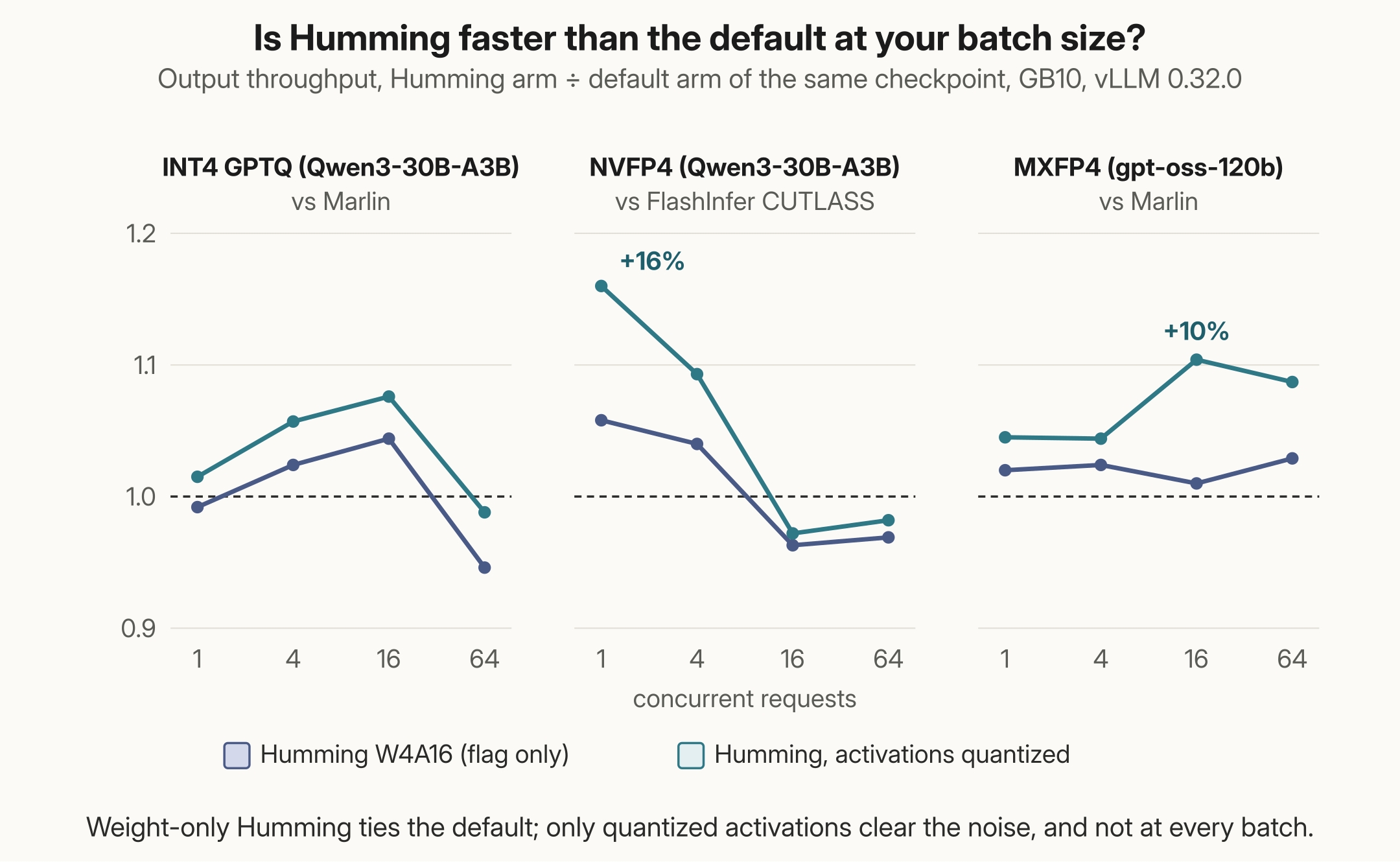
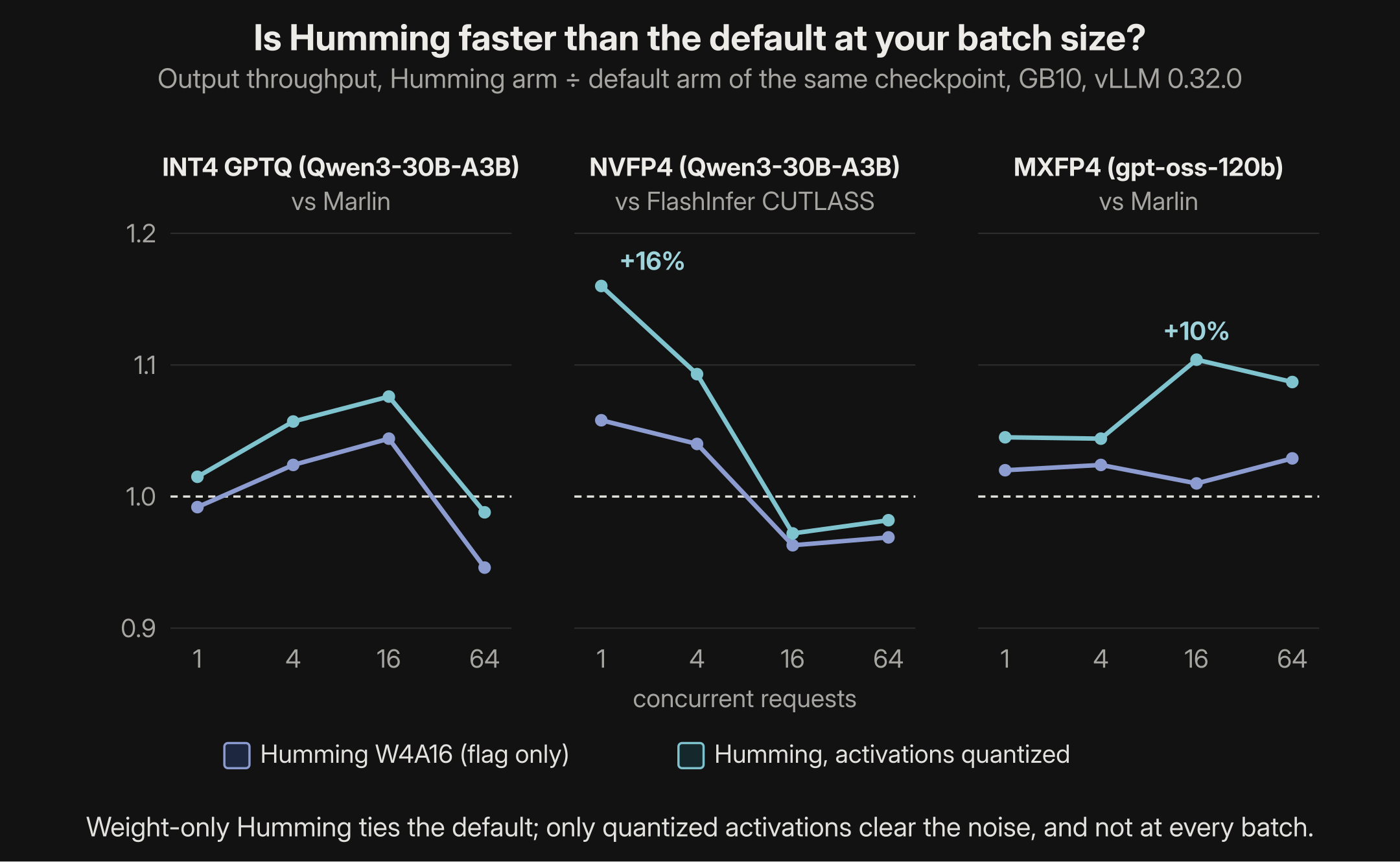
Figure 2: one line keeps its lead at both 16 and 64 requests, gpt-oss W4A8; the NVFP4 W4A4 gain fades by 16.
Humming W4A16 is Marlin's equal here too, 1% to 3% ahead at every batch. MXFP8 activations are the one Humming mode that kept its lead as the batch grew: +4% at 1 and 4 requests, +10% at 16, +9% at 64 (349 against 321 tokens/s), with a KL above the kernel-swap floor (0.026 against 0.018) and the same 96.5% on 200 GSM8K problems. The announcement's +19% for this mode is against FlashInfer CUTLASS MXFP4×MXFP8, a baseline we did not run, so this is not a check of it; against the backend you actually get, the gain is 4% to 10%.
Check it on your GPU
The launch lines, with the flags that matter on their own lines; the memory share is what fit next to other work on our 121 GiB machine, so set yours. Every server below is named m, which the sweep and the eval script expect:
# INT4 weight-only MoE: Humming instead of Marlin
$ vllm serve RedHatAI/Qwen3-30B-A3B-Instruct-2507-quantized.w4a16 --served-model-name m \
    --max-model-len 4096 --max-num-seqs 64 --gpu-memory-utilization 0.40 \
    --moe-backend humming

# ... with FP8 per-token activations into the experts (W4A8)
$ VLLM_HUMMING_INPUT_QUANT_CONFIG='{"dtype":"float8e4m3"}' \
  vllm serve RedHatAI/Qwen3-30B-A3B-Instruct-2507-quantized.w4a16 --served-model-name m \
    --max-model-len 4096 --max-num-seqs 64 --gpu-memory-utilization 0.40 \
    --moe-backend humming

# NVFP4 checkpoint: Humming W4A4 (the flag alone gives W4A16)
$ VLLM_HUMMING_INPUT_QUANT_CONFIG='{"dtype":"float4e2m1","group_size":16,"scale_dtype":"float8e4m3"}' \
  vllm serve <nvfp4-checkpoint> --served-model-name m \
    --max-model-len 4096 --max-num-seqs 64 --gpu-memory-utilization 0.40 \
    --moe-backend humming

# gpt-oss: MXFP8 activations; needs humming-kernels 0.1.18 or later (0.33.0+ pins 0.1.19)
# (the announcement's --quantization-config.moe.activation is dropped on 0.32.0, honored from 0.33.0)
$ VLLM_HUMMING_INPUT_QUANT_CONFIG='{"dtype":"float8e4m3","group_size":32,"scale_dtype":"float8e8m0"}' \
  vllm serve openai/gpt-oss-120b --served-model-name m \
    --max-model-len 8192 --max-num-seqs 64 --gpu-memory-utilization 0.63 \
    --moe-backend humming
Then the sweep, the same for every arm, against the server on port 8000:
$ export TOK=Qwen/Qwen3-30B-A3B-Instruct-2507     # the served model's tokenizer (gpt-oss: openai/gpt-oss-120b)
$ for c in 1 4 16 64; do
    vllm bench serve --backend openai --endpoint /v1/completions --model m --tokenizer $TOK \
      --dataset-name random --random-input-len 512 --random-output-len 256 --random-range-ratio 0 --ignore-eos \
      --seed 7 --request-rate inf --max-concurrency $c --num-prompts $(( c < 2 ? 8 : 4 * c )) \
      --percentile-metrics ttft,tpot,itl --save-result --result-filename arm-c$c.json
  done
And the KL check with quant_evals.py from Measuring the Damage, about 2 minutes per arm:
# once, on the reference server (BF16, or the default arm when no BF16 exists): writes ref/ref-logprobs.json
$ python quant_evals.py --base-url http://localhost:8000/v1 --label ref --out ref/ \
    --tokenizer $TOK --evals logits
# then on each arm
$ python quant_evals.py --base-url http://localhost:8000/v1 --label humming-w4a4 --out arm/ \
    --tokenizer $TOK --evals logits --ref ref/ref-logprobs.json
humming_probe.py loads the model offline and prints, for every MoE layer, the experts class and Humming's input and weight schemas (python humming_probe.py --model <ckpt> --tokenizer $TOK --moe-backend humming --out probe.json, with the same environment variable as the server). nvfp4_scales.py prints, per layer, how far apart the experts' calibrated activation ranges are in an NVFP4 checkpoint (python nvfp4_scales.py <ckpt>, CPU only). A full arm, start to KL to sweep, took about 7 minutes for Qwen (11 with GSM8K) and 15 for gpt-oss.
Gotchas
An NVFP4 MoE checkpoint can carry wrong activation scales, and nothing warns you. Our llm-compressor build loaded, served and answered, and the default backend scored 60% on GSM8K. Two builds of the same 20-sample recipe differed by a factor of four in KL. Run the KL check on every NVFP4 build, or serve it with run-time scales (Humming W4A4).
Two of the silent cases above give no warning you will notice. Compressed-tensors MXFP4 ignores --moe-backend entirely, and the announcement's gpt-oss W4A8 command runs W4A16 on 0.32.0 (its environment-variable replacement needs humming-kernels 0.1.18: 0.1.17 can write NaN rows on gpt-oss's padded hidden size). Read the log line every time.
INT8 W8A8 still does not load on SM12x with auto. The first INT8 linear kernel is CUTLASS, which has no SM120 implementation, which is why W8A8 on this site recorded INT8 as not running on this GPU. Triton and Humming INT8 kernels exist behind --linear-backend (from source; not run).
The same flag is a different kernel in SGLang. SGLang 0.5.22 pins humming-kernels 0.1.12, which predates the SM120 and SM121 performance tuning (first in 0.1.13); vLLM 0.32.0 pins 0.1.17, without 0.1.18's MoE heuristics. SGLang's Humming method (--quantization humming) also does not take gpt-oss's MXFP4 checkpoints (humming.py): "gpt-oss has a special weight loading logic, so we don't support it now". From the pins; not run.
Since 0.32.0
The measurements stay on 0.32.0; vLLM 0.33.0 (2 November) and 0.34.0 (16 November, the current release) change what you do to reproduce them. From the release notes and the source at the tags; not rerun.
- gpt-oss W4A8 needs no second environment. Both releases pin humming-kernels 0.1.19 (
requirements/cuda.txt), which carries the NaN fix from #157, and 0.33.0 honors--quantization-config.moe.activationfor Humming MXFP4 (#62751), so the announcement's command now runs MXFP8 activations. The environment variable still works and, when set, wins. - Marlin has no W4A8 path any more. 0.34.0 removes the INT8 and FP8 activation paths vLLM had added to Marlin (#65542); setting
VLLM_MARLIN_INPUT_DTYPEis now a startup error that points to--quantization hummingwithVLLM_HUMMING_INPUT_QUANT_CONFIG(envs.py). None of our Marlin arms used it; for 8-bit activations on a 4-bit MoE checkpoint, Humming is now the path. - Unchanged.
autostill prefers Humming only on SM90 (priority.py), and #63561 is still open. On NVFP4, the flag alone still gives BF16 activations: the oracle still passes Humming no input schema (nvfp4.py). Compressed-tensors MXFP4 still ignores--moe-backend humming(compressed_tensors_moe_w4a4_mxfp4.py). SGLang 0.5.23 still pins humming-kernels 0.1.12 (pyproject.toml), so the skew with vLLM has grown. - The memory share. The launch lines set
--gpu-memory-utilizationbecause our GPU was shared. 0.34.0 defaults it to 1.0 with the extensible KV cache on, and its release notes advise leaving it unset on a GPU that runs nothing else.
Verdict
With vLLM 0.32.0 on this GPU, by format:
| Checkpoint | Decode, 1-4 requests | Decode, 16-64 requests |
|---|---|---|
| INT4 GPTQ | keep auto (Marlin): Humming W4A16 within 2.5%; W4A8 +2% to +6% |
keep auto: Humming W4A16 5% slower at 64; W4A8 +8% at 16 and −1% at 64, no consistent gain |
| NVFP4 from llm-compressor | check KL first; ours needed Humming + env var (W4A4): accurate, and 8% to 14% less time per token | Humming + env var: within 3% of the default's speed |
| gpt-oss MXFP4 | either: Humming within 2% to 5% | Humming + MXFP8 activations, humming 0.1.18: +9% to +10%, KL cost 0.007 over the kernel floor |
Humming is not a free 2x on this GPU; in decode it is a tie with Marlin on weight-only formats, a 9% gain where its W4A8 path has no rival in auto, and on NVFP4 the one backend that ran our checkpoint correctly, because it computes the activation scales the checkpoint got wrong. The decision rule is the same whatever your GPU: read the backend and activation path from the log or the probe, sweep the batch sizes you serve, and run the KL check before trusting a faster arm, or a default one. Prefill is not in this table and is where W4A8 and W4A4 should matter most; add it to your sweep if your prompts are long.
Quantizing MoE Models is the other half: which parts of an MoE to quantize in the first place. The kernel decides the speed; the recipe decides the damage. DeepGEMM covers the other kernel family behind MoE layers: FP8 grouped GEMM.
Sources
- vLLM blog, "Announcing Humming: Fast, Flexible Kernels for Quantized Inference" (2026-10-21).
- vllm-project/humming v0.1.18 (README,
docs/config.md,humming/tune/sm121.py); PR #157 (2026-10-21). - vLLM source at v0.32.0:
quantization/utils/humming/priority.py,fused_moe/oracle/{int_wna16,nvfp4,mxfp4}.py,quantization/utils/flashinfer_fp4_moe.py,compressed_tensors_moe_w4a4_mxfp4.py,kernels/linear/__init__.py,csrc/quantization/w8a8/cutlass/scaled_mm_c3x_sm120.cu;requirements/cuda.txtat v0.22.0. - vLLM PRs #61556 (in 0.32.0), #62751 and #62816 (after 0.32.0), #63561 (still open on 2026-11-21), #65542 (in 0.34.0); release notes for v0.33.0 and v0.34.0.
- SGLang v0.5.22:
python/pyproject.toml,srt/layers/quantization/humming.py; v0.5.23:python/pyproject.toml. - llm-compressor 0.14.0.1:
examples/quantization_w4a4_fp4/qwen_30b_a3b.py,src/llmcompressor/datasets/utils.py. - NVIDIA Technical Blog, "3 Ways to Boost MoE Inference on NVIDIA DGX Spark" (2026-10-27).
- Model cards: Qwen/Qwen3-30B-A3B-Instruct-2507 @
0d7cf23, RedHatAI/Qwen3-30B-A3B-Instruct-2507-quantized.w4a16 @e9c59cd, openai/gpt-oss-120b @b5c939d.