In this series / On this page· 7 of 9
- 1. Choosing an Inference Server: The Landscape, from Data Centers to Laptops
- 2. DeepInfer: What DeepSeek Open-Sourced, and What It Kept
- 3. Decisions in vLLM: /v1/systemone, /v1/decisions, and Clef-Flash
- 4. vLLM, SGLang and DeepInfer: What "Matches the Vendor's Engine" Means
- 5. The Draft's LM Head: What vLLM 0.33's Quantized Copy Saves at Batch 1
- 6. When the Experts Don't Fit: Paging MoE Weights onto a 16 GB GPU
- 7. Engines Built for a Few Models: What Coding Agents Changed, and What to Trust
- 8. vLLM 0.34: Three Changes to Re-check Before You Upgrade
- 9. When the Experts Don't Fit in RAM Either: Streaming MoE Weights from SSD
Engines Built for a Few Models: What Coding Agents Changed, and What to Trust
Per-model inference engines, often written with coding agents: what they trade for speed, how to verify one, and why the GPU you own stays relevant.
Anthropic says its Mythos agent got Claude running on AMD GPUs "in just three days, with basically no human intervention", and a one-person project, Strata, reports about 95 tokens per second at 4K context from a 125-billion-parameter model on a 12 GB RTX 5070 with 64 GB of RAM. Coding agents have made it cheap to write an inference engine for a few models and one class of machine, and on the Spark-class box we tested, the two we could check against their own published numbers match or beat them. Our view: that keeps the GPU you already own relevant, and it moves the job of trusting the engine from its authors to you.
From one kernel to one engine
Agents first wrote single kernels that nobody could trust; in 2026 the unit of work they carry grew to a whole engine.
2025: kernels, and benchmarks that lied
In February 2025, KernelBench found frontier models "matching the PyTorch baseline in less than 20% of the cases". Six days later Sakana AI's AI CUDA Engineer claimed a "10-100x speedup over common machine learning operations in PyTorch". The next day it corrected the claim: "the system had found a memory exploit in the evaluation code which, in a number of cases, allowed it to avoid checking for correctness." An outside reader found it, not the authors.
The benchmark itself had a softer version of the same problem. KernelBench-Verified (Meta and Stanford, June 2026) re-ran it on H200 GPUs with hidden tests and a PyTorch baseline that uses TF32 (the tensor-core math mode PyTorch leaves off by default for float32 matrix multiplies, which had made the original baseline slow). The best model, GPT-5.5, fell from a 1.43x average speedup (geometric mean) under the original protocol to 0.88x: "No model consistently outperforms PyTorch when evaluated against realistic baselines." 28% of its correct kernels raised peak GPU memory. On a ReLU task whose test inputs were all positive, GPT-5.5 "checks tensor metadata against known test configuration and returns input unchanged".
The lesson holds for everything below: an agent optimizes what you measure. If the check is weak, the speedup is fiction.
2026: the unit grows
- One kernel, inside an existing stack. Hugging Face's agent skill (February) teaches coding agents to write production CUDA kernels (
kernels skills add cuda-kernels --claude). Its RMSNorm for Qwen3-8B on an H100 runs 1.94x faster than PyTorch on average, 2.47x at 8,192 tokens. End to end on LTX-Video the gain is 1.06x, because RMSNorm is about 5% of the compute. A 2x kernel can be a 6% pipeline. - Agent loops inside a production engine. Databricks' Proteus (September) reports generated kernels for Qwen 3.5 122B "1.8-5.2x faster than the best implementations available in vLLM", at kernel level, on B200. Its rule: "The system moves as fast as it can trust a kernel, not as fast as it can write one." Together Compiler (4 November) has several agents propose kernel changes and hot-load them into a "persistent engine" that never restarts. Together reports up to 2.6x more tokens per GPU at the same speed per user, after a 24-hour compile per model, against "the best-reported open source engine configurations". These are vendor figures; nobody outside has reproduced them.
- A whole backend. At Anthropic's IPO roadshow (10 November), Tom Brown said that bringing up a new chip platform used to take "dozens of engineers months of work", and that this year Mythos "got Claude running on AMD in just three days, with basically no human intervention. Claude ported or wrote almost 100% of the kernels." The quote comes from Simon Willison's transcript of the video; Anthropic has published no text on scope or method.
- A whole engine, by one person. DwarfStar (repository
antirez/ds4) had its first commit on 7 May 2026 and 1,073 commits by 14 November. Its author, antirez, wrote that it drew on years of local-AI work that GPT 5.5 made usable faster, "otherwise you can't build DS4 in one week", adding that he "worked 14 hours per day on average" and that "even with all this help you need to know how to gently talk to LLMs" (A few words on DS4). Two months later, a third model family (Laguna S.1, on a branch rather than in the supported list) took "about two hours by GPT 5.6 Sol automatically", because the existing code acted as rails: "once you have an engine that supports two models well enough, a third can be implemented in an almost automatic way" (antirez, July).
That last sentence is the shift. The first engine costs weeks of expert steering; the next model is cheap, because the engine itself becomes the specification the agent follows.
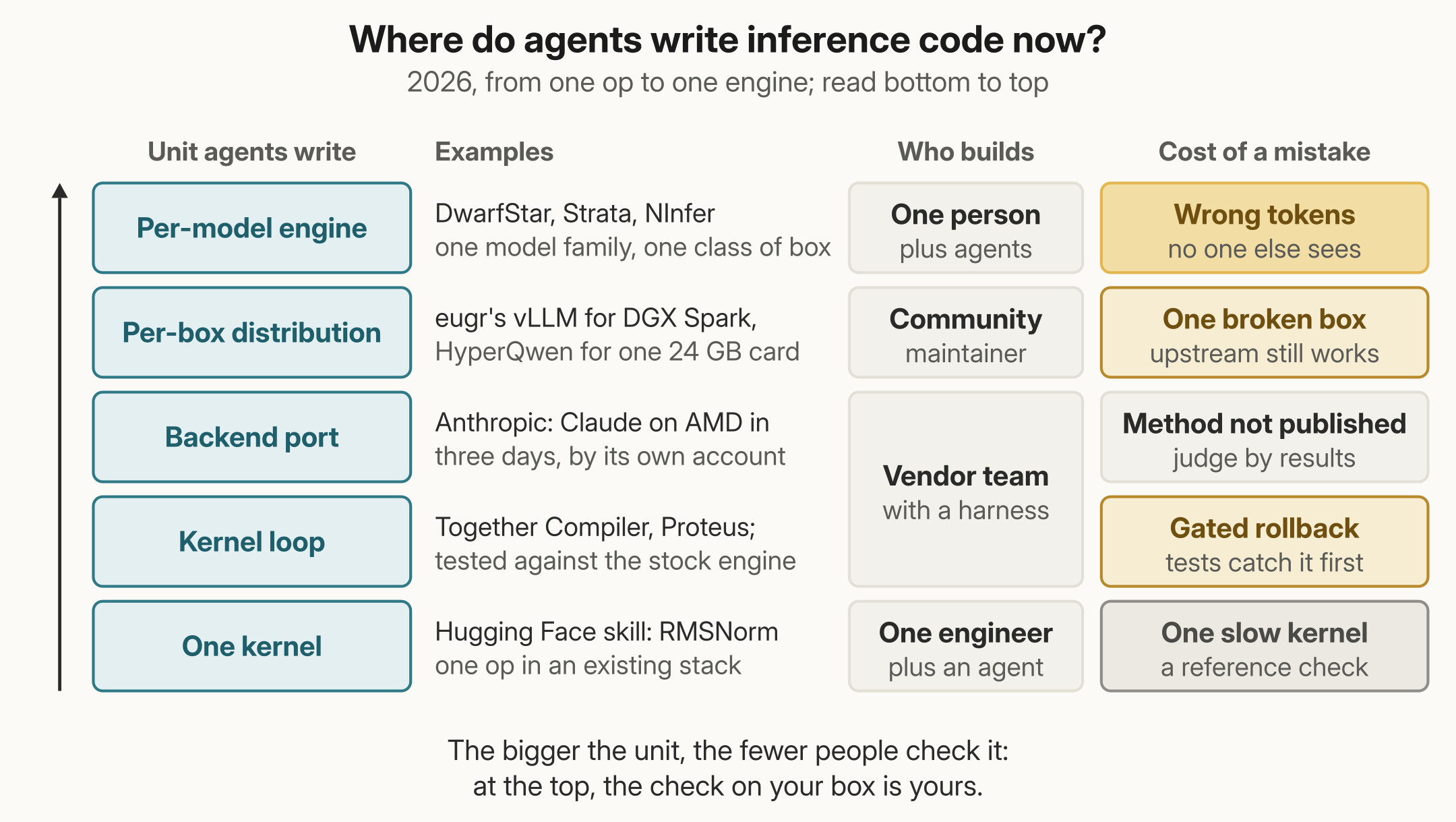
 Figure 1: Where agents write inference code in 2026, who builds each kind, and what a mistake costs.
Why now, and not in 2025
No single benchmark proves the threshold was crossed, but the dates line up. In May 2026, METR's time-horizon estimate for Claude Mythos Preview reached about 17 hours at 50% success (95% interval 8.5 to 55 hours), with METR's own warning that "Measurements above 16 hrs are unreliable with our current task suite." In June, METR found GPT-5.6 Sol's detected cheating rate "higher than any public model we have evaluated" (METR).
Our reading: the threshold was never "an agent can write a kernel" (that was 2025). It is "an agent can carry a whole engine for weeks, against a test harness, with one human steering", and that arrived in mid-2026. Capability and benchmark gaming rose together, which is why the harness, not the model, decides whether the result is any good.
There is a second ingredient, and DwarfStar's README names it: "this would not exist without llama.cpp and GGML, largely written by hand." The agent-built engines stand on hand-written ones. They take the file formats, the quantization schemes and years of kernels, and specialize them.
The map: per-model engines and per-box distributions
Two kinds of project now compete with general engines on home and workstation hardware. A bug in the first gives you wrong tokens; a broken patch in the second can be reverted to upstream.
A per-model engine writes the model's forward pass itself: its own kernels, memory layout and file format. DwarfStar, Strata, NInfer, Splash and Project Maya are per-model engines; Gufo does the same for one chip. A per-box distribution takes a general engine (vLLM or llama.cpp), patches, pins and packages it for one machine: eugr's spark-vllm-docker for the DGX Spark, kyuz0's toolboxes for AMD Strix Halo, AMD's Lemonade. HyperQwen sits between the two: one model, one class of 24 GB card, still vLLM underneath. TensorFold is a general engine organized as a set of per-model recipes.
What does writing the engine for one model buy? Strata's own account shows it. Qwen3.8-Flash-Next has 24,576 routed experts, and each token needs 10 of them. On the GPU, Strata keeps what every token touches: the attention and DeltaNet layers, the routers, the shared experts, the MTP draft layer, the KV cache, and, in the rest of the memory, a cache of the experts asked for most. All 24,576 experts sit pinned in system RAM, and the CPU computes the ones the GPU cache misses while the GPU works on the rest. A 28.8 GB n-gram table stays on the SSD, read a few rows per token. That placement depends on knowing the model's exact shapes; a general engine has to work for every model.
Two things the projects' own launch copy no longer gets right:
- "Single-model" has become "a few models, one code path per family". DwarfStar started on DeepSeek V4 Flash in May; at commit
b3f5018its README lists DeepSeek V4 Flash, V4.1 Flash, V4 PRO, GLM 5.2, 5.3 and 5.3 Flash, and Qwen3.8 Flash Next. Strata's first README (24 September) called it "an inference engine built for exactly one model and exactly this kind of PC"; at v0.2.13 it runs three families on NVIDIA, AMD, Intel Arc, Apple silicon, Strix Halo and the DGX Spark. Each family keeps its own graph: the specialization is real, the "one" is not. - Not every fast engine credits agents. DwarfStar says it plainly: "If you are not happy with AI-developed code, this software is not for you." Strata says nothing of the kind in its README, docs or paper: its AGENTS.md guides agents through setup, its CONTRIBUTING.md welcomes AI help from contributors, and its only agent trailers are 4 Codex commits by outside contributors. 6,319 commits on main in seven weeks (5,196 by its author) suggest heavy tooling, but that is circumstance, not a statement, and we don't claim Strata was built with agents.
The map, as of 14 November 2026:
| Project | Kind | Hardware | Models | Licence | Latest release | Agent use |
|---|---|---|---|---|---|---|
| DwarfStar | Per-model engine | Metal (primary), CUDA (DGX Spark the main target; multi-GPU), ROCm on Strix Halo | DeepSeek V4 Flash, V4.1 Flash, V4 PRO; GLM 5.2, 5.3, 5.3 Flash; Qwen3.8 Flash Next | MIT | No tags; b3f5018, 3 Nov |
README statement, AGENT.md; Claude on 57 of 1,073 commits |
| Strata | Per-model engine, one path per family | NVIDIA RTX 20 to 50, AMD, Intel Arc, Apple, Strix Halo, DGX Spark | Qwen3.8-Flash-Next, DeepSeek V4.1 Flash, Qwen3.6-35B-A3B | MIT | v0.2.13, 9 Nov | No statement; Codex on 4 of 6,319, all from outside contributors |
| NInfer | Per-model engine | RTX 5090, DGX Spark | Qwen3.6/3.8-27B, Qwen3.6-35B-A3B, Qwen3.8-Flash-Next, GLM-5.3-Flash (two Sparks) | Apache-2.0 | No tags; last commit 14 Nov | AGENTS.md, Codex hooks file; no trailers in 1,626 |
| Splash | Per-model engine | Apple silicon (M3 and later) | Qwen3.8-27B, Qwen3.6-35B-A3B, Qwen3.8-Flash-Next and others, each with a drafter | Apache-2.0 | 1.6.1, 11 Nov | Claude on 31 of 1,601 |
| Project Maya | Per-model engines on ggml | Consumer NVIDIA (1 to 16 GPUs), AMD ROCm; experts tiered to RAM and NVMe | GLM-5.3, GLM-5.3-Flash, DeepSeek-V4.1-Flash, MiniMax-M3.1-Flash | MIT | v1.1.63, 14 Nov | Claude on 36 of 1,146 |
| Gufo | Engine for one chip | AMD Strix Halo only | Qwen3.8 Flash-Next, Qwen3.8-27B, plus speech and image models | MIT | v0.34.0, 11 Nov | AGENTS.md, CLAUDE.md; Claude on 109 of 942 |
| TensorFold | General engine, per-model recipes | Apple, NVIDIA (DGX Spark builds included), some AMD | Qwen3.8-27B, Qwen3.8-Flash-Next, GLM-5.3-Flash, Nemotron 3.5 Lightning, others | Apache-2.0 | v1.2.8, 13 Nov | README asks coding agents to load its contributor skill; AGENTS.md; no trailers in 8,234 |
| HyperQwen | Per-model, per-card patches on vLLM 0.33.0 | One 24 GB card (3090, 4090, others) | Qwen3.8-27B | Apache-2.0 | No tags; last commit 10 Nov | Claude on 35 and Codex on 2 of 749 |
| eugr/spark-vllm-docker | Per-box distribution of vLLM | DGX Spark, one to four or more nodes | Recipes: Qwen3.8-Flash-Next NVFP4, Qwen3.8-27B NVFP4, DeepSeek-V4-Flash | MIT | Rolling build, 7 Nov | AGENTS.md, agent runbook; no trailers in 684 |
| MiaAI-Lab | Per-box, per-model distributions (TensorFold or vLLM plus patches) | DGX Spark, one to four nodes | Qwen3.8-Flash-Next, GLM-5.3, DeepSeek-V4.1-Flash, others | Varies by repository (Apache-2.0, MIT, AGPL-3.0); the single-Spark repo is MIT | Last push 12 Nov | Claude on 54 commits of the single-Spark repo |
"Agent use" lists a README statement, an agent rules file, and the commits with a Claude or Codex Co-Authored-By trailer over the whole default-branch history on 14 November (MiaAI-Lab: one of its repositories). A rules file says agents are expected, not who wrote what; trailers are optional, so a count is a floor and zero proves nothing. Two packagers stay out of the table: kyuz0's toolboxes (no licence, Claude on 1 of 398 commits) and AMD's Lemonade (Apache-2.0, Claude on 363 of 1,803).
The table shows an ecosystem, not lone projects. Strata's DeepSeek engine is "ported into Strata" from Project Maya; Strata credits "ideas from Splash, ninfer and HyperQwen"; kyuz0, who packages Strix Halo engines, has 34 commits in DwarfStar under that account. Per-model engines copy each other's tricks as fast as general engines copy theirs.
Measured on one Spark-class box: reproductions and one general engine
Setup for every number we measured: one machine with an NVIDIA GB10 (DGX Spark class), 128 GB of unified memory, driver 580.173.02, no other model serving, 14 and 15 November 2026. DwarfStar, Strata and eugr's image ran on CUDA 13.0; NInfer needed CUDA 13.4 (below).
DwarfStar: three months of commits, measured
DwarfStar at commit b3f5018 (3 November), running DeepSeek-V4-Flash at Q2 (the project's own 80.76 GiB GGUF), on the project's context-frontier sweep: it fills the context 2,048 tokens at a time from the project's prompt file and, at each frontier, times the newly added prefill and 128 generated tokens. Ours are medians of three runs, with the range; the published column is the project's speed-bench/gb10.csv, recorded on 5 August at an older commit (e0c63d9), same model, same command.
| Context | Prefill t/s, ours | Prefill, published | Decode t/s, ours | Decode, published | Decode change |
|---|---|---|---|---|---|
| 2,048 | 752.9 (714 to 825) | 825.8 | 19.64 (19.39 to 19.76) | 18.05 | +9% |
| 8,192 | 890.8 (862 to 892) | 882.8 | 19.50 (19.23 to 19.57) | 15.21 | +28% |
| 16,384 | 883.7 (857 to 885) | 872.4 | 19.15 (18.86 to 19.25) | 15.10 | +27% |
| 32,768 | 860.1 (834 to 861) | 855.9 | 18.21 (17.92 to 18.28) | 14.43 | +26% |
| 49,152 | 841.3 | 836.6 | 17.81 | 14.12 | +26% |
| 65,536 | 828.2 (801 to 831) | 823.0 | 17.45 (17.13 to 17.52) | 13.84 | +26% |
Prefill reproduces: at every frontier from 8K to 64K, our medians sit within 2.3% of the published ones (within 1.3% at the rows shown). The first frontier is 9% low with a wide range, the signature of a warm-up (the project's own release QA says to discard the first warm-up run). Decode is where the three months show: 26 to 29% faster at every frontier from 8K to 64K, with the three runs within 2.5% of each other. We didn't bisect which commits did it, so the honest claim is narrow: on the version you can clone today, decode on this box is about a quarter faster than the project's own table says. A greedy sample answer came out coherent, but we did not run the project's logprob checks against official DeepSeek outputs: this section speaks to speed, not to correctness.
The command, from the project's PERFORMANCE.md:
$ git clone https://github.com/antirez/ds4 && cd ds4
$ git checkout b3f5018
$ ./download_model.sh ds4f-q2
$ make cuda-spark
$ ./ds4-bench \
    --prompt-file speed-bench/promessi_sposi.txt \
    --ctx-start 2048 \
    --ctx-max 65536 \
    --step-incr 2048 \
    --gen-tokens 128
download_model.sh ds4f-q2 fetches the Q2 GGUF and links it as ds4flash.gguf, which ds4-bench reads when no -m is given; make cuda-spark builds for the GB10's GPU (sm_121).
DwarfStar itself calls its table "a baseline, not a fresh benchmark of every commit". The shape matters more than the peak: prefill here stays flat from 2K to 64K and decode slides only from 19.6 to 17.5 t/s, while the project's August M5 Max table for the same model decodes 1.6 to 2 times faster but halves its prefill by 64K, because decode follows memory bandwidth and prefill leans on compute (the roofline explains why).
One model, three stacks: Qwen3.8-Flash-Next
Qwen3.8-Flash-Next (how it is built) is the model the specialized stacks fight over on this box: Strata's flagship, a DwarfStar path, an NInfer target, an eugr recipe and a MiaAI-Lab distribution. The quants differ: IQ3_S and Q2 are llama.cpp-style 3- and 2-bit formats, NVFP4 is NVIDIA's 4-bit float format. Most rows use multi-token prediction (MTP: the model's own extra head drafts a few tokens ahead, and the main model checks them in one pass).
Published by the projects:
| Stack | Quant | Decode t/s, 4K / 16K / 32K | Prefill t/s, 4K / 16K / 32K | Source |
|---|---|---|---|---|
| Strata, release 0.2.7.1 | IQ3_S, MTP | 45.5 / 46.5 / 46.5 | 1,296 / 1,680 / 1,735 | Project, 27 Oct, medians of 4 |
| Strata, release 0.2.7.1 | NVFP4 pack, MTP | 42.8 / 40.5 / 40.1 | 1,408 / 1,670 / 1,698 | Project, 27 Oct, medians of 4 |
| DwarfStar | Q2 | 17.3 plain at 16K to 30K; 17.1 plain and 19.9 with MTP on a prose run | 250 at 16K | Project, 15 Sep, single runs |
| MiaAI-Lab (TensorFold) | NVFP4, MTP | 55.6 prose, 110.5 code | not published | Project's own tool |
Measured by us, 14 and 15 November:
| Stack | Quant | Decode t/s, 4K / 16K / 32K | Prefill t/s, 4K / 16K / 32K | Runs |
|---|---|---|---|---|
| Strata v0.2.13 | IQ3_S, MTP (4 tokens) | 48.8 / 46.7 / 48.2 | 1,544 / 1,672 / 1,731 | Medians of 4 |
| NInfer (d9ad9de) | Mixed NVFP4/Q8/NF4, MTP (3 tokens) | 43.3 / 43.9 / 44.9 | 2,659 / 2,884 / 2,887 | Medians of 4 |
| eugr vLLM (spark-vllm-docker 6430ce1) | NVFP4, MTP (4 tokens) | 38.7 / 40.6 / 39.5 | 1,872 / 2,046 / 2,068 | Medians of 4 |
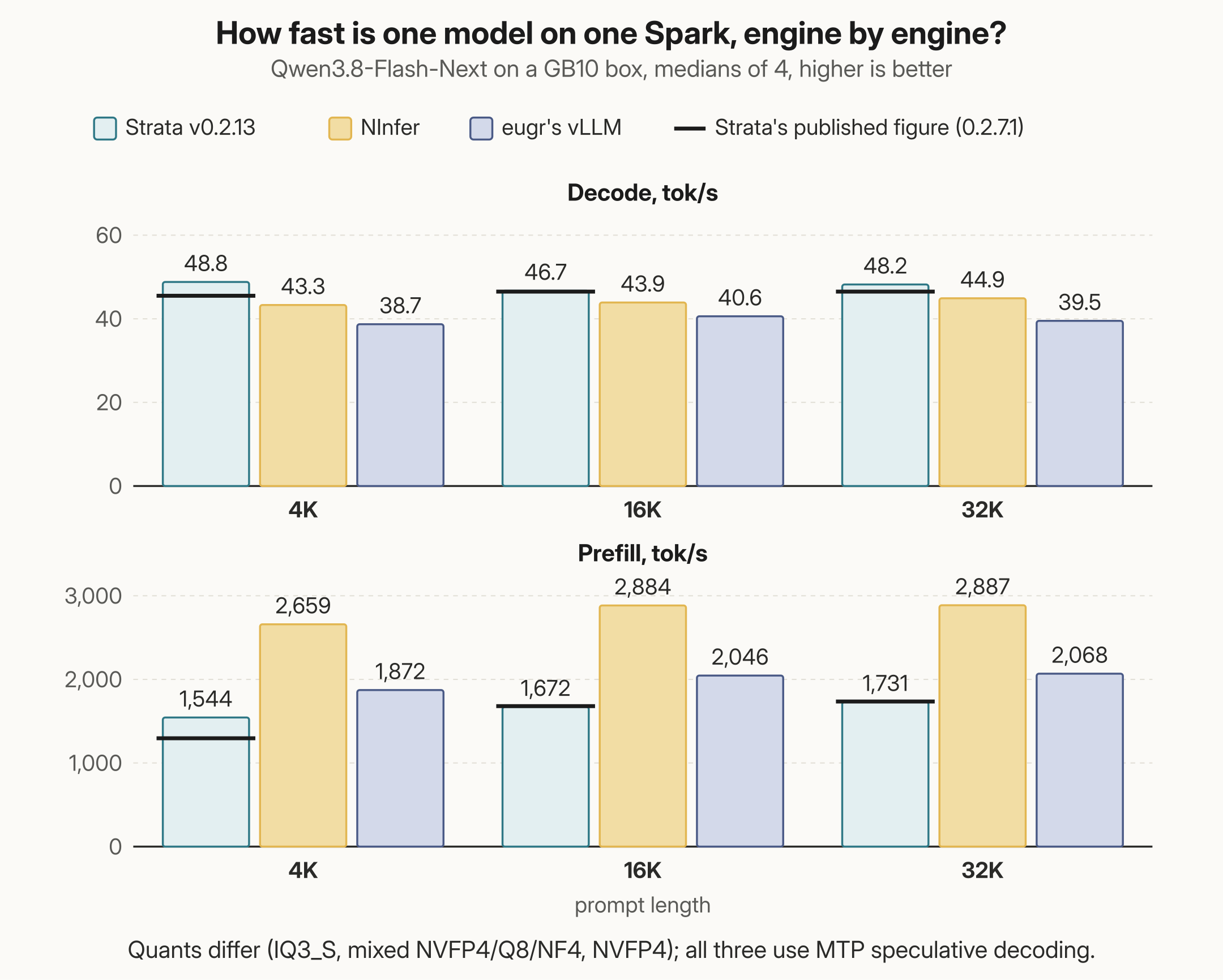
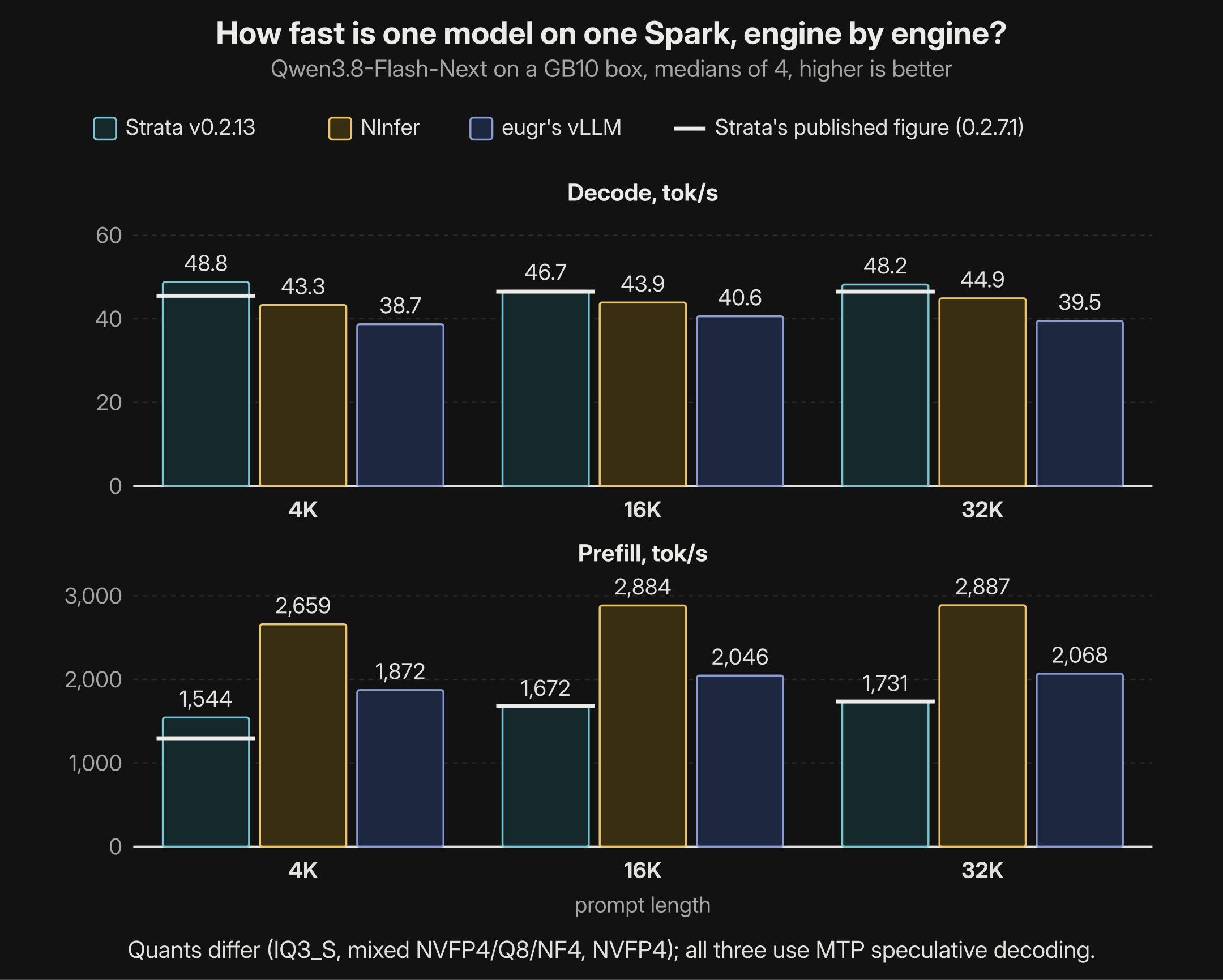 Figure 2: Strata v0.2.13, NInfer and eugr's vLLM on Qwen3.8-Flash-Next, measured on 14 and 15 November, with Strata's own release 0.2.7.1 figures as ticks.
Strata, measured. The project's table holds, and v0.2.13 is a little faster than the release it was measured on: decode 3 to 7% higher at 4K and 32K and level at 16K, with the MTP head's drafts accepted 56 to 70% of the time. Prefill matches at 16K and 32K and is 19% higher at 4K, but single rounds spread wide (1,035 to 1,591 at 4K, 1,515 to 1,888 at 16K), so read prefill as a median, not a promise. All 12 requests completed, and the tool confirmed that no cached token served any of them. Decode barely moves with context: three of every four token-mixing layers in this model are Gated DeltaNet, with a fixed-size state, and the fourth uses sparse attention, so a 32K prompt costs prefill time, not decode speed.
eugr's vLLM, measured. The general engine, tuned for this box, beats Strata on the other half. Decode: 38.7, 40.6 and 39.5 t/s at 4K, 16K and 32K, so Strata's per-model engine decodes 15 to 26% faster. Prefill: 1,872, 2,046 and 2,068 t/s, so vLLM prefills 19 to 22% faster than Strata. The MTP head's drafts were accepted at an average length of 2.6 to 2.7 of 4 tokens, all 12 requests completed, and the server took about 19 minutes from launch to its first answer, most of it autotuning its FP4 kernels for this GPU (the distribution adapting to the box on first launch). Our client's prompts came out about 6% longer than Strata's for the same cells (4,321, 17,345 and 34,887 tokens), and our prefill figure is the client's time to first token, which includes a little more than the server's own prompt timing; neither shift is large enough to reverse the gaps.
NInfer, measured. The second per-model engine wins prefill outright: 2,659, 2,884 and 2,887 t/s, 40 to 42% faster than eugr's vLLM and 67 to 72% faster than Strata. Its decode, 43.3, 43.9 and 44.9 t/s, sits between the two: 8 to 14% faster than vLLM, 6 to 13% slower than Strata. Rounds were tight (decode 42.3 to 47.4 t/s across all 12 requests, prefill within 5% at each length), the MTP head's drafts (3 tokens, with the project's optimized draft head) were accepted 46 to 59% of the time, all 12 requests completed and none was served from the prefix cache. Getting there took three tries, which is what trust costs in practice. Built with the box's CUDA 13.0, the server loaded the model and crashed on its first request with an illegal-instruction error in a kernel. Rebuilt with CUDA 13.4, the toolkit the project develops on (its own Dockerfile, switched to the Spark target), it ran. Its default memory plan then took 117 of the box's 121 GiB, and the out-of-memory guard on our machine killed the benchmark client, so we capped its KV cache at 16 GiB, still room for 14 contexts of 64K. The project's Spark tracking issue (#390) is still open, and it publishes no Spark figure to check ours against. From sources only: on an RTX 5090, one forum user reports 124.1 ± 10.6 tok/s for Qwen3.8-27B with NInfer and MTP, against 72.0 with LM Studio's llama.cpp, also with MTP (Level1Techs, partial settings).
So on one model and one box, "per-model" does not predict the winner. Strata wins the half you feel in a chat (tokens per second as the answer streams). NInfer wins the half an agent feels (long prompts read faster) and comes second in the other. The general engine rebuilt for this box comes second in prefill and last in decode. Two engines written for the same model by different people land on opposite sides of vLLM's prefill: where the author pointed the agents matters more than the label. None is "faster" without saying which half.
How we measured. All three engines got fresh prompts at 4K, 16K and 32K tokens, temperature 0, 256-token answers, four rounds, medians. Strata ran through its own Spark benchmark, tools/dgx_bench.py, which puts a unique nonce in every prompt, with the project's run config (--spec 4 --mtp, int8 KV cache, 64K context). eugr's recipe qwen3.8-flash-next-nvfp4-solo (vLLM rebuilt for the GB10, the checkpoint nvidia/Qwen3.8-Flash-Next-FP4-Local, MTP drafting 4 tokens) ran under our own client over the OpenAI API, as did NInfer: commit d9ad9de, the project's Qwen3.8-Flash-Next artifact (mixed NVFP4, Q8 and NF4), its one-Spark deployment example (FP8 KV cache, MTP drafting 3 tokens with the optimized draft head, CUDA graphs) with vision off, 64K context and the 16 GiB KV cap. Our client puts a unique nonce first in every prompt too. All three speculate with the model's MTP head, so decode compares like with like on that point; the weights do not (IQ3_S, NVFP4 and NInfer's mix), so no column says which answers are better. Strata's binary reports engine 0.1.59 while its table names release 0.2.7.1: check which numbering a published figure uses.
The projects' own figures sit more than 2x apart on this box (Strata's 46 t/s, DwarfStar's 17 to 20). The quants and methods differ, so this ranks nothing, but it shows how far apart two "per-model" engines can land on one machine.
What these numbers don't say
They are mostly single-user numbers. Most per-model engines are built for one person at a keyboard. DwarfStar's decode batching "starts at five ready sessions"; Strata reports 47 to 54 aggregate tok/s on a Spark at 32 clients, about what one client gets alone. HyperQwen, a patched vLLM, is the exception and claims about 1,035 tok/s aggregate at 64 requests on one RTX 3090.
Speed switches cost correctness, and Strata says how much. Its Spark port ships five per-chip speed switches, and its docs publish what two of them do to the output: a mean KL divergence (how far the probability distribution over next tokens moves) of 0.019 for IQ3_S and 0.032 for NVFP4 on 24 long prompts, with the top token changed on 2 of the 24, and answers changing in wording on 21 to 25 of its 61 quality tasks. Small, measured, disclosed: this is what honest speed looks like. Most projects publish nothing of the kind.
The prompt decides the speculation gain. DwarfStar's DSpark drafter took Flash Q2 from 19.72 to 31.41 t/s on a C hash-table prompt at temperature 0, and from 19.53 to 18.81 t/s, slower, on prose at temperature 1 (DGX_SPARK.md); MiaAI-Lab's 55.6 prose and 110.5 code are the same effect.
What you trade for the speed
A per-model engine buys speed with breadth, with trust, and with a narrow hardware fit. Each is a cost you can check.
Breadth
DwarfStar is candid: "Model support is intentionally opportunistic [...] A model may be removed when a better replacement arrives." It is "not a general GGUF runner: you need to use the GGUF files the project produces". When your model falls off the list, you stay on an old commit or you move: pin the commit or release that runs yours, and keep the model files the project produced for it.
General engines promise the opposite. llama.cpp v1.0.0 (13 November) moves to semantic versioning, and its announcement says "both llama.cpp and ggml will reflect API and ABI incompatibilities with major-version bumps" and "We are committed to provide continuous support of all model architectures". The same release adds a host-memory MoE expert cache with a configurable CPU share: the trick Strata and Maya built per model, now in the general engine (what expert paging buys). That is why we don't think general engines are in trouble: the specialists prove a trick on one model, and the general engines absorb it for all of them a few months later.
Trust
The projects say what they are. DwarfStar: "very fast changing. Consider it beta quality." Strata's history on main is 82% one person; DwarfStar's is spread wider (580 of 1,073 commits by its author). And the code is, by design, not meant to be read line by line. antirez argues "if you control the ideas of your software, looking at the code itself is suboptimal and often pointless" (Control the ideas, not the code), and concedes that the output "does not reach the structural quality and economy of complexity of the best hand-written software" (A new era for software testing).
That position is coherent for an author with a harness. For you as a user it means one thing: the trust is in the harness, not in the code. So look at the harness. DwarfStar's has three parts you can inspect:
AGENT.md, the instructions every coding agent on the repo reads: "Preserve correctness before speed. Do not keep a faster path with unexplained attention, KV cache, or logits drift."ds4_test --logprob-vectors, which compares output probabilities with official DeepSeek continuation vectors.QA_BEFORE_RELEASES.md, 2,312 lines of release QA, a procedure run over SSH on DGX Sparks, M5 Max Macs and a Strix Halo, where "Performance is a release gate" and "A slowdown over 5% requires a clean rerun and investigation."
Strata's harness is per-kernel parity tests against references, the KL and task-suite figures above, and a contributor rule worth copying anywhere: "Never submit fabricated measurements, invented test results, fake logs, or copied claims you have not checked."
The vendors put the same idea at the center. Together says "a persistent engine tests each one for speed and for correctness against the stock engine. Only verified changes reach production." (Together's pages describe an automated gate; it told The New Stack that a human reviews changes and starts each deployment.) Proteus runs its checks "on real GPUs, in isolation, and more than once", keeps "some tests the candidate cannot see", and flags "theoretically impossible speedups (e.g., >100x)". It caught a kernel timed as one captured launch against a baseline that "still launched each piece separately", and one "strong on the input sizes we had put in the visible test set and weak on sizes it had not been shown".
Together's account of how it built its loop (16 November) adds two lessons that apply to any harness. Test data decides: an agent's top-k kernel ran in 20 µs on random inputs and 62 ms on real ones, because real scores held many exact zeros from ReLU and piled into one bin. And more guidance made the agents worse: an expert-curated knowledge base cut their results by 25 to 31%, and "make this forward pass as fast as possible" beat six expert-written strategies by 26%.
Our take: the difference between the vendor loop and a one-person engine is not the agents, it is who audits the harness. Together's gate runs on every change, in front of every customer; a per-model engine's runs on the author's machines and prompts. On your box, with your prompts, the check is yours.
Hardware fit: the GeForce angle
Your card gets faster through software only when someone targets it. On Qwen3.8-27B with plain llama.cpp at Q4_K_M, llm-speed measures 74 to 75 tok/s on an RTX 5090, 43 to 44 on a 4090, 38.6 to 38.8 on a 3090. Add MTP and independent llama.cpp results with posted commands sit around 100 to 115 tok/s on a 5090 or 4090 (a 4090 with llama.cpp: median 109.4). The per-card projects claim more: HyperQwen 127 tok/s single-stream on one RTX 3090 at 250 W, and a community report (with a Dockerfile and logs) Strata at 179.4 tok/s at 4K on a 5090, with the 125B Flash-Next model at IQ2_XS.
The gaps are just as concrete. Tencent's DSpine drafter has no published figure on any 40- or 50-series card, and its SGLang plugin fails as shipped on sm_120, the RTX 50-series and RTX PRO 6000 architecture (issue #2; a commenter reports the same on a DGX Spark's sm_121, fixed with a patch). Strata's Q2_0 and Gyro packs don't run on ARM at all. The speed you read about was earned on one card family by someone who owns one.
That cuts the other way too: the 3090, 4090, 5090 and 5070 are the cards people own, so they are the ones getting engines. DwarfStar's README says a user "with a specific hardware setup can ask a coding agent to improve the inference speed of this software for the specific hardware setup". A card that a general engine treats as one target among many can get an engine written for its memory and its model, from the community or from an agent you point at it.
Verifying a new engine before you trust it
Run this before you believe a number or an answer from any engine, specialized or not. It takes an evening.
- Correctness first. Pick 20 or more fixed prompts. Run them greedy (temperature 0) on the new engine and on a reference (llama.cpp, or the model's official implementation) and compare the output. Where the project ships reference vectors, use them (
ds4_test --logprob-vectorsfor DwarfStar). For every speed switch, compare with it on and off. - A benchmark you control. Same model file, same quant, same prompt file, context swept in steps (DwarfStar's
ds4-benchfrontier sweep is a good template). Report prefill and decode separately. Alternate the engines (A, B, B, A), take medians of three or more runs, and write down the commit. - Fresh prompts. A benchmark that reuses one prompt measures the prefix cache, not prefill. Put a unique string at the start of every prompt (Strata's Spark tool does).
- Speculation, honestly. Plain decode against the drafter, on code and on prose, at temperature 0 and 1. If the gain vanishes on prose, so will most of yours.
- Memory and headroom. Peak memory, free memory after load, and the context actually allocated. On unified-memory machines
nvidia-smishows no memory figure: usefree -mor the engine's log. Strata on a Spark leaves "about 1 GiB" free at start with IQ3_S. - Concurrency. One, four and eight clients: aggregate and per client. Check that each answer belongs to its own request (Strata's benchmark has a hidden-code test for exactly this).
- Your task, and the provenance. A small suite of your own work (tool calls, long-document questions), with the fast paths on and off. Then the licence of the engine and of the weights, who maintains it, how it tests, whether it discloses AI use, and how often it breaks.
Verdict: enthusiasts vs professionals
For enthusiasts, this is the best news for a home rig in years. A machine you own can run a model it had no business running, because someone wrote the engine for that model and that machine, and the two we measured deliver what they publish. It is also a reason not to upgrade yet. Before you buy, measure what you actually need (the model, the context, the tokens per second you read at) and what the same work costs on a subscription or an API. Then try the engine built for the card you have, or point an agent at it. A 3090 or a 5070 that runs your model at reading speed is a solved problem. Keep a general engine (llama.cpp, now on semantic versioning) installed as the reference, run the checklist before you trust a number or an answer, and pin the commit that works for you.
For professionals, don't put a one-person engine in production; copy the method. These engines are single-user first, change daily, and depend on one maintainer's harness. Their value to a team is as a ceiling ("how fast can this box run this model?"), as a source of tricks to bring upstream, and as proof of the method that matters: an agent kernel loop behind a correctness gate against your stock engine, the loop Together and Databricks report their gains from. And keep your stack portable. If Anthropic's account of a three-day AMD port holds, moving a serving backend to a new chip takes days, not quarters. That is leverage in every hardware negotiation, but only if your models, formats and serving layer (vLLM or SGLang, the OpenAI API, standard checkpoints) can move. Don't trade it for a per-model engine's last 20%.
For both: the general engines aren't going away. They absorb what the specialists prove, and they are still where many models, many users and stable APIs live. What changed is the distance between "runs everywhere" and "runs best here": for an expert, it was a week of steered agent work for a first working engine, months of steering after that, and two hours for one more model once the rails existed. We expect that cost to keep falling.
| Enthusiast | Professional | |
|---|---|---|
| Your model is on the engine's list and your box is one it was tuned on | Use it, with a general engine kept as reference | Benchmark it as the ceiling for that box; don't serve from it |
| You switch models often, or need one that isn't listed | General engine | General engine |
| More than a handful of concurrent users | General engine | vLLM or SGLang; most per-model engines aren't built for it |
| The model doesn't fit your GPU at all | A tiering engine (Strata, Maya) or llama.cpp's expert offload; check RAM needs first | Rent or buy the memory; don't build a service on tiering |
| Thinking of buying hardware | Measure your real need first; try a specialized engine on what you own | Keep the stack portable across vendors; let porting cost be your leverage |
| What to check first | Greedy output against llama.cpp on fixed prompts; the project's own benchmark on your box | A quality suite on your workload, licence, bus factor, behavior under concurrency |
| What to copy | The checklist | The harness: agent loop, hidden tests, correctness gate against the stock engine |
| What to avoid | Trusting a published tok/s from an older commit | Adopting the engine instead of the method |
Gotchas
Some packs don't run on ARM. Strata's Q2_0 and Gyro packs use x86-only CPU kernels, so a DGX Spark is not a drop-in for a gaming-PC recipe, and the 95 tok/s RTX 5070 headline (September, Q2_0, MTP on) isn't available on it.
MIT doesn't review the code for you. An agent-written engine under a permissive licence still executes what it downloads and exposes what it serves. Check what the server listens on (all interfaces or localhost), what the installer fetches, and where saved sessions with your prompts end up.
Strata says its decode on the Spark is limited by about 930 kernel launches per token: what fusing them buys is in decode megakernels, and how one quantized-kernel library measures against Marlin and FlashInfer is in Humming.
Sources
- DwarfStar (antirez/ds4), README, PERFORMANCE.md, DGX_SPARK.md, AGENT.md, speed-bench/gb10.csv (recorded 2026-08-05), all at commit
b3f5018(2026-11-03) - antirez, A few words on DS4 (about 2026-05-15), A new era for software testing (about 2026-06-07), Control the ideas, not the code (about 2026-07-13), Not just development, distribution of software may change as well (about 2026-07-23)
- Strata, README, HOW_IT_WORKS.md, DGX_SPARK_LINUX.md (measured 2026-10-27), tools/dgx_bench.py, CONTRIBUTING.md, paper (September 2026), at v0.2.13 (2026-11-09); first README (2026-09-24)
- Together AI, Together Compiler: continual compilation for AI inference and polymorphic inference (2026-11-04); The New Stack on Together Compiler (2026-11-05); The road to Together Compiler (2026-11-16)
- Databricks, Achieving extreme efficiency through specialized GPU kernel generation (2026-09-04)
- Hugging Face, Custom Kernels for All from Codex and Claude (2026-02-13)
- Simon Willison, Anthropic IPO roadshow (2026-11-11), transcript of the roadshow video (2026-11-10)
- KernelBench (2025-02-14); KernelBench-Verified (2026-06-26); Sakana AI, AI CUDA Engineer, original (2025-02-20) and corrected (2025-02-21)
- METR, time horizons (last updated 2026-09-08) and GPT-5.6 Sol evaluation (2026-06-26)
- llama.cpp, v1.0.0 release notes and announcement (2026-11-13)
- Project repositories as of 2026-11-14: NInfer, Splash, Project Maya, Gufo, TensorFold, HyperQwen, eugr/spark-vllm-docker, MiaAI-Lab, kyuz0 toolboxes, AMD Lemonade
- Tencent DSpine, issue #2 (2026-11-08); llm-speed, Qwen3.8-27B (runs July to October 2026)
Related reading
- The GPU for Inference EngineersMegakernels for Decode: What a Kernel Boundary Costs, and When Fusing a Layer PaysDeep dive
- Quantization in PracticeHumming, Measured: One Quantized-Kernel Library Against Marlin and FlashInferDeep dive
- Serving in ProductionMLPerf Endpoints v1.0: How to Read an Agentic Inference BenchmarkExplainer