In this series / On this page· 14 of 15
- 1. NVFP4 on Blackwell: Serving a 4-Bit Model End to End
- 2. Quantization, Mapped: Weights, Activations, KV Cache
- 3. How Much Does Each Bit Cost? Size, Speed, and Quality, Measured
- 4. Post-Training Quantization: Rounding, Calibration, and the Outlier Problem
- 5. GPTQ, Explained and Run
- 6. AWQ: Protecting the Weights That Matter
- 7. SmoothQuant and W8A8: Quantizing Activations Too
- 8. Rotations for 4-Bit Activations: QuaRot, SpinQuant, and Friends
- 9. Quantization-Aware Training: When the Model Learns Its Own Precision
- 10. Quantizing the KV Cache: FP8 and Below
- 11. GGUF Quant Types Decoded: K-Quants and I-Quants
- 12. Quantizing Mixture-of-Experts Models
- 13. Measuring the Damage: Evaluations That Catch Quantization Errors
- 14. Quantization Tools Compared: LLM Compressor, ModelOpt, AutoRound
- 15. Humming, Measured: One Quantized-Kernel Library Against Marlin and FlashInfer
Quantization Tools Compared: LLM Compressor, ModelOpt, AutoRound
Qwen3-8B quantized by LLM Compressor, ModelOpt, and AutoRound, served on vLLM and SGLang: what each writes, costs, and loses, measured.
We quantized one model, Qwen3-8B, to the same two schemes with LLM Compressor, NVIDIA's ModelOpt, and Intel's AutoRound, using each tool's documented default recipe, then served every checkpoint with vLLM and SGLang and scored it against BF16 problem by problem. The tools don't separate on task results. What does separate them is the file each one writes, whether the engines load it, and what it costs to produce: from 2 minutes to almost 5 hours for NVFP4.
The setup for everything below: Qwen3-8B, one NVIDIA GB10 (121 GiB of memory shared by CPU and GPU), llmcompressor 0.14.0.1, nvidia-modelopt 0.47.0, auto-round 0.16.1, each in its own environment with PyTorch 2.13, then vLLM 0.32.0 and SGLang 0.5.22. The two schemes are W4A16 (4-bit integer weights in groups of 128, activations in BF16) and NVFP4 (4-bit float weights and activations in groups of 16, with FP8 scales; see NVFP4 on Blackwell). lm_head stays in BF16 everywhere, each tool's default.
The answer
| You want | Use | Why |
|---|---|---|
| A checkpoint for vLLM or SGLang | LLM Compressor | Writes compressed-tensors, which both engines loaded for both schemes here; fastest here (2 min for NVFP4, 18 for GPTQ); calibrates one layer at a time, so peak GPU memory stayed at 3.2 GiB for an 8B model |
| The 4-bit integer checkpoint closest to BF16 (KL) | AutoRound, W4A16 | KL from BF16 0.044 against 0.069 for GPTQ, same kernel, same speed; 40 minutes instead of 18. No task result separated the two |
| NVFP4 for NVIDIA's stack, or matching NVIDIA's own checkpoints | ModelOpt, NVFP4 | 6 minutes, loads in both engines; task results within the spread of the others |
| INT4 from ModelOpt | TensorRT-LLM only | Its int4_awq checkpoint (W4A16_AWQ) is refused by vLLM 0.32.0 and SGLang 0.5.22 |
| FP8 weights and activations, Hopper or Blackwell | LLM Compressor (FP8_DYNAMIC, no calibration data) or ModelOpt (--qformat fp8) |
Both formats are in both engines' loaders (vLLM's ModelOpt path lists FP8, SGLang has modelopt_fp8); not measured here |
| NVFP4 on a GPU before Blackwell | Prefer W4A16 or FP8 | No FP4 tensor cores: both engines ship a weight-only Marlin path for FP4 (marlin_utils_fp4.py), so the activations stay 16-bit anyway; not measured here |
| A mixture-of-experts model | See Quantizing MoE Models | What you leave unquantized matters more than the tool |
| To know whether your checkpoint lost anything | A paired test against BF16, with code | The 4-bit integer checkpoints from both tools lost 7 to 9 HumanEval points in both engines; GSM8K showed nothing |
Others, one line each, versions as of 27 October 2026 and not measured here: GPTQModel 7.7.0 writes GPTQ checkpoints that both engines list; AMD's Quark 0.13 targets ROCm first and has a quark loader in both engines; torchao 0.18.0 quantizes inside PyTorch and vLLM has a torchao loader; bitsandbytes 0.50.2 quantizes at load time, with no calibration; llama.cpp writes GGUF files, covered in GGUF Quant Types Decoded.
Three tools, three files
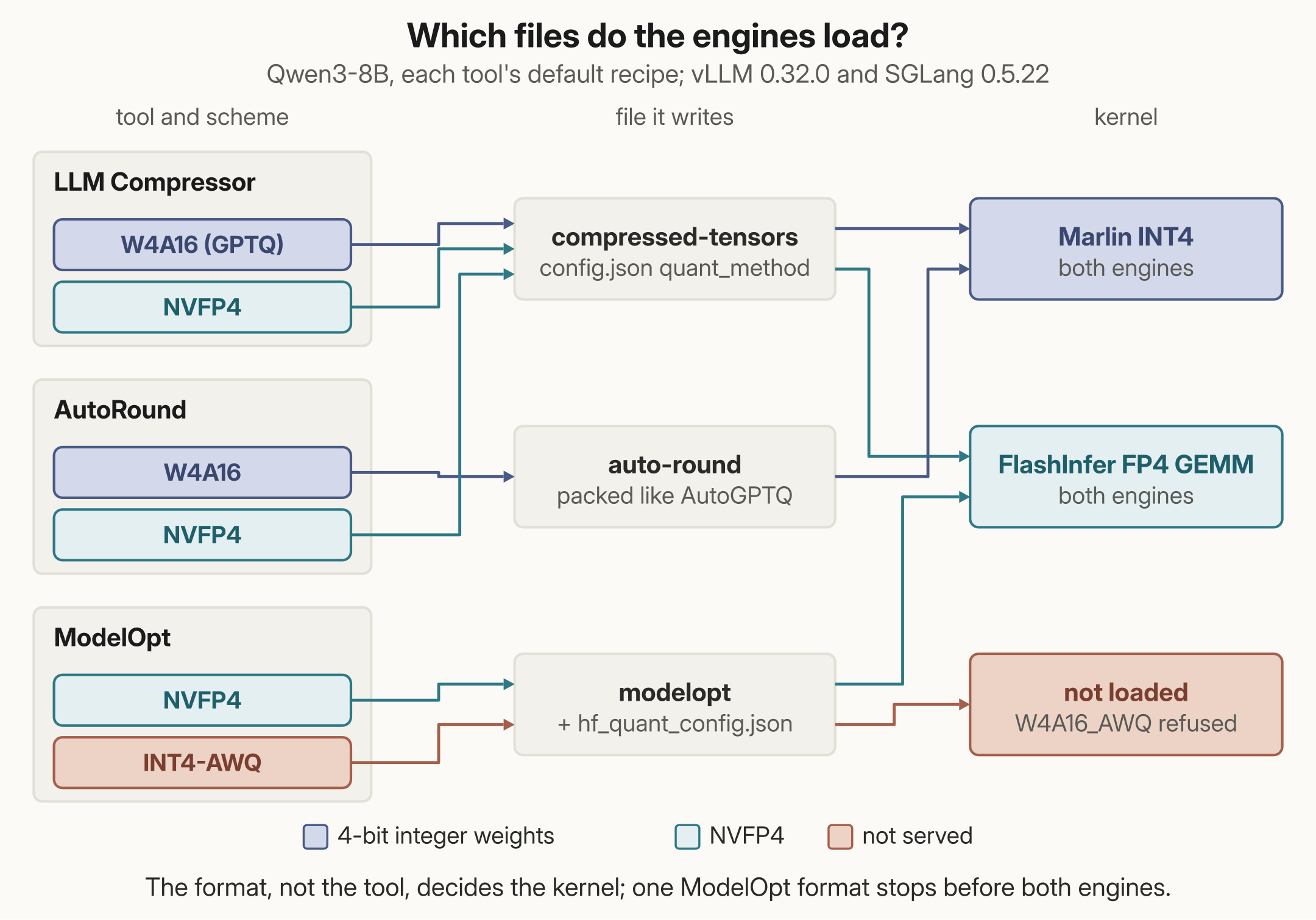
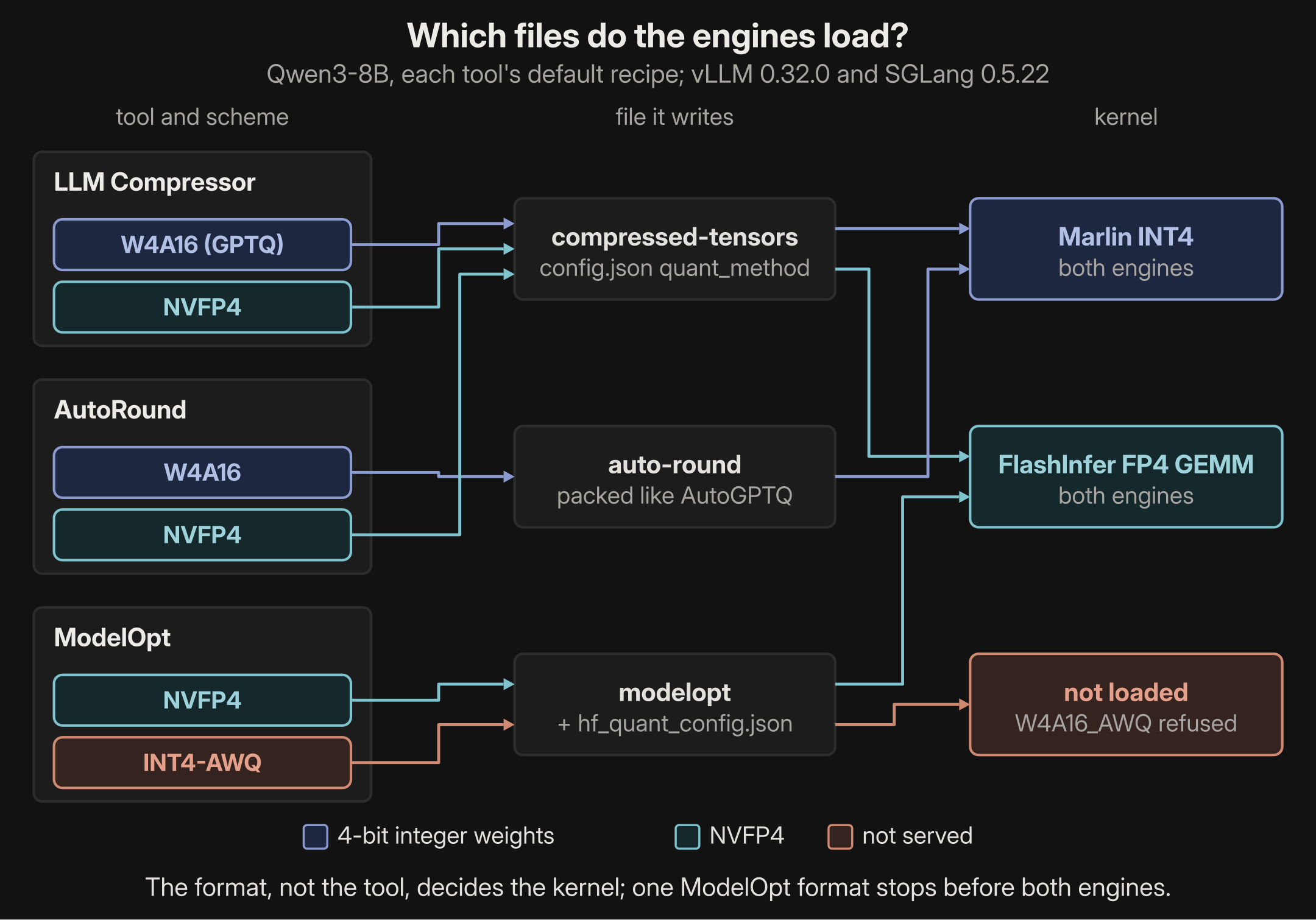 Figure 1: every path but one ends on a kernel in both engines. The tools differ in the file they write; the engines detect the format from
config.json without any flag. vLLM's kernels are from its logs, SGLang's from its source (it logs none).
- LLM Compressor (Red Hat and the vLLM project) runs modifiers over a model:
GPTQModifier,AWQModifier,SmoothQuantModifier, rotations, and anAutoRoundModifier. It writesquant_method: compressed-tensorsinconfig.json, with aformatper scheme:pack-quantizedfor INT4 weights,nvfp4-pack-quantizedfor NVFP4. Most earlier pieces in this series used it (GPTQ, AWQ, SmoothQuant). - ModelOpt (NVIDIA) quantizes through presets (
--qformat fp8,nvfp4,int4_awq,nvfp4_awq_lite,w4a8_awq_beta, and more) and exports a Hugging Face checkpoint withquant_method: modeloptand a separatehf_quant_config.jsonthat names the algorithm (NVFP4,W4A16_AWQ). It also targets TensorRT-LLM, which is where some of its formats stop. - AutoRound (Intel) learns the rounding: for each block of layers it tunes, by signed gradient descent, how far each weight is pushed up or down before rounding and how much each group is clipped, 200 iterations per block by default. It writes its own format (
quant_method: auto-round, packed like AutoGPTQ) or exports to the others:auto_gptq,auto_awq,llm_compressor, GGUF.
The tools no longer stand apart. LLM Compressor 0.14.0.1 depends on auto-round and runs it as a modifier. AutoRound recommends exporting NVFP4 in LLM Compressor's format, and that is what we did, so two of the six checkpoints are compressed-tensors files from different tools.
Producing the checkpoints
Each command is the tool's own example; we changed only the paths and, for ModelOpt, the two flags explained below. LLM Compressor, W4A16 with GPTQ (examples/quantization_w4a16/llama3_example.py at 0.14.0.1):
# condensed from scripts/gx10/quant_tools.py (llmc-w4a16)
model = AutoModelForCausalLM.from_pretrained("Qwen/Qwen3-8B", dtype="auto")
oneshot(model=model, dataset="perfectblend", splits="train[:512]",
        recipe=GPTQModifier(targets="Linear", scheme="W4A16", ignore=["lm_head"]),
        max_seq_length=2048, num_calibration_samples=512)
model.save_pretrained(out, save_compressed=True)
For NVFP4 the example swaps in QuantizationModifier(targets="Linear", scheme="NVFP4", ignore=["lm_head"]) and 20 calibration samples: no GPTQ, the data only sets the global scales. AutoRound, both schemes:
# condensed from scripts/gx10/quant_tools.py (ar-w4a16, ar-nvfp4)
from auto_round import AutoRound
AutoRound("Qwen/Qwen3-8B", scheme="W4A16").quantize_and_save(out, format="auto_round")
AutoRound("Qwen/Qwen3-8B", scheme="NVFP4").quantize_and_save(out, format="llm_compressor")
ModelOpt, from its examples/hf_ptq directory at 0.47.0:
$ python hf_ptq.py \
    --pyt_ckpt_path Qwen/Qwen3-8B \
    --qformat nvfp4 \
    --dataset cnn_dailymail \
    --kv_cache_qformat none \
    --export_path ./mo-nvfp4
The two flags we added are both gotchas (below): the default dataset is gated, and the default --kv_cache_qformat fp8_cast also quantizes the KV cache, which would make the comparison unfair.
| Checkpoint | Calibration (tool default) | Time | Peak GPU memory | Size |
|---|---|---|---|---|
| LLM Compressor, W4A16 (GPTQ) | 512 perfectblend samples, 2,048 tokens | 18 min | 3.2 GiB | 5.7 GB |
| LLM Compressor, NVFP4 | 20 samples | 2 min | 2.9 GiB | 6.0 GB |
| AutoRound, W4A16 | 128 pile-10k samples, 2,048 tokens, 200 iterations | 40 min | 9.7 GiB | 5.7 GB |
| AutoRound, NVFP4 | same | 4 h 46 min | 32.7 GiB | 6.0 GB |
| ModelOpt, INT4-AWQ | 1,024 cnn_dailymail samples, 512 tokens | 53 min | 19.2 GiB | 5.8 GB |
| ModelOpt, NVFP4 | same | 6 min | 22.0 GiB | 6.0 GB |
Peak GPU memory is PyTorch's peak allocation. BF16 Qwen3-8B is 16.4 GB.
LLM Compressor's low peak comes from its default pipeline, which moves one decoder layer at a time to the GPU, runs the calibration data through it, quantizes it, and moves on. That is what lets it quantize models larger than the GPU, by design; on this machine CPU and GPU share one memory, so the saving shows in PyTorch's count, not in free memory. ModelOpt held the whole model (19 to 22 GiB); AutoRound also works block by block, but kept 9.7 GiB for W4A16 and 32.7 GiB for NVFP4. AutoRound's NVFP4 run is the outlier: it logs "Block-forward torch.compile is disabled because at least one quantized layer uses NVFP4", and each block took 476 seconds instead of 70 for W4A16.
Serving them
Neither engine needs a quantization flag: both read quant_method from config.json.
$ vllm serve ./llmc-w4a16 \
    --gpu-memory-utilization 0.70 \
    --max-model-len 16384
$ python3 -m sglang.launch_server \
    --model-path ./llmc-w4a16 \
    --mem-fraction-static 0.70 \
    --context-length 16384
Five of the six loaded in both engines. ModelOpt's INT4-AWQ loaded in neither: vLLM answers "ModelOpt currently only supports: ['FP8', 'FP8_PER_CHANNEL_PER_TOKEN', 'FP8_PB_WO', 'NVFP4', 'W4A16_NVFP4', 'MXFP8', 'MIXED_PRECISION']", and SGLang "ModelOptFp8Config only supports regular FP8 quantization, but found 'W4A16_AWQ'".
| Checkpoint | vLLM kernel | vLLM tok/s, 1 / 32 requests | SGLang tok/s, 1 / 32 requests |
|---|---|---|---|
| BF16 | (unquantized) | 13.6 / 340 | 13.6 / 333 |
| LLM Compressor, W4A16 | MarlinLinearKernel |
40.8 / 603 | 41.1 / 602 |
| AutoRound, W4A16 | MarlinLinearKernel (through the AutoGPTQ path) |
40.7 / 601 | 41.1 / 607 |
| LLM Compressor, NVFP4 | FlashInferCutlassNvFp4LinearKernel |
35.0 / 740 | 38.0 / 688 |
| ModelOpt, NVFP4 | same | 36.6 / 723 | 37.0 / 693 |
| AutoRound, NVFP4 | same | 36.7 / 709 | 37.9 / 696 |
| NVIDIA's published NVFP4 | same, FP8 KV cache | 38.1 / 843 | 37.0 / 802 |
Output tokens per second, vllm bench serve, random prompts of 512 tokens and 256 output tokens, 8 requests one at a time and 128 requests 32 at a time, one run each. SGLang logs no kernel name; its kernels are read from its source (Marlin for compressed-tensors INT4, FlashInfer's FP4 GEMM, whose autotuner it logs).
Within a scheme the tools are interchangeable: the kernel is chosen by the format, not by who wrote it, and the spread between tools (709 to 740 tokens/s at 32 requests) is what one run can't resolve. vLLM 0.32.0 runs NVFP4 here on a native FP4 kernel, not a Marlin fallback; INT4 on Marlin is faster for one request and NVFP4 is faster at 32. The one checkpoint that stands out, NVIDIA's own published one, does so because its FP8 KV cache halves what attention reads, not because of its weights (see the gotchas).
Quality: the tools rank, the tasks don't
We scored each checkpoint with the harness from Measuring the Damage: KL divergence from BF16 over 81,880 WikiText-2 positions (vLLM only: SGLang's API doesn't return prompt log-probabilities), then GSM8K (1,319 problems) and HumanEval (164), each compared to BF16 problem by problem with an exact McNemar test. Serving BF16 twice sets the noise: identical log-probabilities, 10 GSM8K problems lost and 7 gained, HumanEval unchanged.
| Checkpoint | KL from BF16 | GSM8K, vLLM | HumanEval, vLLM: lost / gained (p) | HumanEval, SGLang: lost / gained (p) |
|---|---|---|---|---|
| BF16 | 0 | 93.2% | 87.2% | 87.2% |
| LLM Compressor, W4A16 | 0.069 | 93.1% | 79.3%: 17 / 4 (0.007) | 78.0%: 18 / 3 (0.001) |
| AutoRound, W4A16 | 0.044 | 92.6% | 79.9%: 15 / 3 (0.008) | 79.9%: 16 / 4 (0.012) |
| LLM Compressor, NVFP4 | 0.104 | 93.0% | 84.8%: 10 / 6 (0.45) | 81.7%: 14 / 5 (0.064) |
| ModelOpt, NVFP4 | 0.103 | 92.5% | 79.3%: 19 / 6 (0.015) | 82.9%: 15 / 8 (0.21) |
| AutoRound, NVFP4 | 0.093 | 91.3%: 51 / 26 (0.006) | 83.5%: 12 / 6 (0.24) | 80.5%: 15 / 4 (0.019) |
| NVIDIA's published NVFP4 (FP8 KV cache) | 0.107 | 92.9% | 77.4%: 18 / 2 (0.0004) | 83.5%: 12 / 6 (0.24) |
| Red Hat's published NVFP4 | 0.095 | 91.5%: 43 / 21 (0.008) | 80.5%: 16 / 5 (0.027) | 84.1%: 11 / 6 (0.33) |
GSM8K lost / gained shown where p < 0.05 in either engine (Red Hat's in SGLang: 39 / 20, p = 0.018); the others are not significant. Same GSM8K and HumanEval prompts in both engines; each engine's checkpoints are compared to the same engine's BF16. ModelOpt's INT4-AWQ has no row: no engine loaded it.
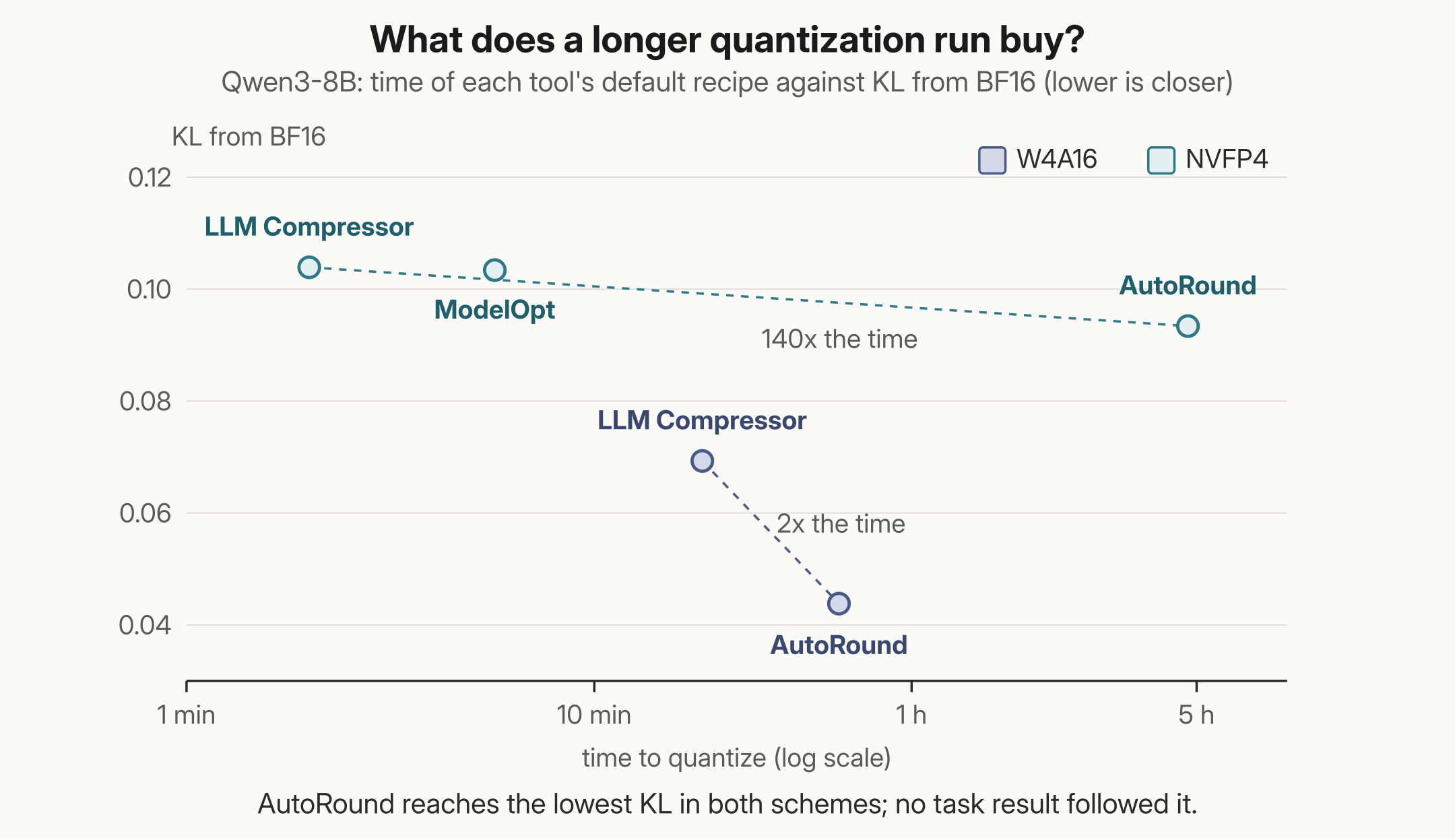
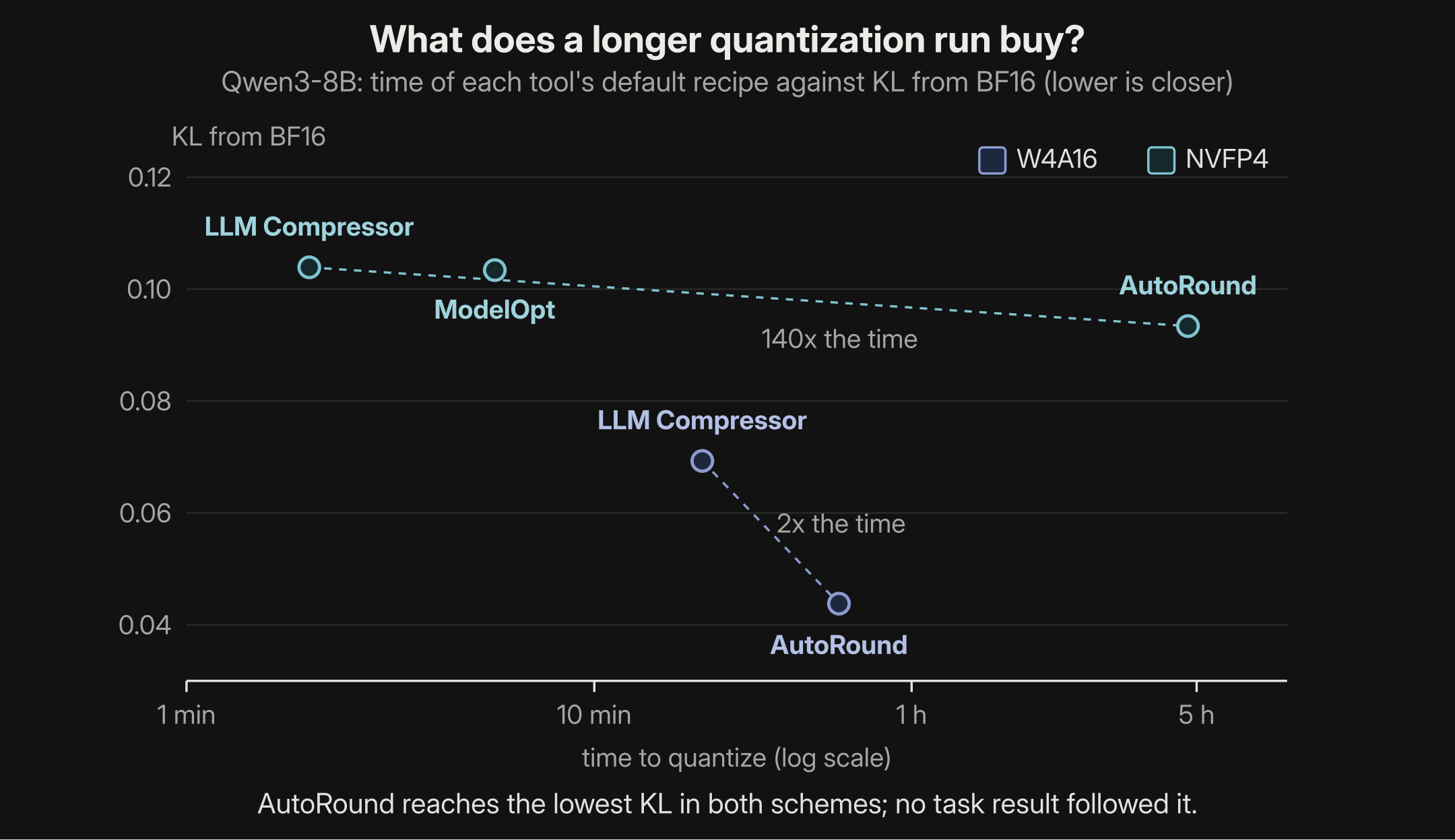 Figure 2: AutoRound's default recipe reaches the lowest KL in each scheme, at 2x LLM Compressor's time for W4A16 and 140x for NVFP4. No task result followed it. ModelOpt's INT4-AWQ is absent: no engine loaded it.
Three things hold:
- KL ranks the default recipes. AutoRound's learned rounding gives the lowest divergence in both schemes. For W4A16 the gap is large (0.044 against 0.069); for NVFP4 it is small (0.093 against 0.103 and 0.104), and we quantized each once, so we can't say how much of it a different calibration sample would move. Lower KL is what the algorithm optimizes: the output error of each block on calibration data.
- The task results don't follow KL. The two NVFP4 checkpoints with the lowest KL, AutoRound's (0.093) and Red Hat's (0.095), are the two that lost on GSM8K: Red Hat's in both engines (p = 0.008 and 0.018), AutoRound's in vLLM only (p = 0.006; 0.1 in SGLang). The W4A16 checkpoints, the closest to BF16 by KL, are the ones that lost on code in every run.
- What holds is the scheme, not the tool. Both W4A16 checkpoints, from two different algorithms, lost 7 to 9 HumanEval points in vLLM and in SGLang (p from 0.001 to 0.012). The table holds 28 paired tests, so about one result below 0.05 is expected by chance and a single p near 0.02 is weak evidence; four results in the same direction from two algorithms are not. NVFP4 isn't free on code either: every NVFP4 checkpoint lost more HumanEval problems than it gained, in both engines (in vLLM, the five together lost 75 and gained 25), but 164 problems are too few to call any one of them.
The same file can change verdict between engines: NVIDIA's NVFP4 lost 18 problems against 2 gained on vLLM (p = 0.0004) and 12 against 6 on SGLang (p = 0.24). Part of that is run-to-run noise, which we measured only for BF16 on vLLM. On this model, the differences between the tools' default recipes are no larger than the difference between two engines serving the same file.
Gotchas
ModelOpt's INT4 is a TensorRT-LLM format. --qformat int4_awq ran for 53 minutes and wrote a checkpoint that neither vLLM nor SGLang loads. Its NVFP4 checkpoint loads in both, and both engines' ModelOpt loaders list FP8. If you need 4-bit integer weights for vLLM or SGLang, use LLM Compressor or AutoRound.
ModelOpt's default calibration data is gated. With no --dataset, hf_ptq.py 0.47.0 uses cnn_nemotron_v2_mix, which includes nvidia/Nemotron-Post-Training-Dataset-v2. Without a Hugging Face login that has accepted its terms, calibration fails with DatasetNotFoundError after the model has loaded. Pass --dataset cnn_dailymail (the mix's open half) or your own data.
ModelOpt writes an FP8 KV cache unless told not to. The default --kv_cache_qformat fp8_cast adds kv_cache_quant_algo: FP8 to the checkpoint, and both engines then store the KV cache in FP8: twice the tokens for the same memory (SGLang allocated 1,057,775 instead of 526,351), and half the bytes for attention to read at every step. Capacity isn't what made NVIDIA's checkpoint faster at 32 requests (about 20,000 tokens are live, which fit either way); bandwidth is. Qwen3-8B keeps 144 KiB of KV per token in BF16, about 3 GB read per decode step at 32 requests against about 6 GB of weights, so halving it should save roughly a sixth of the bytes: the lead is 17% over ModelOpt's NVFP4 (843 against 723 tokens/s in vLLM), and nothing at one request (38.1 against 36.6). vLLM also logs "Using KV cache scaling factor 1.0 for fp8_e4m3": the checkpoint carries no calibrated KV scales. If you compare checkpoints, compare like with like; if you want an FP8 KV cache, see Quantizing the KV Cache first.
AutoRound's NVFP4 runs without torch.compile. 4 hours 46 minutes and 32.7 GiB at peak for an 8B model here, against 40 minutes for W4A16: the minutes depend on the GPU, the factor of 7 on the missing compilation. For NVFP4 on this model, the extra hours bought a KL of 0.093 instead of 0.104 and no task gain.
AutoRound's other two surprises. Exporting to llm_compressor needs compressed-tensors, which pip install auto-round doesn't pull: the run stops with an ImportError before quantizing. And quantize_and_save(out) writes into a subdirectory named after the model and scheme (out/Qwen3-8B-w4g128/), not into out.
LLM Compressor caps AutoRound's version. 0.14.0.1 requires auto-round>=0.14.1,<=0.15.1, so the AutoRound you get inside LLM Compressor lags the standalone release (0.16.1). Run AutoRound in its own environment if you want the current one.
Verdict
For checkpoints served by vLLM or SGLang, start with LLM Compressor: it writes the format both engines read for every scheme, it was the fastest here, and its layer-by-layer pipeline is built to fit models larger than the GPU. Reach for AutoRound in W4A16 when the lowest KL is worth about twice GPTQ's time (40 against 18 minutes here), and export it in whichever format your engine reads; for NVFP4 its default run cost hours for no measured gain. Use ModelOpt for NVFP4 (and FP8, which both engines' ModelOpt loaders list, not measured here) when you are on NVIDIA's stack or want to match NVIDIA's checkpoints, and pass --kv_cache_qformat deliberately; keep its INT4 for TensorRT-LLM. Whatever the tool, the checkpoint isn't done until it has been compared to BF16 problem by problem on code, preferably in the engine you'll serve it with.
Next: Quantizing Mixture-of-Experts Models, where what you leave unquantized matters more than which tool does the rounding.